Reviewed by Evan Lewis, PhD. Last updated 10 August 2026.
Iodine for nail fungus keeps coming up because it is the same mineral used in wound care since the 1800s, and the published microbiology describing its activity against fungal organisms is well established. What a daily cosmetic routine does with it is a narrower question, and that is what this guide answers.
If you've been struggling with stubborn, discolored toenails, you're not alone. Fungal infection of the feet is common: StatPearls reports that tinea pedis, athlete's foot, may affect approximately 10% of the total population, and many people are searching for accessible, natural alternatives to oral antifungals.
Below we separate two different things: what the research says about iodine as an ingredient, and what a daily cosmetic soak and spray routine actually does for the look of a damaged nail. We also cover the key differences between iodine types (including povidone iodine), how to use it, and what to realistically expect.
Two separate things, kept separate
Published research describes iodine, the ingredient, and the preparations those researchers used. IodinePure EZ Clear Nails is a cosmetic. It is described in appearance terms: a decolorized aqueous iodine used daily to support the look of clearer nails as new nail grows in. Study findings on other preparations are not results for our product, and we do not present them that way.
What Is Toenail Fungus?

Toenail fungus, clinically known as onychomycosis, occurs when dermatophytes, yeasts, or non-dermatophyte molds infect the nail bed, causing the nail to become:
- Discolored (yellow, white, or brown)
- Thickened and brittle
- Crumbly or separating from the nail bed
- Sometimes accompanied by mild odor or discomfort
The condition thrives in warm, moist environments: think sweaty shoes, public pools, and gym showers. It is notoriously slow to change, because the nail plate is a physical barrier and the nail itself only grows about 1.62mm a month. It can also spread to adjacent nails or the surrounding skin if left alone. This is why so many people are exploring topical options like iodine as part of their nail care routine.
Oral antifungal medications carry known risks including liver strain and interactions with other drugs. Topical routines that work at the site, without systemic exposure, are increasingly appealing for people managing fungus-prone nails.
What Does Published Research Say About Iodine and Fungal Organisms?

Mostly it describes mechanism, and the outcome literature on nails is small. Iodine is a naturally occurring essential mineral required for thyroid hormone production, immune function, and cellular metabolism. Beyond its nutritional role, iodine has a long-established history as a broad-spectrum antimicrobial agent used in wound care, surgical preparation, and skin disinfection.
Those two roles get mixed together constantly. Iodine immune support is a nutrition question about what you swallow, and it has its own guide: how iodine and immune function actually relate. Nothing you soak a toenail in changes your iodine status, and nothing on your dinner plate reaches the underside of a nail plate. Same mineral, two unrelated jobs.
On mechanism, a 2020 review in Antimicrobial Agents and Chemotherapy reports that iodine rapidly penetrates into microorganisms and oxidizes key proteins, nucleotides, and fatty acids, and records no observed link to resistance development. Because several targets are hit at once, the authors note resistance is difficult to develop.
On nails specifically, the published record is two small papers and should be read as such: a 2015 single-patient case report of severe, treatment-resistant onychomycosis with a negative culture at 24 weeks, and a 2016 chart review of 13 patients in which 8 of 13 (62%) were culture-negative at 24 weeks, using 1% povidone-iodine in an aqueous DMSO solvent. Those are results for the preparations those researchers made, not for ours.
Types of Iodine Used on Nails
Not all iodine preparations are the same. Here are the most common forms and how they differ:
- Povidone iodine (PVP-I): The most widely available form, found in most pharmacies. Povidone iodine is a water-soluble complex that releases free iodine slowly. Published research into povidone iodine reports activity against dermatophytes, the fungi most commonly associated with onychomycosis. In everyday use it stains skin and fabric brown, which is why daily habits are hard to keep with it.
- Lugol's iodine: A solution of molecular iodine and potassium iodide. More concentrated and used in some natural health protocols, though it also stains.
- Decolorized aqueous iodine (I₂ in water): Iodine stabilised in distilled water, with no alcohol and no stain. This is the form built for daily use on nails and the skin around them, because it is the form people can realistically keep up for 90 days.
Why Is the Nail a Delivery Problem Before Anything Else?

1. The nail plate blocks almost everything
The hard visible nail sits like a shield over the nail bed. Creams, brushes and paints sit on top of it. That is why people apply something to the surface of a nail for months and see very little change: the product never reaches what is underneath.
2. The soak is the answer to that problem
Submerging the toe in solution is a different delivery route entirely. Liquid travels under the free edge, into the nail folds and around the skin at the sides, which is where there is direct access. This is the whole reason the EZ Clear Nails kit is built around a tray rather than only a bottle. The ingredient does the work; the routine makes sure the work happens.
3. Water base means you can do it every day
An aqueous formulation does not stain skin or socks and contains no alcohol, so there is no sting. Compliance over 90 days is the variable that decides what you see, and format is what decides compliance.
4. New growth is the visible change
A damaged nail does not repair itself. It gets replaced. Clear new nail grows down from the base at roughly 1.62mm a month while the older nail grows out and is trimmed away. That is why 90 days of consistency is the sensible minimum before judging anything by eye.
5. Iodine has no documented resistance problem
Unlike single-mechanism pharmaceutical options, there is no established mechanism by which common nail fungi develop resistance to iodine, and the 2020 review above records none. That makes iodine a sensible ingredient for a long-term maintenance routine rather than a short course.
Why Do People Choose an Iodine Routine?
Five reasons come up again and again.
- Accessible and affordable: Iodine solutions are widely available without a prescription.
- Minimal systemic risk: Topical iodine does not carry the liver-related risks associated with oral antifungal medications.
- Well-researched ingredient: Iodine has been studied as an antimicrobial for over a century.
- Works alongside other options: Can be used around laser therapy or a prescription topical, with timing planned.
- Two ingredients: Iodine and pure water. Nothing else to react to.
How Do You Use Iodine on Toenails?

Soak three to four times a week, spray twice a day, and keep going. Consistency is the most important factor, because visible change is paced by nail growth rather than product strength. Here is the routine:
- Clean and dry your feet thoroughly before every application. Reducing moisture matters, since fungi prefer damp conditions.
- Soak 3 to 4 times per week: Submerge the affected nails in the EZ Clear Nails solution using the soak tray included in your kit for 5 to 7 minutes per session, 3 to 4 times per week or simply every other day. Pour 10 to 15ml per tray section (20 to 30ml total), enough to fully submerge the nails. Use the same liquid for both feet, then pour it away when you're finished. Full submersion is what gets solution under the free edge and around the nail folds.
- Spray twice daily: Apply the spray to the nail surface, the free edge, the nail folds and the surrounding skin, morning and evening, between soak sessions.
- Allow to air dry completely, about 30 seconds, before putting on socks or footwear.
- Be patient and consistent: Expect the first visible change at the nail edge and surrounding skin around 4 to 8 weeks. Change in the nail plate itself shows across 90 to 180 days as new nail replaces the older nail. Full replacement can take up to 12 months on a badly damaged nail.
This "Soak. Spray. Repeat." routine, soaking 3 to 4 times per week and spraying twice daily, is what 200+ foot care clinics across North America send home with patients.
IodinePure EZ Clear Nails: A Two-Ingredient Cosmetic Routine

If you want a non-staining clear iodine for fungus-prone nails, the IodinePure EZ Clear Nails Starter Kit is built around the Soak. Spray. Repeat. routine to support the appearance of clearer nails as new nail grows in:
- EZ Clear Nails solution: Decolorized aqueous iodine. Two ingredients, iodine and pure water. Soak 5 to 7 minutes, 3 to 4 times per week, using the included tray.
- Spray bottle: Fill from the same solution and apply to nails and surrounding skin twice daily between soaks.
- Soak tray and funnel: Included, so the soak step is contained and quick.
One 500ml bottle lasts roughly two to three months if one or two nails are affected, and closer to a month if the whole foot goes in the tray. If you are running the full 90 days, the 500ml Refill keeps the routine going.
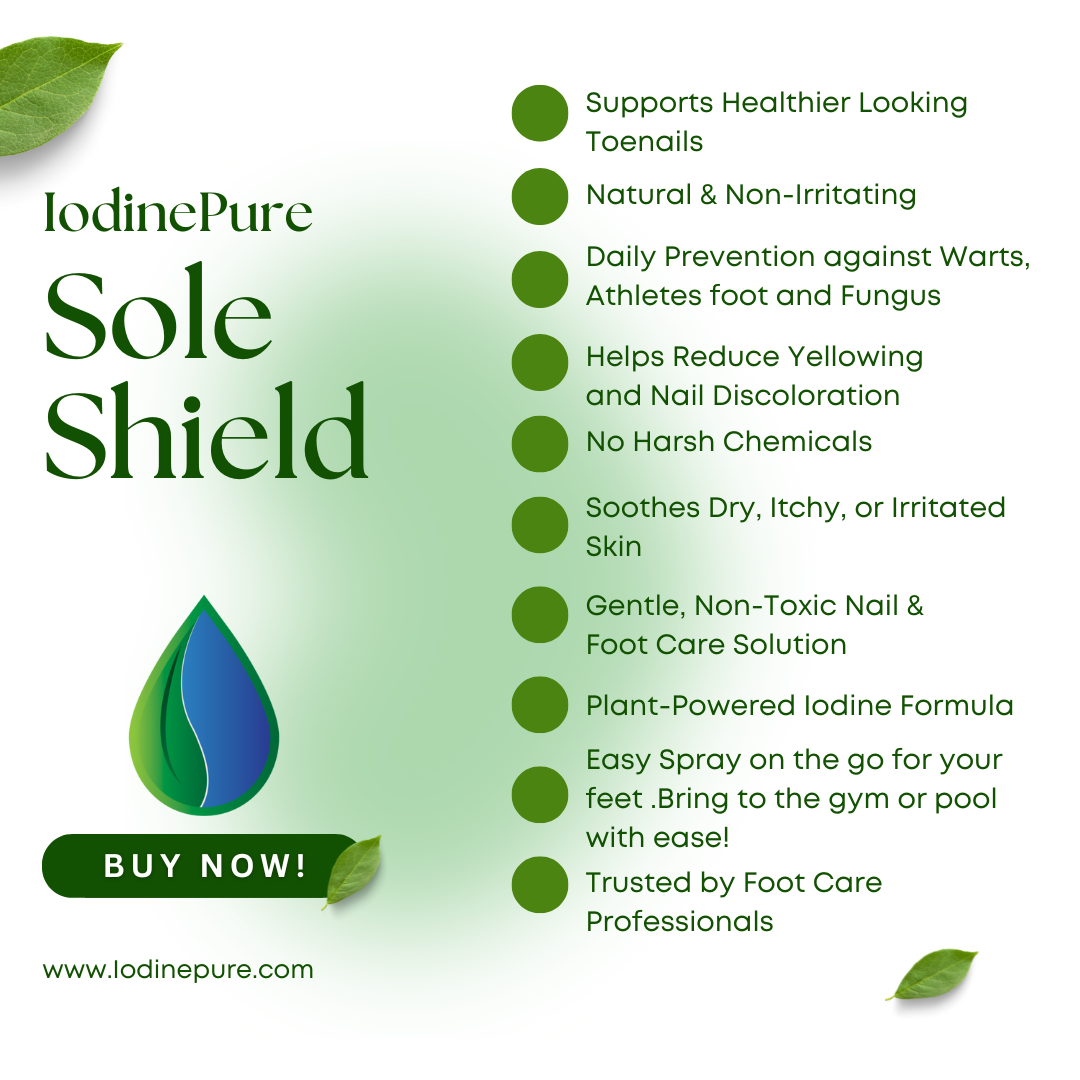
For daily foot hygiene alongside the nail routine, Sole Shield is a daily aqueous iodine foot spray for skin and the inside of footwear. All IodinePure products are listed with Health Canada as cosmetics.
The routine: Soak 3 to 4 times per week. Spray twice daily. Stay consistent for 90 days. That is "Soak. Spray. Repeat."
Is White Iodine the Same as Decolorized Iodine?
As a name, usually yes. White iodine for nail fungus, clear iodine for nail fungus, decolorized iodine for toenail fungus: all three describe iodine with the brown colour taken out, so it does not leave a stain on skin, socks or bed sheets.
The part worth checking is what the iodine is dissolved in, because the name says nothing about that. The FDA-registered DailyMed label for one widely sold decolorized iodine lists 45% alcohol and still carries the warning "Will stain skin and clothing." Alcohol is what stings split skin at a nail fold, and a sting is what ends a daily habit in week two. Decolorized aqueous iodine means the same iodine carried in water instead, no alcohol, which is the version people can actually keep up for 90 days.
Is Iodine Good for Nails in General?
For the look of the nail and the skin around it, yes, and that is why iodine for nails has been in foot care rooms for decades. It is one mineral in water, so there is nothing in it to react to, and it goes onto the cuticle line and the nail folds as easily as onto the plate.
What it is not is a hardener or a growth accelerator. A toenail grows about 1.62mm a month and no topical changes that number. What a daily routine changes is what is sitting on and around the nail while the new growth comes down, which is the part you end up looking at.
When Should You See a Foot Care Professional?
Sooner rather than later in four situations. Book an appointment if a nail is painful, if it is lifting or separating from the nail bed, if there is a dark streak running from the cuticle to the tip, or if you live with diabetes or poor circulation. Those situations want professional eyes on them before any home routine starts.
Precautions: Who Should Use Caution with Iodine?
Iodine is generally well-tolerated for topical use. The following should speak to a healthcare professional first:
- Those with known iodine sensitivity or allergy
- Individuals with thyroid conditions (hyperthyroidism or hypothyroidism)
- People with seafood allergies, which may indicate iodine sensitivity
- Those who are pregnant or nursing
Topical iodine products should never be ingested. If skin irritation occurs, discontinue use and consult a health professional.
Frequently Asked Questions About Iodine for Nail Fungus
Does iodine really help with nail fungus?
Published research describes iodine, including povidone iodine and molecular iodine, as active against the fungal organisms associated with onychomycosis. Those are findings about the ingredient and the preparations the researchers used. What a daily cosmetic soak and spray routine does is different and simpler: it puts solution where a brush cannot reach, every day, while new nail grows in to support the look of a clearer nail.
Which type of iodine is best for toenails?
Whichever one you will still be using in six weeks. Povidone iodine is the most researched but stains skin and fabric brown, so daily use rarely lasts. Decolorized aqueous iodine, iodine stabilised in distilled water, is the form used in IodinePure EZ Clear Nails precisely because it does not stain, does not sting, and can go on every day for 90 days.
How long before I see a change?
Expect 3 to 6 months of consistent use. Toenails grow about 1.62mm a month, so the affected part of the nail has to grow out and be trimmed away while clear new nail replaces it. Full replacement can take 9 to 12 months on an advanced case. Stopping early is the most common reason people see nothing lasting.
Can I use iodine alongside other nail approaches?
Yes. An iodine routine can sit alongside a prescription topical or clinic light therapy, with the timing planned so the two are not applied on top of each other. Tell your healthcare provider what you are using.
Are there any side effects of using iodine on toenails?
Topical iodine is generally well-tolerated. Possible minor effects include temporary skin staining (with Lugol's or other brown preparations) and, rarely, mild skin irritation. Aqueous iodine contains no alcohol and does not stain. Those sensitive to iodine or with thyroid conditions should consult a physician before use. Never ingest topical iodine products.
How do you use iodine for toenail fungus at home?
Soak, spray, repeat, and let nail growth do the rest. Soak 3 to 4 times a week for 5 to 7 minutes with the nails fully under the solution, then spray morning and evening on the plate, the free edge and the nail folds. Clean and dry your feet before every application, and let them air dry before socks go on. Give it 90 days before judging anything by eye. The hard part is the calendar, not the technique.
Is there a toenail fungus support group?
There are online ones, and they are more useful than people expect. Communities on Reddit and Facebook are full of people at week six wondering whether to keep going, which is exactly where most routines get abandoned. Change here is measured in months, so somewhere to post a photo and be told to carry on is worth more than another bottle. Keep specific medical questions for a foot care professional rather than a thread.
Evan Lewis, PhD, specializes in natural and nutritional therapies for the prevention and management of chronic diseases and their complications. His research spans chronic disease, diabetes complications, clinical nutrition, and nerve health, including the development of topical iodine approaches for foot care and wound health. IodinePure products are listed with Health Canada as cosmetics.