Reviewed by Evan Lewis, PhD. Last updated 10 August 2026.
By Dr. Evan Lewis, PhD
If you're reading this, you've probably already tried something. A cream from the pharmacy. Maybe Kerasal, or a prescription lacquer. Perhaps you took oral medication for a few months. The nail looked better for a while, or maybe it never really improved at all, and then the infection came back. Or never left.
You are not alone, and you are not doing anything wrong. Toenail fungus is genuinely one of the most treatment-resistant conditions in everyday medicine, and the reasons have nothing to do with willpower or compliance. The biology of the nail itself works against you.
Why Is Toenail Fungus So Hard to Clear?
Because it is not sitting on top of the nail. Toenail fungus, clinically called onychomycosis, is not just on the surface of the nail. By the time the nail looks discoloured, thickened, or crumbly, the dermatophyte fungi responsible have established themselves in two distinct locations: the nail plate (the hard keratin structure you can see and touch) and the nail bed (the soft tissue underneath). The nail plate is dense, relatively impermeable tissue. Getting any active ingredient through it to the nail bed requires consistent, prolonged contact, which is also why stick-on fungal nail patches tend to underdeliver on established infections.
Toenails grow slowly. In a study of healthy young adults published in the Journal of the European Academy of Dermatology and Venereology, toenails grew an average of 1.62mm a month. A fully affected nail has to grow out entirely before the nail looks normal again, and that takes nine to twelve months from the day a routine starts. If you stop treatment at week eight because the nail "looks better at the base," the infection is still present in the tissue that hasn't yet grown out.
This is the core reason most people believe treatments don't work: they stop too early, and the recurrence that follows feels like failure, when in reality, it was incompletion.
Why Do Most Treatments Fail Before They Have a Chance to Work?
Because they get abandoned. Studies consistently show that the majority of treatment failures in onychomycosis are adherence failures, not pharmacological failures. The typical treatment window that delivers meaningful clearance is six to twelve months of daily, consistent application. Most people abandon treatment within four to six weeks.
People expect to see the nail looking better at the tip, but early improvement happens at the base. The clear, healthy nail growing in from the nail matrix is not visible until two to three months of treatment. By any visual assessment at week six, most successful treatments look like nothing is working.
How Well Does Jublia Actually Work?
Less often than most people expect. Efinaconazole (Jublia) is a prescription topical antifungal lacquer applied daily to the nail. In the two pivotal trials summarised in the CADTH clinical review, complete cure was reached by 17.8% and 15.2% of patients at 52 weeks. Mycologic cure, which is the culture result on its own, was higher at 55.2% and 53.4%.
CADTH makes a point that is worth carrying with you. It notes that a mycologic cure rate on its own "may overestimate treatment effect," because a negative culture and a nail that looks normal are not the same thing.
Are Oral Antifungals Right for Everyone?
No, and that is the honest answer. Terbinafine (Lamisil) taken orally reaches higher clearance than topical lacquers. CADTH's review states that mycologic cure rates with oral agents such as terbinafine and itraconazole are reported to be higher, without attaching a figure to terbinafine. The same review reports recurrence of 35.7% after itraconazole and 11.9% after terbinafine.
The trade-off sits elsewhere. Oral terbinafine requires liver function monitoring because of rare but documented hepatotoxicity. It interacts with certain medications and is not appropriate during pregnancy or for patients with liver disease. That is a conversation for your doctor, not a decision to make from a blog post.
What Does "Permanent" Actually Mean for Nail Fungus?
It means a measured result at a point in time, not a lifetime guarantee. In the clinical literature, clearance is measured two ways: mycological cure, meaning the culture comes back negative, and clinical cure, meaning the nail looks normal. Both are milestones in time, not a permanent state, because the fungi behind onychomycosis are ordinary environmental organisms that live in changing rooms, showers and shoes. Reaching clearance does not remove you from the world those organisms live in.
This is why the concept of "permanent clearance" requires two phases:
- Phase 1, Treatment: Daily consistent application for the full nine to twelve months until the nail has completely grown out.
- Phase 2, Prevention: Daily maintenance habits that reduce the fungal load in your immediate environment, primarily your footwear, to prevent reinfection.
Skipping Phase 2 is the most common reason people experience what they call "recurrence."
If a nail is painful, lifting away from the nail bed, has a dark streak running from cuticle to tip, or you live with diabetes or poor circulation, have it looked at by a foot care professional before starting anything at home. A daily routine sits alongside that care, not instead of it.
Can Your Shoes Reinfect Your Nails?
Yes, and this is the step most people skip. The interior of an enclosed shoe, particularly one worn for eight or more hours, is a warm, dark, moist environment with organic material present. Dermatophyte fungi survive in this environment. If your nail has been infected, your shoes contain fungal spores regardless of whether the nail has cleared.
Washing does not automatically solve it. In a 2022 study in the Journal of Fungi, dermatophyte spores survived a 40°C household wash and were only removed at 60°C, and neither freezing nor heat drying removed them.
The numbers on coming back are not small either. Gupta and Versteeg, writing in the Journal of the American Podiatric Medical Association, report that recurrence and relapse rates for superficial fungal infections of the feet run from 10% to 53%.
Treating the nail without addressing the shoe interior is analogous to resolving a mould problem in a house and then leaving the conditions that caused it unchanged. This is why treatment of the footwear environment is not optional, it is a structural part of a complete protocol.
The Two-Phase Protocol: EZ Clear Nails + Sole Shield
Phase 1: The EZ Clear Nails 90-Day Protocol
EZ Clear Nails is a two-ingredient aqueous iodine cosmetic, elemental iodine in pure water, listed with Health Canada and used daily on the nail, the free edge and the surrounding skin to support the look of clearer nails as new nail grows in. On the ingredient itself, three published papers have applied iodine preparations to toenails affected by onychomycosis; in the largest, a 13-patient case series, 8 of 13 patients (62%) had negative fungal cultures at 24 weeks. Those findings belong to the researchers and to the preparations they made, not to any retail product. Our review of the iodine research goes through all three.
- Prepare the nail: After showering, dry the feet thoroughly, especially between toes and around the nail folds.
- Apply EZ Clear Nails: Spray directly onto the nail surface, the free edge, and the skin around the nail margins.
- Allow to dry: Wait at least 30 seconds before applying socks.
- Apply twice daily: Apply in the morning before socks and shoes, and again in the evening.
- Add the soak: Soak 3 to 4 times per week for 5 to 7 minutes in the EZ Clear Nails solution using the kit's tray, which carries the solution under and around the nail.
- At 90 days: Assess the nail base. Some new clear growth should be visible. Continue the protocol.
- Do not stop early: The infected nail tissue must grow out completely.
Phase 2: Sole Shield For The Inside Of Your Shoes
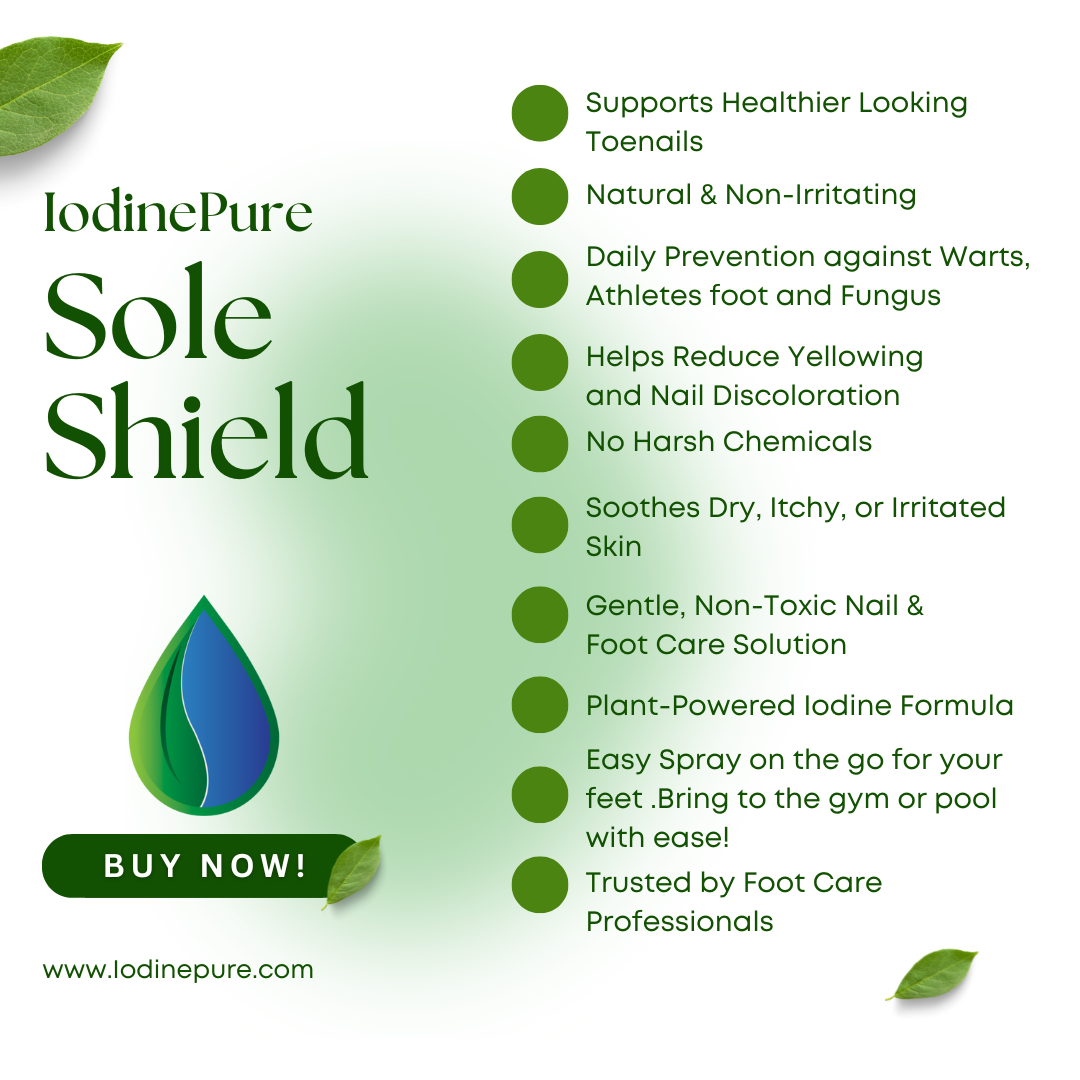
Throughout your EZ Clear Nails protocol, and indefinitely after clearance, spray Sole Shield into the interior of all footwear worn regularly. Spray the toe box, the insole, and the inner heel. Allow shoes to air dry fully between wears. Rotate between two pairs of shoes where possible.
Frequently Asked Questions
Can toenail fungus be eliminated permanently?
Clearance is measured, not promised. In the published literature it means a negative culture and a nail that looks normal, reached through months of consistent daily application and then held with ongoing habits. Because the organisms responsible live in the everyday environment, staying clear is a practice rather than a finish line. Your foot care professional is the person who can tell you where your own nail sits on that path.
How long does toenail fungus take to clear completely?
A fully affected nail needs nine to twelve months to grow out completely at 1.62mm a month. Most people first notice change at the nail base between months two and three, because that is where new nail arrives first.
Why does toenail fungus keep coming back after treatment?
There are two main reasons. First, treatment is stopped before the infection is fully resolved. Second, reinfection from the shoe environment. Fungal spores survive in shoe interiors for extended periods, and wearing the same footwear after nail clearance without treating the inside of the shoe can result in a new infection.
Does toenail fungus get worse if left untreated?
Yes. Without treatment, onychomycosis typically progresses over time. The infection spreads to more of the nail, the nail plate thickens and distorts further, and the infection can spread to adjacent nails or surrounding skin.
What is the most effective approach for toenail fungus?
Oral terbinafine achieves the highest clearance rates in clinical data. For people who prefer a topical approach, consistent daily topical application over a full nine to twelve month period, combined with treatment of the shoe environment, represents the most complete practical protocol.
Can shoes reinfect toenails after fungus has been cleared?
Yes. The interior of enclosed footwear worn during an infection retains dermatophyte spores. Wearing untreated shoes after nail clearance is a common cause of what people call recurrence, which is why the inside of the shoe belongs in the routine rather than outside it.
Phase 1: The Nail. Phase 2: The Shoe.
EZ Clear Nails covers Phase 1: daily application to the nail, the free edge and the skin around it, for as long as the nail takes to grow out. Sole Shield covers Phase 2: the inside of the shoe, which is the part of the routine most people skip. Both are two-ingredient aqueous iodine cosmetics, listed with Health Canada, and both are used alongside the care your foot care professional gives you rather than in place of it.