Reviewed by Dr. Evan Lewis, PhD
Last updated 9 August 2026
There is no single "best" toenail fungus treatment for everyone. The right option depends on how severe the infection is, your overall health, your budget, and how consistent you can realistically be. This guide compares every major option honestly, from prescription pills to natural topicals, so you can choose the approach most likely to work for your situation.
What Actually Makes a Toenail Fungus Treatment Work?
Consistency across a full nail growth cycle, more than the strength of whatever is in the bottle. The infection lives inside and under the nail plate, where most treatments struggle to reach, and toenails grow far more slowly than most people think.
The 3mm-a-month figure repeated all over the internet is the fingernail rate. When researchers measured toenails directly they came out at about 1.62 mm a month. A great toenail runs roughly 20 to 25mm from base to tip, so replacing one completely takes somewhere between twelve and eighteen months, whichever route you take. You cannot "clear" a nail. You can only support healthy new growth while the affected nail grows out.
That is why adherence is the whole game. In a study of 250 people on topical treatment, Sevimli Dikicier (2019) found 45.6% stopped early, and 37.7% of those stopped because of irritation, redness, scaling, itching or stinging. The treatment that works is the one you will still be using in month twelve.

What Are the Main Toenail Fungus Options in Canada?
Six, and they split cleanly into prescription, in-clinic, and things you can buy yourself. Here is an honest read on each.
Prescription Oral Antifungals (Terbinafine, Lamisil)
Oral pills are among the more effective options for moderate to severe infections. The trade-offs: a typical course runs about 12 weeks, they can interact with other medications, and they may require blood tests to monitor liver function, which is why they are often not the first choice for older adults or people on several prescriptions. Recurrence after a course is common. Reviewing superficial fungal infections of the feet, Gupta and Versteeg (2019) report recurrence and relapse rates of 10% to 53%. Prescription required.
Prescription Topical Solutions (Efinaconazole, Jublia)
A brush-on prescription applied daily for up to 48 weeks. It avoids the systemic effects of pills, and the numbers are public. Canada's health technology assessment agency reviewed the pivotal trials in its CADTH clinical review: mycological cure of 55.2% and 53.4%, and complete cure of 17.8% and 15.2%, across the two trials.
Cost is the other half of the decision, and it is documented too. The CADTH pharmacoeconomic review lists a submitted price of $89.04 per 8 mL bottle, and models a 48-week course at $178 for a single affected great toenail or $445 for one great toenail plus three smaller ones. Those are review figures rather than shelf prices, so check with your own pharmacy, and note it is frequently not covered by insurance. We break down why Jublia costs what it does in Canada separately.
If you are already on it, here is how to add IodinePure without the two working against each other. Some foot clinics also dispense their own brush-on systems; we cover how Tolcylen compares as well.
Laser and Light Therapy
In-clinic laser treatment is painless and has no drug interactions, but evidence for long-term clearance is mixed, it usually requires multiple sessions, and it is one of the most expensive options, typically paid out of pocket. Light-based (photodynamic) treatments like Toe FX work on a similar clinic-based model; if you are doing one, see how to fit your IodinePure routine around Toe FX sessions.
Drugstore Creams and Medicated Paints
Widely available without a prescription, but most over-the-counter creams, paints, and stick-on fungal nail patches struggle to penetrate the nail plate to reach where the fungus lives. They can help with surrounding skin and very early surface cases, but tend to underperform on established nail infections. If you are weighing a specific brand, our Kerasal vs IodinePure comparison looks at what each one actually does. We have also broken down undecylenic acid brush-ons like Fungi-Nail and how Nonyx compares.
Home Remedies (Vinegar, Tea Tree Oil, Vicks)
Several have laboratory activity against fungi and a long history of anecdotal use, but the human evidence is limited and results are inconsistent, largely because people apply them irregularly and give up before a nail can grow out. They are low-cost and low-risk, but rarely a complete answer on their own.
Aqueous Iodine (IodinePure EZ Clear Nails)
Iodine has been used on skin in clinical settings since the 1800s. IodinePure EZ Clear Nails is a modern take on it: an aqueous (water-based) iodine kit with two ingredients, built around a twice-daily spray plus a soak that carries the solution under the free edge and around the nail folds, where a brush-on never reaches. It is non-staining, it does not sting, and it takes seconds, which matters when the deciding factor is whether you are still doing it a year from now. No prescription. Listed with Health Canada as a cosmetic, and carried by over 200 foot care clinics across North America. Nothing changes a nail overnight, because visible change waits on new nail growth.
So Which Option Is Best for You?
It depends mainly on severity and on what you can sustain. A rough guide:
- For a severe or long-standing infection, see a doctor or foot care professional about whether an oral antifungal is appropriate.
- For people who cannot or would rather not take oral medication, including many seniors, a gentle daily topical routine is the usual alternative. If you are doing this for a parent, our caregiver's guide to senior foot care covers the practical side.
- If you want a no-prescription, natural, low-cost option you can sustain, aqueous iodine fits well.
- Many people combine approaches: professional nail reduction (debridement) at a clinic to thin a thick nail, plus a daily routine at home between visits.

Is the "Strongest" Treatment Really the Best One?
No, and the word is a trap. A stronger formula that irritates your skin, costs too much to continue, or needs monitoring you will skip is not stronger in any way that matters. The nail still grows at 1.62 mm a month no matter what goes on it.
The other half people miss is re-exposure. In their scoping review of household spread, Jazdarehee and colleagues (2022) found onychomycosis and dermatophytosis transmitted between household members in 44% to 47% of cases. Your own shoes, socks and bathroom floor are part of the picture. Pick something you can tolerate and afford, use it every day, spray the inside of your shoes too, and do not stop until the nail has grown out.
What Do Toenail Fungus Treatment Reviews Actually Tell You?
Mostly how long the reviewer stuck with it. Nail reviews get written weeks into a job that takes twelve to eighteen months, so a one-star "did nothing" and a five-star "amazing" are often the same product photographed at day 30 and day 200.
Three things worth checking when you read them. How far in the person was when they wrote it. Whether they are describing new growth at the base of the nail or the old damaged tip, because only the base tells you anything. And whether they stopped because of stinging, staining or mess, which is the reason Sevimli Dikicier's 45.6% dropped out.
How Does the Aqueous Iodine Routine Work?
Soak, spray, repeat. If you go this route, the routine is short enough to survive a bad week.
- Spray EZ Clear Nails on clean, dry nails twice a day, morning and evening.
- Three to four times a week, add a soak: pour enough solution into the soak tray included in the kit to just submerge the nails (about 10 to 15ml for an average-size foot), soak for 5 to 7 minutes, then pour the used liquid down the sink or toilet.
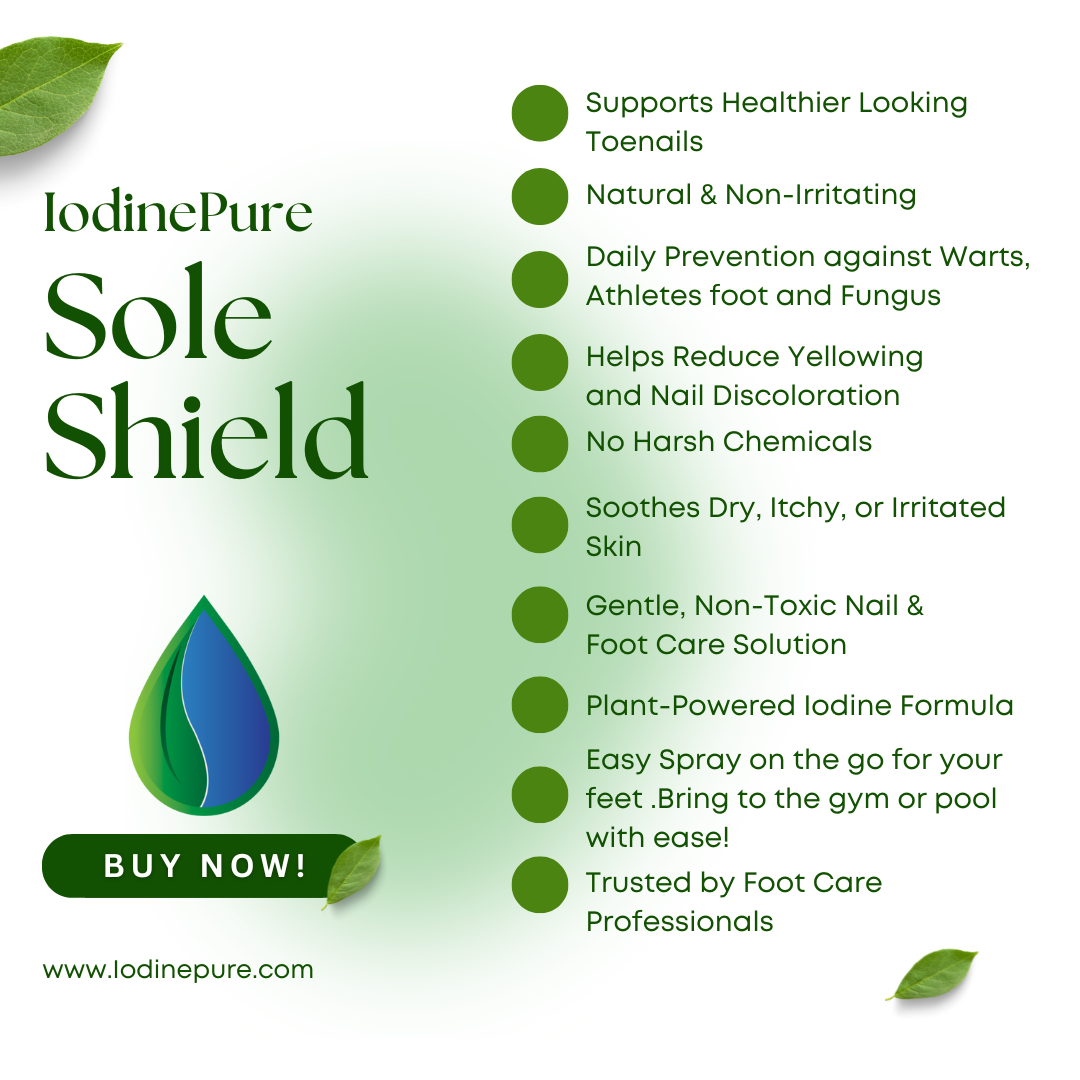
- Spray Sole Shield inside your shoes daily, so you are not re-exposing the nail every time you get dressed.
- Expect the first clear growth at the base of the nail around 60 to 90 days, and keep going until the whole nail has grown out.
Everything the routine needs is in the 90-day EZ Clear Nails Kit.
Frequently Asked Questions
What is the best over-the-counter toenail fungus treatment?
Most over the counter creams and paints struggle to penetrate the nail. Among no-prescription options, a topical you can apply consistently every day for the full growth cycle tends to matter more than the specific active ingredient, which is why adherence research is so unflattering to strong formulas. IodinePure EZ Clear Nails is one non-prescription option built around daily consistency: a two-ingredient aqueous iodine routine, sprayed twice daily with soaks three to four times a week.
What is the strongest toenail fungus treatment?
Oral prescription antifungals are among the most effective for severe cases, but they can require liver monitoring and may interact with other medications, and Gupta and Versteeg report recurrence and relapse rates of 10% to 53% in superficial fungal infections of the feet. Strongest is not always best. The treatment that works is the one you can consistently use for the twelve to eighteen months a nail takes to grow out.
How much does Jublia cost in Canada?
CADTH's pharmacoeconomic review lists a submitted price of $89.04 per 8 mL bottle, and models a full 48-week course at $178 for a single affected great toenail, or $445 for one great toenail plus three smaller ones. Those are review figures rather than pharmacy shelf prices, and it is frequently not covered by insurance, so check with your own pharmacy before budgeting.
How long does any toenail fungus treatment take to work?
No treatment changes a nail quickly, because a healthy nail has to grow out to replace the affected one. Toenails grow about 1.62 mm a month, and the 3mm figure quoted everywhere is the fingernail rate, so clear growth at the base typically appears around 60 to 90 days, with full grow-out taking twelve to eighteen months on a 20 to 25mm nail.
Can I treat toenail fungus without a prescription?
Yes. Many people manage it with a consistent non-prescription topical routine, especially for mild to moderate cases or when avoiding oral medication. For severe or painful infections, or if you have diabetes or circulation problems, see a healthcare professional first.
Is a natural toenail fungus treatment as good as prescription?
Prescription options can be more potent, but they come with cost, access and monitoring trade-offs, and adherence over many months is often the real barrier: 45.6% of people in one topical acne study stopped early, and the pattern in nail care is no kinder. A gentle natural routine you can sustain daily can be a practical choice, particularly alongside professional nail care.
What is the best fungal nail treatment for severe cases?
For a severe or long-standing nail infection, the usual first step is a conversation with a doctor or foot care professional about an oral antifungal, because a pill reaches the nail bed through the bloodstream instead of having to cross the nail plate. That route needs a prescription and sometimes liver monitoring, and Gupta and Versteeg report recurrence and relapse rates of 10% to 53% in superficial fungal infections of the feet, so most people pair it with a daily home routine and shoe hygiene afterwards. A thick, crumbling nail is usually reduced by a foot care nurse first, which gives anything applied on top a shorter distance to travel.
What is the best iodine for toenail fungus?
An aqueous, meaning water-based, iodine if you want something you can put on a nail twice a day for a year. The pharmacy tincture and decolorized versions are alcohol-based, and the FDA-registered DailyMed label for decolorized iodine lists 45% alcohol and warns it will stain skin and clothing, which is exactly why people abandon them. IodinePure EZ Clear Nails is a water-based two-ingredient version made for daily nail use, so it does not stain the nail brown and it does not sting broken skin around the nail fold.
References
- Yaemsiri S, Hou N, Slining MM, He K. Growth rate of human fingernails and toenails in healthy American young adults. J Eur Acad Dermatol Venereol. 2010. PMID 19744178.
- CADTH. Clinical Review Report: Efinaconazole (Jublia). NCBI Bookshelf NBK543976.
- CADTH. Pharmacoeconomic Review Report: Efinaconazole (Jublia). NCBI Bookshelf NBK543376.
- Gupta AK, Versteeg SG. A critical review of improvement rates for conventional and alternative therapies for superficial fungal infections of the feet. 2019. PMID 29521517.
- Sevimli Dikicier B. Topical treatment of acne vulgaris: efficiency, side effects, and adherence rate. J Int Med Res. 2019;47(7):2987-2992. PMID 31122106.
- Jazdarehee A, Malekafzali L, Lee J, Lewis R, Mukovozov I. Transmission of onychomycosis and dermatophytosis between household members: a scoping review. J Fungi. 2022;8(1):60. PMID 35050000.
A No-Prescription Option You Can Actually Keep Up
IodinePure EZ Clear Nails is a two-ingredient aqueous iodine kit for the toenail, built for the soak, spray, repeat routine. Listed with Health Canada as a cosmetic, made with natural iodine, and carried by over 200 foot care clinics across North America.

About the Author
This article was reviewed by Evan Lewis, PhD, who specialises in natural and nutritional therapies for the prevention and management of chronic diseases and complications, with a focus on chronic disease, diabetes complications, clinical nutrition, and nerve health.