Reviewed by Evan Lewis, PhD. Last updated 10 August 2026.
Iodine has been used in medicine for over 150 years. It predates antibiotics, predates synthetic antifungals, and predates most products in a pharmacy today. Unlike many older remedies that faded when pharmaceuticals arrived, iodine stuck around, because the clinical evidence kept supporting it.
This article is a reference hub. It gathers the published evidence on iodine's antifungal, antibacterial, antiviral, and wound-care properties in one place, explains the mechanisms behind them, and contextualizes what iodine is, and is not, in a modern clinical setting.
Section 1: What Does Iodine Do to Fungi?
It oxidises them, through two routes rather than one.
The Mechanism
Iodine's antifungal activity operates through two primary mechanisms. First, iodine disrupts fungal cell membranes through oxidative action. Second, iodine interferes with fungal protein structures, denaturing the enzymes and structural proteins fungi require for growth and reproduction.

These mechanisms make iodine active against dermatophytes, the fungal species most commonly responsible for nail fungus (onychomycosis) and athlete's foot. Dermatophytes, including Trichophyton rubrum and Trichophyton mentagrophytes, depend on keratin as a nutrient source.
Key Research: Onychomycosis
Davidson R. "An economical cure." CMAJ, 2006. A single case.
A retired physician applied 2.5% iodine tincture once a day to his own affected toenail. Normal-looking nail appeared at the base within about two weeks, and the affected portion grew outward from there. Total cost, $3.27. The author was explicit that this was one isolated case, and said a larger number of patients would be needed for scientifically acceptable results. PMC1569938
Capriotti K, Capriotti JA. Int Med Case Rep J, 2015. One patient.
A patient with severe, treatment-resistant onychomycosis applied 1% povidone-iodine in a dimethyl sulfoxide (DMSO) vehicle twice daily. At the 24-week visit the authors report the nail had cleared with a negative fungal culture. PMC4599634
Capriotti K, Stewart KP, Pelletier JP, Capriotti J. Clin Res Trials, 2016. Thirteen patients.
A retrospective chart review of 13 patients on the same 1% povidone-iodine in aqueous DMSO twice daily. Pre-treatment cultures were positive in all thirteen. At the 24-week point, 8 of 13 (62%) had negative culture results, and none discontinued use due to intolerance. full text
That is the whole outcome literature on iodine and nails: one case letter, one case report, and thirteen charts. These are findings about iodine as an ingredient, in the preparations each research group used, and they are worth reading at exactly that weight.
Section 2: What Does Iodine Do to Bacteria?
The same thing, by the same oxidative route, and this is the best-documented part of the record.
The Mechanism
Iodine's antibacterial activity is one of the most well-documented properties in all of clinical microbiology. The mechanism is oxidative disruption of bacterial cell walls. Iodine is effective against both gram-positive and gram-negative bacteria and does not rely on a single receptor pathway, which is one reason bacterial resistance to iodine has not been a clinically significant issue.
Key Applications in Foot and Skin Care
Staphylococcus (shoe and foot odor): Staphylococcus species, along with Brevibacterium, are the primary bacteria responsible for foot and shoe odor.
Cutibacterium acnes (acne): Cutibacterium acnes is the bacteria primarily implicated in acne vulgaris.
Wound pathogens: Iodine has been used as a wound antiseptic in clinical settings for over 150 years.
Section 3: Where Does Iodine Fit in Wound Care?
On the WHO essential medicines list, and in operating theatres worldwide.
WHO Essential Medicines
The World Health Organization's Model List of Essential Medicines includes povidone iodine for wound management. Iodine for wound care is on the WHO list because it is clinically effective, reliably available, and has a well-established safety profile.
Surgical and Post-Operative Use
Povidone iodine solutions are used globally for surgical skin preparation. The continued use of iodine-based solutions in surgical prep in major hospitals worldwide reflects its status as a clinically proven, trusted antiseptic agent.
Aqueous Iodine Advantage
Aqueous iodine, iodine stabilised in distilled water without a polymer carrier, offers the antibacterial and antifungal activity of iodine in a formulation that does not stain and is designed for daily topical use.
Section 4: Is Iodine Antiviral?
Partly, and it is the least settled part of the record. Iodine's antiviral properties are an active area of ongoing research. Some research supports an antiviral mechanism for iodine against certain viral types at the skin surface level. In the context of daily foot hygiene, iodine's primary validated roles are antifungal and antibacterial.
Section 5: How Long Has Iodine Been in Clinical Use?
Since 1839, on the documented record.
1811: Bernard Courtois first isolates iodine from seaweed ash.
1839: First documented use of iodine as a clinical antiseptic.
1955: Povidone iodine (iodine complexed with polyvinylpyrrolidone) is developed. Betadine is introduced shortly after.
Present: Aqueous iodine formulations represent the most recent evolution: retaining clinical efficacy in a formulation suited to daily skin and footwear use without staining.
Iodine remains on the WHO Model List of Essential Medicines and is used in surgical prep in hospitals worldwide.
Section 6: What Is Iodine, and What Isn't It?
Four boundaries worth stating plainly.
Not a Thyroid Supplement
IodinePure's topical products are for external use. They are listed with Health Canada as cosmetics and are not intended to be ingested. They do not function as thyroid supplements. (IodinePure's separate daily supplement line is a different product category.)
Grounded in the Evidence
Iodine has well-defined antifungal, antibacterial, and antiseptic properties in specific clinical contexts. We present that science accurately, letting the mechanism, the published research, and real-world clinic adoption make the case rather than overstating beyond the evidence base.
A Partner to Professional Care
More than 200 foot care clinics across North America recommend our routine as part of professional care protocols, which is exactly why the science matters to practitioners putting their name behind it.
Not the Same as Betadine
Betadine uses polyvinylpyrrolidone as a carrier polymer. Aqueous iodine is iodine stabilised in distilled water instead. It does not stain and is designed for daily use on skin, nails, and inside footwear.
Section 7: What Makes IodinePure Different?
The label. Our products contain two ingredients: iodine and distilled water. No synthetic preservatives, no alcohol base, no polymer emulsifiers, no fragrance, no colorants.
EZ Clear Nails: a soak of 5 to 7 minutes, 3 to 4 times a week, plus a spray twice daily. A 90-day nail care protocol.
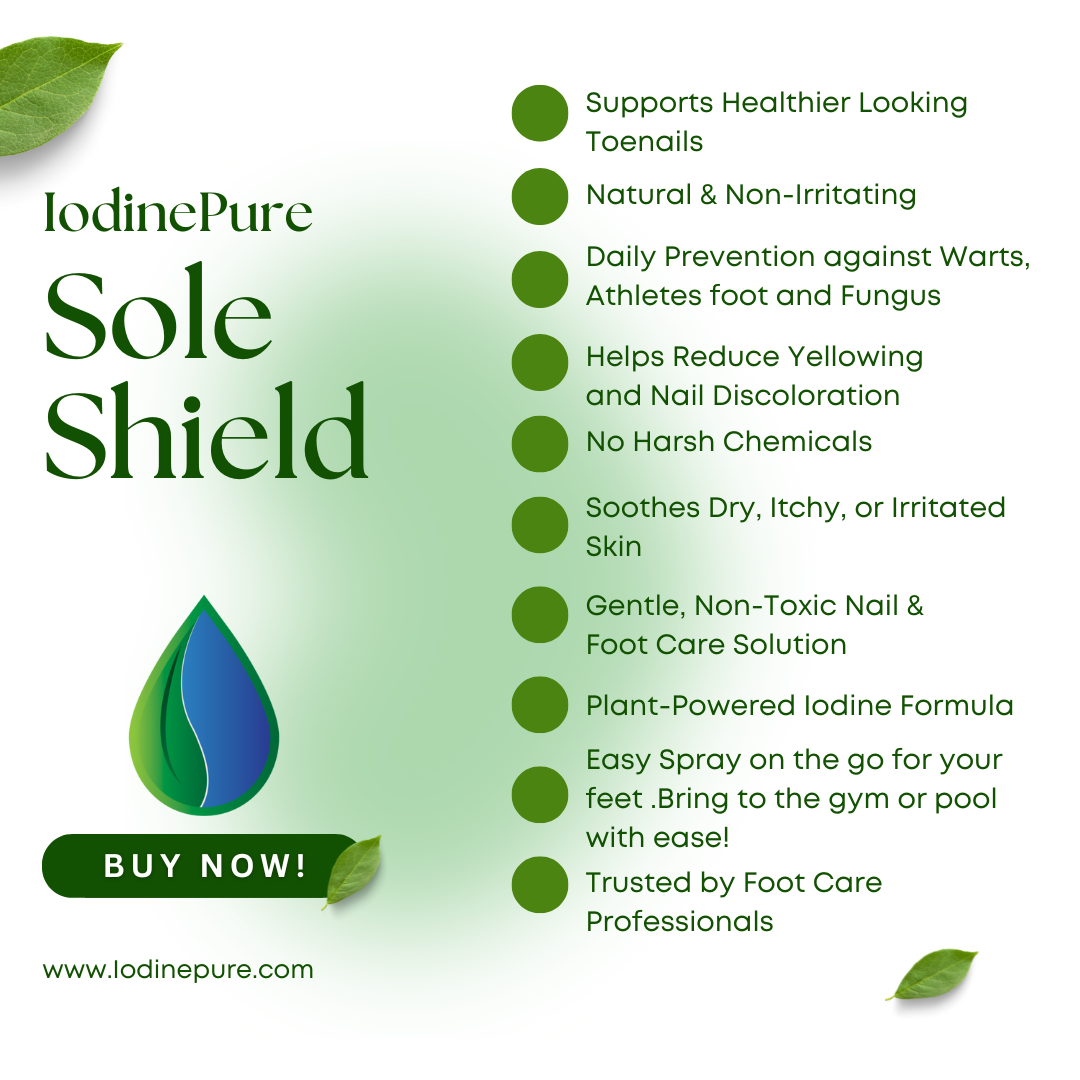
Sole Shield: foot surface application and inside footwear after each wear.
EZ Clear Skin: facial and body spray.
For clinic partnerships, see our clinic partner page. Carried by 200+ foot care clinics across North America.
Frequently Asked Questions
What helps get rid of toenail fungus without a prescription?
Several topical approaches are used without a prescription. Iodine-based solutions have been examined in peer-reviewed research for their activity against dermatophytes, the fungal species behind nail infections. IodinePure's EZ Clear Nails is a Health Canada listed cosmetic designed to support the look of clearer nails using aqueous iodine, run as a 90-day routine: a 5 to 7 minute soak 3 to 4 times a week, plus a spray twice daily.
How long does it take for iodine to work on toenail fungus?
Published research on topical iodine for onychomycosis has evaluated periods of several months, which fits the slow rate at which nails grow out. The 90-day routine, soaking 3 to 4 times a week and spraying twice daily, follows that timeframe. Because nails grow slowly, consistent daily application matters far more than any single use.
Is iodine backed by clinical research against fungi?
Peer-reviewed work has examined iodine's activity against dermatophytes including Trichophyton rubrum and Trichophyton mentagrophytes, the species most commonly responsible for nail fungus and athlete's foot. Lepelletier and colleagues (Antimicrobial Agents and Chemotherapy, 2020) describe iodine rapidly penetrating microorganisms and oxidizing key proteins, nucleotides and fatty acids, with no observed link to resistance development. On nails specifically, the outcome literature is the three papers set out in Section 1.
What is the difference between Betadine and aqueous iodine for skin and nail use?
Betadine uses polyvinylpyrrolidone (PVP) as a polymer carrier, which causes the characteristic brown staining associated with iodine products. Aqueous iodine stabilizes iodine in distilled water without a polymer carrier, so it does not stain and is suited to daily use on skin, nails, and inside footwear. Both deliver active iodine, but aqueous iodine is more practical for everyday topical application.
Can iodine help with foot odor and bacterial skin issues?
Foot odor is primarily caused by Staphylococcus and Brevibacterium species that thrive in the warm, moist environment inside footwear. Iodine has well-documented antibacterial activity against gram-positive bacteria including Staphylococcus. Sole Shield is designed as a daily hygiene step on foot surfaces and inside shoes, where that environment sits.
The IodinePure range at a glance
- EZ Clear Nails: the 90-day nail routine, soak 3 to 4 times a week plus spray twice daily
- Sole Shield: daily foot and footwear hygiene spray
- EZ Clear Skin: face and body spray
For clinic partnerships: see our clinic partner page
Carried by 200+ foot care clinics across North America.