Reviewed by Evan Lewis, PhD. Last updated August 2026.
Yes. A nail tech can refuse service on a nail that is not healthy, and in most of North America the rule expects her to. It is written into cosmetology regulation or public health guidance rather than left to her judgement. The hard part is never the decision. It is the thirty seconds of conversation that follows it.

Where does the right to refuse come from?
It is not a salon policy you invented. It is in the rules, and it reads differently depending on where you work.
In the United States
Georgia states it as a positive requirement: “All cosmetology services shall only be performed on intact, healthy scalp, skin, and nails.” Texas states it as a prohibition, at 16 TAC §83.102(b): a practitioner may not perform services where she has reason to believe there is a contagious condition, or “inflamed, infected, broken, raised or swollen skin or nail tissue”, or an open wound in the area to be serviced.
California comes at it from the other direction. 16 CCR §984 is written around risk to the licensee, and adds that services on inflamed or broken skin require appropriate precautions or gloves.
Federal guidance agrees without picking a state. OSHA tells salon workers to “avoid clients with cuts, open wounds/sores, blisters, or visibly infected skin on their hands, feet, or nails”.
In Canada
The right is there too. It just comes from a different place, and that trips people up, because a Canadian tech who reads a state board rule is reading someone else’s law.
Licensing is provincial or territorial, and there is no national licence. The Government of Canada’s Job Bank puts it plainly: “The steps to get a license or certification are different in each province or territory. You will need to contact the regulatory authority where you want to work to learn what to do.” It lists Esthetician (Nail Technician) as regulated in Manitoba and Saskatchewan, Cosmetologist as regulated in New Brunswick, and the occupation as non-regulated in Nova Scotia. If your province is not named there, that does not mean there are no rules. It means the answer is with your own provincial or territorial authority.
But the thing that actually backs a refusal is usually public health, not a beauty board. In Ontario a salon is a “personal service setting” under the Health Protection and Promotion Act and it is inspected by the local public health unit. Public Health Ontario’s guidance for those settings is the closest thing Canada has to the Georgia sentence, and it goes further, because it names the nail and it names the next step:
Notice that the guidance itself contains move three of the script below. The referral is not something you are adding on. In Ontario it is part of the instruction.
Two caveats worth taking seriously. That document is Ontario, and it says of itself that it does not supersede the regulation. Every province and territory runs its own public health rules and its own inspections, so check your province and your own local public health unit before you write a salon policy on it.
So the honest answer to “can I refuse?” is that you are usually not refusing, you are complying. In the US that is your board. In Canada it is your province and the public health unit that inspects you. Look up your own wording, because none of the sources above says quite the same thing and this article is not legal advice.
How do you look up the nail tech rules that apply to you?
Go to the body that licenses you, not to a forum thread. In the United States that is your state board of cosmetology, and the search that works is your state plus board of cosmetology rules. Nail tech state board rules are not written to be interesting, but the sanitation and client-condition sections are usually only a few pages, and they are written in plain enough English that you can find the sentence covering a nail you cannot work on.
In Canada, start with your provincial or territorial authority for the licence and with your local public health unit for what happens in the chair. The rules and regulations for nail technician work are split across those two bodies, which is why one search rarely returns one clean answer. Print the sentences that matter, keep them at the desk, and re-read them once a year, because the wording does get revised.
What are you refusing, and what are you not?
You are declining a service, on a nail, today. You are not turning away a person, and you are not telling her what is wrong with her.
That distinction is worth holding onto, because it is what keeps the conversation calm. Those are three different things and only the first one is yours.
Where the situation is anything other than a straightforward health-and-safety call, that is a question for your board, your provincial authority or an attorney rather than a blog post. What follows is about the ordinary version.
What do you actually say?
Four moves, in order. None of them require you to name a condition.
1. Describe what you can see
“This nail has changed since I last saw it.”
Observed, true, and entirely inside your scope. No cause, no name, no guess. If she asks what it is, the answer is that you are not the person who can tell her that, which is honest rather than evasive.
2. Point at the rule, not at her
“My licence only lets me work on healthy nails.”
This is the sentence that does the most work in the whole exchange. It moves the decision from your opinion of her feet to a rule you both have to live with. Nobody argues with a licence the way they argue with a person.
3. Refer to a profession, not a condition
“Someone who works on feet should take a look at it.”
Podiatrist, chiropodist or foot care nurse. Naming the professional keeps you clear of naming the problem, and it gives her a concrete next step instead of a vague worry.
4. Hand her something to leave with
“There’s a routine a lot of my clients use at home in the meantime.”
This is the move most techs skip, and it is the one that decides whether she books again. She came in for something and she is leaving without it. Something in her hand changes the ending.
The sentences to avoid, and what to use instead
| Don’t say | Why | Say instead |
|---|---|---|
| “You’ve got a fungal infection.” | A diagnosis, and not yours to make. Thick yellow nails also come from trauma, psoriasis, bruising and polish staining. | “This nail has changed since I last saw it.” |
| “This will clear it up.” | A health claim. Repeating a drug’s claims is the sentence a board notices. | “This is what a lot of my clients use at home.” |
| “Don’t worry, I’ll polish over it.” | A service the rule does not allow, offered to avoid an awkward moment. | “Let’s get it looked at, then rebook.” |
| “I can’t touch you.” | Sounds like a judgement on her, not on one nail. | “I can’t work on this nail today.” |
How do you not lose the client?
By ending the appointment with a date rather than an apology.
The awkwardness is not really about the nail. It is that the client feels judged and has nothing to do about it. Give her two actions, a referral and a routine, and the feeling changes from rejection to plan.
It also helps to have something to send her afterwards. Whether you can get a pedicure with toenail fungus is this same conversation written for the client rather than the tech, and a link in the follow-up message lands better than a leaflet handed over at the desk.
Then put the rebook in the diary before she leaves. Toenails grow at about 1.62mm a month, so four to six weeks out is a sensible checkpoint and it is also your normal rhythm anyway.
Why is a cosmetic the only thing you can hand over?
Because it carries no claim for you to repeat.
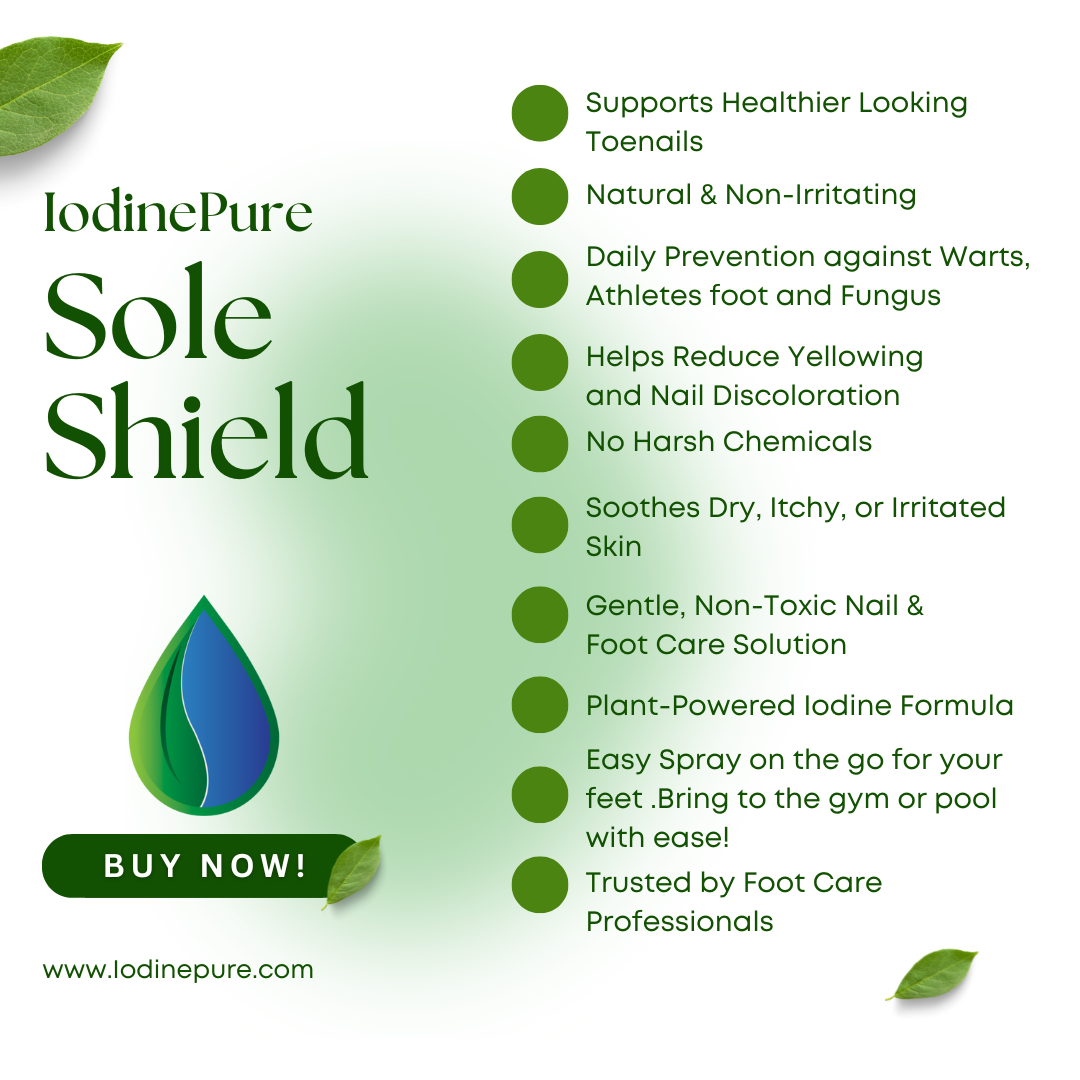
You are not allowed to make health claims. Neither are we. IodinePure is a cosmetic, listed with Health Canada as a cosmetic, with no drug claims attached to it. Two ingredients in water, sold for the look of the nail.
That is a genuinely unusual overlap. Almost anything else you could mention in that moment is a registered drug, and the sentence that sells it is the sentence that puts your licence in play.
Our EZ Clear Nails kit is built around a soak tray rather than a brush, because submerging the toe carries the solution under the free edge and around the folds. It is designed to run alongside professional care, and around 200 foot care clinics across North America use it that way.
What does this not fix?
It does not make the nail workable today. If your rule says intact and healthy, handing over a routine does not change that answer, and it should not be offered as though it does.
It does not replace the referral. You still do not know what you are looking at, and that is the reason for sending her on.
And it will not be quick. If she needs her toes to look different for something in three weeks, say so plainly. She will trust the rest of what you tell her more, not less.
Common questions
Can a nail tech refuse service?
Yes, on a nail or skin that is not healthy, and in most places the rule requires it rather than merely permitting it. Georgia requires services to be performed only on intact, healthy nails. Texas prohibits service where the practitioner has reason to believe there is inflamed, infected, broken, raised or swollen tissue. Check your own board, because the wording differs by state.
Can a nail tech refuse service in Canada?
Yes, and the backing is usually public health rather than a cosmetology board. In Ontario, Public Health Ontario guidance for personal service settings says service is to be deferred where there are visible skin infections including nail fungus, and that the client is to be advised to seek medical treatment. That document is Ontario guidance and does not supersede the regulation, and every province and territory runs its own rules, so check your province and your local public health unit.
Can a nail salon refuse service for toenail fungus?
A salon can decline the service on a nail that does not meet the health requirement where it operates. What it cannot do is tell the client what she has, because that is a diagnosis. The practical position is that the service is declined on that nail and the client is referred to a foot care professional.
Do I have to explain why I am refusing?
A short, plain reason lands better than silence, and pointing at the licence rule keeps it off the client personally. My licence only lets me work on healthy nails explains the decision without naming a cause or making a judgement about her.
What if the client insists?
The rule is not negotiable and it is easier to say so once, kindly, than to relitigate it. Repeat the licence sentence, offer the referral, offer the rebook, and offer something she can do at home. Most people accept a boundary that comes with a plan attached.
Can I just work around the affected nail?
That depends entirely on where you work, and it is exactly the point where techs get caught out. Some boards read the requirement as applying to the nail being serviced, others to the area. Some salons decline the whole foot. Ask your own board or provincial authority rather than copying what somewhere else does.
Should I still charge for the appointment?
That is a business decision, not a regulatory one. Many techs waive it and use the time for the conversation and the rebook, on the grounds that the goodwill is worth more than one service fee. Whatever you choose, decide it before it happens rather than in the moment.
What do I do with the file I used?
Texas is explicit: a buffer block or porous nail file exposed to broken skin or unhealthy skin or nails must be discarded immediately after use. Porous items cannot be reliably reprocessed, which is why single-use is the standard for files and buffers. Metal tools are cleaned and disinfected per your board’s procedure.
Can you get in trouble for doing nails without a license?
Where a licence is required, yes, and it is the licensing body that enforces it rather than the client. In the US that is your state board. In Canada it varies by province: the Government of Canada Job Bank says trade certification is compulsory in Manitoba, and lists the occupation as regulated in Saskatchewan and New Brunswick and non-regulated in Nova Scotia. Owner-operators also need a business licence. Ask your own authority what applies where you work.
Who is liable if a client says she got nail fungus at the salon?
Nail salon fungus liability is an insurance and legal question rather than a board one, and the answer turns on your jurisdiction and your policy. What is inside your control is the record: following the health requirement in your own rules, discarding porous files and buffers after any client with unhealthy skin or nails, disinfecting metal tools to your board’s procedure, and noting the date you declined a service and referred someone on. Talk to your insurer, and to a lawyer if it goes further than that.
The bottom line
Describe, point at the rule, refer, and hand her something. Four sentences, no diagnosis, no claim.
Done that way, a refusal stops being a lost appointment. It becomes the appointment where you were the professional who told her the truth and gave her a plan, which is the reason she comes back.
If you want the counter display and the partner side of this, the professional partner page covers it. It is open to techs in Canada and the United States on the same terms, with the same commission split and the same free kit to start with. There is no stock to buy, and how retail commission works without holding inventory walks through the mechanics if that is the part you are weighing up.
Also worth reading: what a nail tech can and cannot do about a fungal-looking nail, and how a changed nail gets told apart from injury, psoriasis and bruising.
Evan Lewis, PhD, specializes in natural and nutritional therapies for the prevention and management of chronic diseases and their complications. His research spans chronic disease, diabetes complications, clinical nutrition, and nerve health, including the development of topical iodine therapy for foot care and wound health. IodinePure products are listed with Health Canada as cosmetics. This article is general information for licensed professionals, not legal advice, and requirements change and differ by state, province and territory.
Sources: Ga. Comp. R. & Regs. R. 240-4-.02. Texas Administrative Code Title 16, Part 4, Chapter 83, §§83.102 and 83.106. Cal. Code Regs. Tit. 16, §984. OSHA, Health Hazards in Nail Salons: Biological Hazards. Government of Canada, Job Bank, job requirements for Nail Care Technician, NOC 63211. Public Health Ontario, Guide to Infection Prevention and Control in Personal Service Settings, 3rd edition, first revision July 2019. Yaemsiri S, Hou N, Slining MM, He K. Growth rate of human fingernails and toenails in healthy American young adults. J Eur Acad Dermatol Venereol. 2010.