Reviewed by Evan Lewis, PhD. Last updated August 2026.
A corn on your pinky toe happens because the fifth toe sits at the widest point of your foot with a bony knuckle and almost no padding over it. Every shoe that narrows towards the front presses right there. The corn is your skin thickening to protect that spot, and it stays as long as the pressure does.

Why does the little toe collect corns?
Three things stack up on that one toe.
It's the outermost point of your forefoot, so it meets the side of the shoe before anything else does. It has a bony prominence on the outside of the joint with very little soft tissue over it. And it tends to sit slightly rotated or curled in most people, which turns a flat surface into an edge.
StatPearls describes the classic hard corn, heloma durum, as most commonly located over the outer and upper aspect of the fifth toe. That's not a coincidence of the literature. It's a description of where shoes meet bone.
The same review puts corn prevalence at 14 to 48% depending on the group studied, rising with age as the fat pad under the foot thins.
Hard corn or soft corn, which one is on your little toe?
Where exactly it sits changes what you do about it.
A hard corn sits on the outside or the top of the little toe. It's dry, firm, often a bit yellow or waxy, with a hard centre. It comes from a shoe pressing directly on the toe.
A soft corn sits in the web space, usually between the fourth and fifth toes. It's white, soggy and macerated, because the skin there never gets to dry out. StatPearls describes heloma molle as a painful lesion seen primarily in the web spaces, especially the fourth, where the head of one toe bone abuts the base of the next. Two bones, one thin bit of skin in between, and permanent damp.
| Hard corn | Soft corn | |
|---|---|---|
| Where | Outside or top of the little toe | In the web, usually between the fourth and fifth toes |
| Looks like | Dry, firm, waxy, hard centre | White, soft, soggy, sometimes split |
| Pressed by | The side or top of the shoe | The two toe bones either side of it |
| Made worse by | Narrow toe boxes, pointed shoes, high heels | Sweat, damp socks, toes crowded together |
| Main fix | More room across the front of the shoe | Separating the toes and keeping the web dry |
| Risk if ignored | Skin splitting under the core | Maceration, and infection getting in through broken skin |
Is it a corn or a bunion on the pinky toe?
Press it and you'll know. A corn is thickened skin sitting on the surface, so it moves with the skin and it has a firm centre you can feel. A bunionette, also called a tailor's bunion, is the bone itself pushing outwards at the base of the little toe, so the lump is fixed, wider, and it doesn't shift under your thumb.
The confusing part is that most people with one have both. The bunionette pushes the joint into the side of the shoe, the shoe presses back, and the skin over the bump thickens into a corn. So the corn is the visible half of a problem that starts underneath it.
That matters for what you buy. Paring the corn or padding it helps the skin. It does nothing to the bone angle, which is why it comes back on the same spot within weeks. Widening the shoe is the one change that helps both halves at once.
Could it be a wart instead?
On the little toe, usually not, but check anyway because people buy the wrong product on a guess all the time.
Look for black dots. Warts have their own blood vessels, and when those clot they show as pinpoint dark dots. A 2023 dermoscopy study of 70 patients found black or red dots in every wart examined and in none of the corns or calluses.
Then follow your skin lines. On a corn they run straight over the top. On a wart the pattern stops at the edge. And squeeze it sideways versus pressing it down: warts hurt more on the squeeze, corns on the press. The full corn or wart guide works through all of it.
What actually shifts a corn on the little toe?
The corn is a symptom. The pressure is the problem. Take the pressure away and the skin stops making the corn, because it has no reason to.
Change the shoe first. This is 80% of it and everybody skips it. Measure the width of your foot, not just the length. Buy for the widest point, which is exactly where the fifth toe sits. If the shoe narrows to a point, it is pressing on that toe no matter how comfortable it feels in the shop.
Get it pared if it hurts. A chiropodist or podiatrist takes a painful corn down in a couple of minutes and the relief is immediate. It'll come back if the shoe hasn't changed, which is the honest version nobody enjoys hearing.
Separate the toes for a soft corn. Interdigital foam or felt padding, or a bit of lamb's wool, keeps the two toe bones off each other and lets the web dry out.
Don't cut it out. The NHS says it plainly on its corns and calluses guidance: don't cut them yourself, don't walk long distances on them, don't wear high heels or tight shoes. Do wear thick cushioned socks, use soft insoles or heel pads, soak in warm water, file gently, and moisturise.
The bone is the last resort. Where a soft corn keeps coming back, the underlying cause is a bony prominence, and the permanent option is a small surgical smoothing of that bone. That's a podiatric surgeon's call, and it's a long way down the list.
The shoe checklist
- Can you press down over your little toe and feel space, or does it hit the upper straight away?
- Does the toe box come to a point? If yes, it's squeezing the fifth toe inwards.
- Is the heel higher than about 4cm? That drives your whole foot forward into the narrowest part.
- Are your socks thin, or are they seamed right across the little toe?
- Are your insoles flattened? Worn insoles change where load lands.
- Buy shoes at the end of the day, when feet are at their largest.
Looking after the skin
Straight up: nothing in a bottle removes a corn, ours included. A corn goes when the pressure goes. What is in your hands is the condition of the skin, and on the little toe that matters more than most people think, because the skin there is thin, it splits when it dries out, and a split between the toes is an open door.
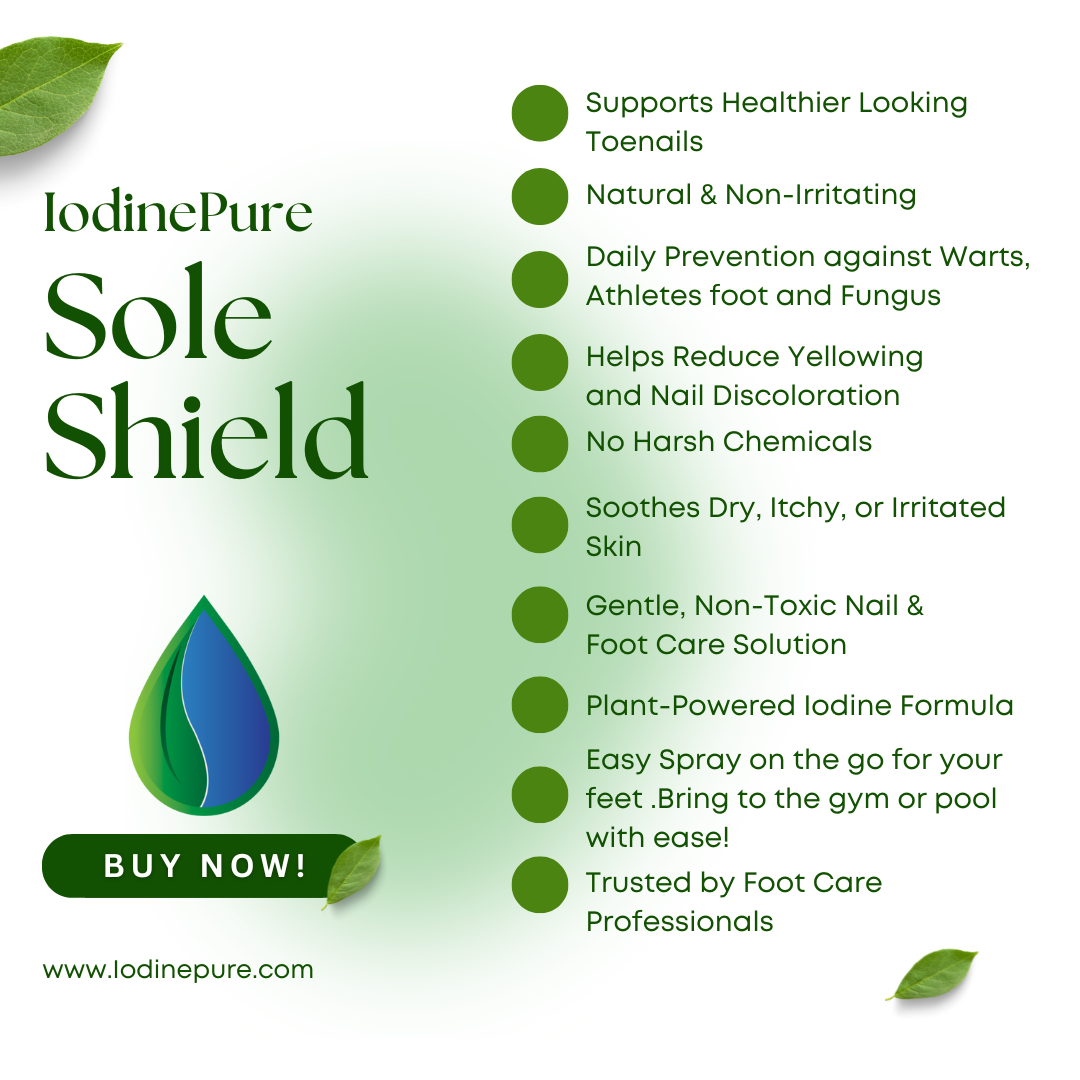
That's the job Sole Shield is built for. Two ingredients, iodine and pure water, sprayed on the feet and into the shoes. No alcohol, so it isn't stripping skin that's already dry, no sting on skin that's already sore, and no staining on socks. The shoe half matters here, because the shoe is where the pressure and the damp both come from. It doesn't touch the corn. It looks after the skin the corn lives in.
When should you get it looked at?
- The skin over or beside it has split or is bleeding
- The web space between the toes is white, soggy and sore
- It hurts enough that you're changing how you walk
- Three weeks of shoe changes and home care have done nothing
- You have diabetes, poor circulation, or reduced feeling in your feet
That last one overrides everything else. The NHS advises that people with diabetes, circulation problems or a weakened immune system should not treat corns and calluses themselves.
Common questions
Why do I keep getting a corn on my pinky toe?
Because the pressure causing it has not changed. The fifth toe sits at the widest point of the foot with a bony knuckle and little padding, so any shoe that narrows towards the front presses on exactly that spot. Having the corn pared down relieves it, but it rebuilds unless the footwear changes.
How do I get rid of a corn on my little toe?
Take the pressure off it, which in practice means wider shoes with a rounder toe box and a lower heel. Have a chiropodist or podiatrist pare it down if it is painful. Soak, file gently and moisturise as the NHS advises. Do not cut it out yourself.
What is the white soggy thing between my fourth and fifth toes?
That is most likely a soft corn, known clinically as heloma molle. It forms where two toe bones press against each other in a web space that stays damp, so instead of going hard the thickened skin turns white and macerated. Separating the toes and keeping the space dry is the main approach.
Is a corn on the pinky toe the same as a bunionette?
No, though they turn up together. A bunionette, or tailor's bunion, is a bony bump at the base of the fifth toe. A corn is thickened skin, and it often forms on top of a bunionette because the bump is what the shoe presses on. Treating the corn without addressing the bump means it returns.
Does a bunion corrector help with a corn on the pinky toe?
It depends what the device does. A toe spacer or a sleeve that holds the little toe off its neighbour and off the side of the shoe takes pressure off the skin, and less pressure means less corn. A splint sold as a bunion corrector is aimed at the joint angle rather than the skin, and the research on realigning bone that way is thin. Neither is a substitute for a wider shoe.
Can a corn on the pinky toe be a wart?
It can, though it is less common there than on the sole. Warts usually show tiny black dots, break the skin line pattern running across them, and hurt more when squeezed from the sides than pressed from above. Corns show no dots, keep the skin lines, and hurt on downward pressure.
Do corn caps work on the little toe?
Medicated corn caps act on the healthy skin around the corn as well as the corn itself, and on a small toe there is very little healthy skin to spare. They are also unsuitable if you have diabetes or circulation problems, or if the lesion is actually a wart. Padding that takes the pressure off is a safer starting point.
The bottom line
The little toe gets corns because of where it sits and what it sits in. That's the whole explanation, and it points straight at the fix.
Wider shoes, a rounder toe box, thicker socks, and somebody to pare it down when it hurts. Then look after the skin so the next one has less to work with.
Related: is it a corn or a wart? and what a seed corn is.
Evan Lewis, PhD, specializes in natural and nutritional therapies for the prevention and management of chronic diseases and their complications. His research spans chronic disease, diabetes complications, clinical nutrition, and nerve health, including the development of topical iodine therapy for foot care and wound health. IodinePure products are listed with Health Canada as cosmetics. This article is for identification and general information, and it is not a diagnosis. Sources: StatPearls, Corns. NHS, Corns and calluses. Patil S, et al. Dermoscopic Findings in Clinically Diagnosed Cases of Plantar Warts, Corns, and Calluses. Cureus. 2023;15(4):e38093.