Last updated: 9 August 2026
Iodine drops are a liquid iodine supplement, usually a few drops in a glass of water once a day. The amount is set by your own clinician, because it depends on your diet, your medication and your thyroid. Here is everything else worth knowing before you start.
What a page like this can do is explain the rest of it properly. What iodine does in the body. Why the requirement moves across a lifetime. Where it comes from in food, who tends to be running short, and what actually matters on a label.
What Does Iodine Do in the Body?
The thyroid uses iodine continuously to build thyroid hormone, and the National Institute of Diabetes and Digestive and Kidney Diseases describes thyroid hormone as controlling the way the body uses energy. Thyroid hormone sets the pace of metabolism in nearly every tissue. It influences body temperature, heart rate, energy through the day, and how the body handles fuel. In pregnancy and early childhood it also has a role in brain and nervous system development, which is why the subject comes up so often in that context.
The body does not manufacture iodine. There is no internal reserve it can top up on its own. Everything the thyroid uses arrived through the diet, which is the whole reason intake is a subject at all.
Why Does the Requirement Change Across Life Stages?
Iodine need is not one fixed figure held across a lifetime. It moves, and it moves for reasons that make sense without putting numbers on them. The published reference values by age and life stage are set out in Health Canada's dietary reference intake tables for elements.
- Adults need a steady, ordinary intake to keep thyroid hormone production ticking over day to day.
- Pregnancy raises the requirement, because the mother is making more thyroid hormone than usual and supporting a developing baby at the same time.
- Breastfeeding raises it again, since iodine passes into breast milk and the infant's entire supply arrives that way.
- Children need less in absolute terms than adults, simply because they are smaller, but a shortfall matters more while growth and development are underway.
- Older adults sit closer to the ordinary adult pattern, though appetite, medication and a narrower diet can all quietly change what is actually going in.
Where any individual sits inside that picture is a clinical question. Thyroid status, prescriptions and what someone already eats all move the answer, and they interact. A doctor, pharmacist, midwife or dietitian can look at those together and put an amount on it for that specific person, which is the right way for anyone to arrive at a number.
Where Does Iodine Come From in Food?
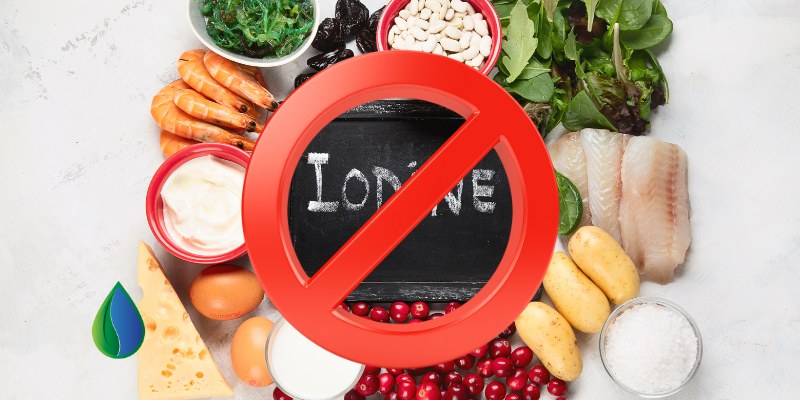
Most people get their iodine without thinking about it, from a small handful of foods. The NIH Office of Dietary Supplements lists the same short set of sources:
- Iodised salt. The single biggest source in most Western diets, and the reason iodine stopped being a common public health problem in the twentieth century.
- Dairy. Milk, yoghurt and cheese carry iodine largely because of livestock feed and dairy processing practices.
- Eggs. A modest but consistent contributor for people who eat them regularly.
- Fish and seafood. Cod, haddock and shellfish are among the richer natural sources.
- Seaweed. The most concentrated food source by a wide margin, and also the most variable, since content differs enormously between species and harvests.
Who Tends to Be Running Short?
Low intake usually happens by accident, when someone removes a source without noticing it was a source. The pattern shows up in a few recognisable groups:
- People who switched from iodised table salt to sea salt, pink salt or kosher salt. Those are usually not iodised, and the swap is almost always made for taste rather than nutrition.
- People eating a mostly plant based diet, where dairy, eggs and fish have all come out at once.
- People who cut dairy for intolerance or preference and did not replace it with anything carrying iodine.
- People who eat mainly restaurant, takeaway or processed food, where the salt used in commercial production is generally not iodised.
- Pregnant and breastfeeding women, whose requirement rises at exactly the point where a previously adequate diet may no longer keep up.
None of that tells you whether it applies to you. A thyroid panel and a conversation about your diet will.
It is not a rare problem either. The World Health Organization still tracks iodine deficiency as a global public health issue, and the groups above are where it tends to reappear in countries that solved it decades ago. We wrote about that pattern in the silent loss of iodine from modern food production, and iodine 101 covers what the mineral does in more depth.
How Are Iodine Drops Normally Taken?
Setting the amount aside, the practical habits around drops are consistent from product to product:
- The label on the bottle is the instruction that matters. Concentrations vary enormously between brands, so drops from one product are not equivalent to drops from another.
- Most people add drops to a small glass of water rather than taking them neat.
- Spacing them away from other supplements and medications by around twenty minutes is a common habit, since minerals can interact.
- Attaching it to something you already do every morning is what makes it stick.
What Should You Look for on a Label?
Check the form and the carrier. Plenty of drops stabilise iodine in alcohol, which the body then has to process alongside the mineral. A pure aqueous form, meaning iodine stabilised in distilled water and nothing else, is the cleanest version of the same idea. Also check that the label states micrograms per serving rather than only a number of drops, because that is the only way to compare two bottles honestly, and it is the figure your pharmacist or doctor will want to see.
What Are Lugol's Iodine Drops?
Lugol's is iodine plus potassium iodide dissolved in water, a formula that has been sold since the 1800s. It is made in several strengths, so two bottles both labelled Lugol's iodine drops can hold very different amounts per drop. That is the reason to read micrograms per serving rather than trusting the name on the front of the bottle.
Lugol's, nascent iodine and plain aqueous drops all sit on the same shelf and get described in similar language. We pulled those categories apart in our comparison of liquid iodine and nascent iodine, which is worth reading before you line two bottles up against each other.
When to speak to a professional first
Speak to a healthcare professional before starting iodine drops if you are pregnant or breastfeeding, if the drops are intended for a child, if you take thyroid medication such as levothyroxine, if you have Hashimoto's, Graves' disease, a nodule or any diagnosed thyroid condition, or if you take lithium or amiodarone. Iodine is an essential mineral with a workable range rather than a "more is better" curve, and thyroid status is what decides where in that range a person belongs.
One practical note that has nothing to do with amounts: topical iodine products are formulated for skin and are not intended to be swallowed. Keep the two categories separate.
If you are pregnant or planning to be, our guide to iodine in pregnancy goes through how the requirement changes and what the published guidance says.
Frequently Asked Questions
How do you take iodine drops?
Most people add the drops to a small glass of water rather than taking them neat, once a day, at the same point in their morning. The label on your bottle is the instruction that matters, because concentrations differ enormously between brands. Drops from one product are not equivalent to drops from another.
Should iodine drops be spaced away from other supplements?
Leaving around twenty minutes between iodine drops and other supplements or medications is a common habit, since minerals can interact. If you take thyroid medication, ask your pharmacist how to space the two, because that answer depends on the prescription.
Can you take iodine drops during pregnancy?
Speak to your midwife, doctor or pharmacist first. The requirement does rise in pregnancy and again while breastfeeding, and it is also the point where the amount matters most, so it is worth having someone set it for you rather than picking a number.
What is the difference between aqueous iodine drops and an alcohol-based tincture?
The carrier. Plenty of drops stabilise iodine in alcohol, which the body then has to process alongside the mineral. A pure aqueous form means iodine stabilised in distilled water and nothing else, which is the cleaner version of the same idea.
Can you swallow a topical iodine product?
Topical iodine products are formulated for skin and are not intended to be swallowed. Use a product labelled for oral use, with micrograms per serving stated on the label, and keep the two categories separate.
Are Lugol's iodine drops the same as aqueous iodine drops?
Not quite. Lugol's is iodine plus potassium iodide in water and comes in several strengths. A plain aqueous drop is iodine stabilised in distilled water and nothing else. Both are water based, so neither carries alcohol, but the amount per drop is not comparable between them. Check micrograms per serving on each label.
Iodine Total Health is coming
Iodine Total Health is our aqueous iodine drop formula: two ingredients, iodine stabilised in distilled water, with per serving amounts stated plainly on the label. It is not yet available for sale. The product is in development, and you can join the waitlist to hear first when it launches.
Everything IodinePure sells today is topical: the EZ Clear Nails Starter Kit, Sole Shield and EZ Clear Skin are cosmetics used on nails, feet and skin.
References
- National Institutes of Health, Office of Dietary Supplements. Iodine fact sheet for health professionals. ods.od.nih.gov
- National Institute of Diabetes and Digestive and Kidney Diseases. Hypothyroidism. niddk.nih.gov
- Health Canada. Dietary reference intakes, reference values for elements. canada.ca
- World Health Organization. Iodine deficiency. who.int