By Dr. Evan Lewis, PhD · Last updated August 2026
Feet sweat in winter because cold weather does not turn the sweat glands down, it seals them in. Thick socks, closed boots and heated indoor air stop the sweat evaporating, so the foot ends up cold on the surface and wet underneath. That is why sweaty feet peak in January, not July.
Why are my feet sweaty in winter?
Because the sweat still comes out and now it has nowhere to go. In sandals in July, most of it evaporates before you notice. In a boot in January it stays in the sock and against the skin for the whole day.
Cold and damp at the same time is not a contradiction. It is the normal result of insulating a surface that is still producing moisture.
Cold sweaty feet in winter confuse people because the two sensations feel like they should cancel out. They do not. Wet skin pulls heat away from you faster than dry skin does, so the damp is exactly what makes the foot feel colder. That is the whole answer to why cold sweaty feet happen at all. The sweating is normal. The evaporation is what has stopped.
Is that actually true, or does it just feel that way?
It is true and it is measurable. We pulled five years of monthly search interest for the phrase in both markets. January indexes at 100 in Canada and 100 in the United States. September is the floor at 55 and 66. December is second in Canada at 99.
That is the exact inverse of the curve for toenail fungus and athlete's foot, which peak in June and July when people start looking at their feet again. If your feet feel worse in the winter, you are not imagining it and you are in a very large group.
What causes sweaty feet in the first place?
The soles carry one of the densest concentrations of eccrine sweat glands anywhere on the body. That is the baseline, before anything else happens. On top of it sit the things that turn the volume up:
- Occlusion. Hours inside a closed shoe. The biggest single factor and the most fixable.
- Heat. Including indoor heating, which people never count.
- Materials. Saturated cotton and cheap synthetics both hold water against the skin.
- Hormones and medication. Puberty, pregnancy, thyroid changes and a long list of common drugs.
- Stress. Real, but rarely the whole story.
- Hyperhidrosis. Sweating well beyond what regulating temperature requires.
Those reasons for sweaty feet stack rather than compete. Most people have three or four of them running at once, which is why a single fix so often disappoints. Only the last one on that list is a named sweaty feet condition in its own right.
Is it normal sweating or is it hyperhidrosis?
Hyperhidrosis is excessive sweating caused by overstimulation of cholinergic receptors on the eccrine glands, and it affects roughly 3% of the United States population. The palms, soles, face and underarms are the usual sites because that is where the glands are densest. When it is confined to the soles, it is often called plantar hyperhidrosis.
The listed criteria for the primary focal form are worth reading because they are specific:
- Excessive sweating for six months or more
- Affecting the underarms, palms, soles or face
- Bilateral and roughly symmetric
- Decreased or absent at night
- Episodes at least weekly
- Onset at 25 years of age or younger
- A family history
- It interferes with daily activities
Two of those are genuinely useful at home. If your sweating stops overnight, that points towards the primary form. If it started after 25, is one-sided, or carries on while you sleep, that is a reason to see a doctor rather than buy another product.
What if it is sweaty hands as well as feet?
Common, and it points the same way. Palms and soles are the two densest gland fields on the body, so the primary form usually shows up in both. If it is only your feet and only since you started a new job in safety boots, look at the boots first.
Sweaty feet and hands together, starting young and running in the family, is the classic primary pattern. It is also the version most worth taking to a doctor, because the options for it are real and most of them are prescription.
Why does the smell follow the sweat?
Sweat itself is close to odourless. What produces the smell is bacteria on the sole breaking it down, and Staphylococcus made up 98.6% of the bacterial population on plantar skin in one study, with the resulting isovaleric acid found on the sole and not detected on the top of the foot. More sweat means more fuel, which is why sweat and smell arrive together. The full chain is in why do my feet smell.
The part that matters more than the smell
Sweaty feet are not just a social problem. The clinical reference on athlete's foot states plainly that the risk of tinea infections is elevated with excessive sweating, and that wearing occlusive shoes for extended periods predisposes patients to dermatophyte infections. Tinea pedis reaches around 10% of the population.
Winter stacks both risk factors at once, for months. That is why athlete's foot noticed in January so often gets blamed on a summer changing room, and it is why we treat the sweat season as the season that matters for foot skin. If you want the link laid out properly, read does smelly feet mean fungus.
What actually helps, and what does each thing reach?
Rotating two pairs and changing socks mid-shift do the most for the least. Here is every option against what it actually touches.
| Approach | What it acts on | How fast | Honest verdict |
|---|---|---|---|
| Antiperspirant on the sole | The sweat volume | Days | The most direct thing for sweat itself |
| Fragranced powder | Your nose, plus a little moisture | Seconds | Fine for a day out, changes nothing |
| Two pairs of boots on rotation | Hours the foot spends wet | Immediate | The best value change on this list |
| Mid-shift sock change | The wet layer against the skin | Immediate | Costs nothing, works, nobody does it |
| Vinegar or black tea soaks | The skin surface, briefly | Hours | Popular, thin evidence, can irritate |
| A daily routine on the skin | The organisms living on the sole | Weeks | Aimed at the consequences of sweat, not the sweat |
| Seeing a doctor | The sweating mechanism itself | Weeks | The right call if it meets the criteria above |
On the home remedies: vinegar, apple cider vinegar and black tea soaks all show up constantly in searches, and the honest position is that they change the skin surface for a few hours and the published evidence behind them is thin. They also sting broken skin. The Listerine foot soak gets the same treatment on this site, for the same reason.
How do you stop sweaty feet?
Nobody wants a matrix, they want an order of operations. This is how to stop sweaty feet in practice, cheapest and highest-yield first.
- Rotate two pairs of boots. A boot needs roughly 24 hours to dry all the way through. Wearing the same pair every day means starting each morning in yesterday's moisture.
- Change socks halfway through the day. Wool or a wicking synthetic rather than saturated cotton. Keep a spare pair in a bag and actually use it.
- Dry between the toes every time. Not a towel-flick. The web spaces stay wet longest and they are where the skin breaks down first.
- Put antiperspirant on the soles at night. An aluminium chloride product on dry skin before bed is the one item on this list that acts on sweat volume itself.
- Get the boots off indoors. Eight hours of heated office air inside a winter boot does as much damage as the walk to work.
- Open the shoe, not just the foot. Loosen the laces, pull the insole out overnight, and let air reach the inside.
How to treat sweaty feet properly depends on where the problem actually sits. If a month of the routine above changes nothing, or you meet the criteria listed earlier, the next step is a doctor rather than a seventh product.
What are the best winter boots for sweaty feet?
Breathable over waterproof, room at the toes, and two pairs instead of one expensive pair. That is most of it.
- Membranes cut both ways. A fully waterproof membrane keeps slush out and keeps sweat vapour in. If your day is indoors and outdoors rather than standing in snow, unlined leather or a breathable upper is usually the more comfortable choice, and it is the main thing separating winter boots for sweaty feet from winter boots generally.
- Leave room. A boot packed tight around a thick sock crushes the sock's loft, and a flattened sock stops wicking and starts rubbing.
- Removable beats branded. Insoles for sweaty feet earn their keep mostly by coming out at night so the inside of the boot can dry. Wool felt and open-cell foam dry faster than a sealed gel pad. No insole reduces how much you sweat.
- Rubber boots and steel toes are their own case. There is no airflow at all, so the mid-shift sock change matters more than anything you can buy.
One more thing about fit. Damp skin slides inside a loose boot, and friction plus pressure is what causes calluses on feet, which is a separate problem from sweat but tends to arrive with it. If you are trying to work out what a hard patch actually is, we cover the difference between a plantar wart, a corn and a callus separately.
Do powders and sprays for sweaty feet work?
Powder absorbs a little and masks a lot. A foot spray does something different again. Neither one is an antiperspirant.
Powder for sweaty feet, whether talc, cornstarch or a branded foot powder, takes up a small amount of moisture and reduces friction, which is why it feels good for the first hour. Once it is saturated it cakes, and a wet paste inside a sock is worse than nothing. If you use it, use a little on a dry foot in the morning and expect to reapply.
A foot spray for sweaty feet is usually one of three things: a fragrance, an antiperspirant built on aluminium salts, or something aimed at the skin surface rather than at the sweat. Check which one you have bought, because the labels look near identical on the shelf and only the middle category changes how wet your feet get.
Where does Sole Shield fit, and what will it not do?
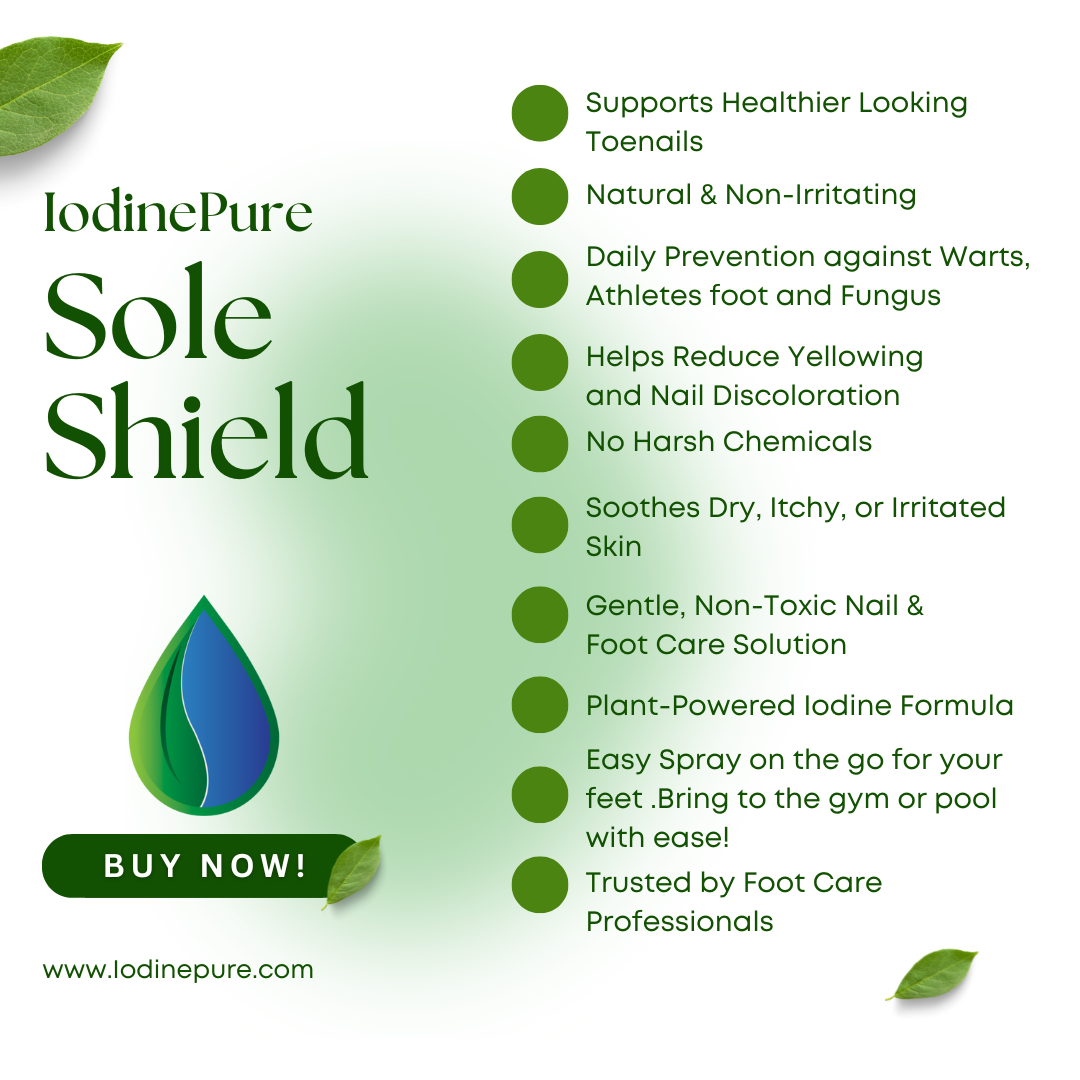
It is not an antiperspirant, and being straight about that matters. Sole Shield is iodine and water, two ingredients, and it has no effect on how much you sweat. If sweat volume is your problem, an aluminium-based antiperspirant or a conversation with your doctor is the right tool and we are not it.
What it is aimed at is what the sweat leads to: the organisms living on the sole and between the toes, and the inside of the boot they get put back into. There is also no fragrance in it, so it will not make anything smell nice. It is a daily habit that works over weeks, next to the drying and the rotation, not a replacement for either.
Iodine has been used on skin since the 1800s, and unlike the decolorized iodine sold in pharmacies, whose own FDA-registered label lists 45% alcohol and warns that it will stain skin and clothing, ours does neither. That matters most when you are applying something to feet that are already damp and slightly macerated.
When to see a doctor
Book an appointment if the sweating is heavy enough to interfere with work or shoes, if it began after age 25, if it is one-sided, if it continues through the night, or if it started alongside weight loss, fever or other new symptoms. Also go if the skin is broken, or if you have diabetes or poor circulation.
Frequently asked questions
What causes sweaty feet?
The soles carry one of the densest fields of eccrine sweat glands on the body, so the baseline is high before anything else is added. Hours in closed shoes, heat, sock material, hormones, some medications, stress and hyperhidrosis all raise it further. Occlusion is usually the largest and most fixable factor.
Why do my feet sweat when they are cold?
Because cold weather does not stop the glands working, it stops the sweat evaporating. Thick socks and closed boots trap the moisture against the skin while the outer surface of the foot stays cold. Cold and damp together is the normal result of insulating a surface that is still producing moisture.
Do feet sweat more in winter than in summer?
They often feel far wetter in winter even when the volume is similar, because winter footwear stops evaporation. Search interest for sweaty feet peaks in January in both Canada and the United States and troughs in September, which is the mirror image of the athlete's foot and toenail fungus curve.
What is the medical term for sweaty feet?
Plantar hyperhidrosis, when the sweating is genuinely excessive. Hyperhidrosis is defined as excessive sweating due to overstimulation of cholinergic receptors on eccrine glands and affects roughly 3% of the United States population. The palms, soles, face and underarms are affected most often because that is where the glands are densest.
How do I know if I have hyperhidrosis or just sweaty feet?
The listed criteria for the primary focal form include six months or more of excessive sweating, bilateral and symmetric involvement, decreased or absent sweating at night, onset at 25 years of age or younger, a family history, and interference with daily activities. Sweating that continues at night, starts after 25 or affects one side is worth a doctor's opinion.
Can sweaty feet cause athlete's foot?
Sweat does not carry the fungus, so it cannot start an infection on its own. It does create the conditions the fungus needs, and the clinical reference lists excessive sweating as a risk factor for tinea infections alongside long hours in occlusive shoes. You still have to pick the organism up, usually from a floor walked on barefoot.
Does an iodine foot spray stop sweating?
No. Sole Shield by IodinePure is iodine and water and has no effect on sweat volume, so it is not an alternative to an antiperspirant. It is aimed at the skin of the sole and the toe webs, and the inside of the shoe, which is where the consequences of sweating show up rather than the sweating itself.
Are sweaty feet in children normal?
Usually, yes. Sweaty feet in children are common, especially in kids who live in trainers, and they often smell more than an adult's because the shoes get worn all day and washed almost never. Wool socks, a second pair of shoes and taking them off indoors covers most of it. Onset at 25 or younger is part of the primary hyperhidrosis pattern, so if a child's socks are soaking daily, if it interferes with school, or if anything else new has appeared alongside it, raise it with a doctor rather than working around it.
Can sweaty feet cause a rash?
They can set one up. A sweaty feet rash is usually one of four things: athlete's foot in the toe webs, pitted keratolysis with its shallow craters across the sole, dyshidrotic eczema with deep itchy blisters along the sides of the toes, or plain contact irritation from a dye or an adhesive inside the shoe. They look different and they need different things, so a rash that keeps coming back is worth showing to someone instead of guessing at it for another six months.
IodinePure products are cosmetics listed with Health Canada, for daily foot, skin and nail care alongside professional care rather than instead of it. If you have diabetes, poor circulation or broken skin, speak to a clinician first.