Reviewed by Evan Lewis, PhD. Last updated 11 August 2026.
Are plantar warts a sign of something serious? Almost never. They are a common viral skin infection that healthy people pick up from shared floors. What they occasionally signal is a skin barrier that is not intact, or an immune system under suppression from medication or illness.
So the answer people are usually looking for is reassuring. But there is a narrow set of circumstances where a wart is worth mentioning to a doctor, and it is worth knowing which is which.
Are plantar warts a sign of a weak immune system?
Not on their own. One wart on the sole of an otherwise healthy adult says nothing except that you walked barefoot somewhere the virus was.
Where the immune question becomes real is with numerous warts, warts that keep returning, or warts that refuse to clear over years. DermNet notes warts are particularly common in people with drug-induced immunosuppression, giving long-term azathioprine or ciclosporin use as examples, and in people with HIV infection. It also records that warts are likely to recur in patients who are immunosuppressed, for example organ transplant recipients.
If you are on none of those, widespread or stubborn warts are far more likely to mean repeated exposure than a hidden illness.
Who actually gets them?
DermNet lists three groups where warts are particularly common, and the second one surprises people.
- School-aged children, though they can occur at any age.
- People with dermatitis, because of a defective skin barrier. Broken skin is the entry point, so eczema on the feet raises the odds.
- People with drug-induced immunosuppression or HIV.
The dermatitis link is the practically useful one. If your skin cracks every winter, the cracks are how the virus gets in, and looking after the barrier matters as much as anything you put on the wart itself.
Are plantar warts hereditary?
The warts are not inherited. You catch them from a surface, not from your parents. What can run in a family is how readily you pick them up, because skin type, sweating and eczema all have a hereditary component and all three change your odds.
There is one genuine exception, and it is rare. DermNet describes epidermodysplasia verruciformis as a rare autosomal recessive condition in which people are susceptible to infection with specific HPV types, producing widespread flat lesions and a risk of squamous cell carcinoma. That is a distinct diagnosis, not the explanation for an ordinary verruca.
The more useful line for most families is exposure, not genetics. Households share bathrooms, mats and floors, so warts cluster in families for the same reason colds do.
Can plantar warts be cancerous?
The common types on the sole are not the ones associated with cancer. DermNet counts more than 150 HPV types, and the plantar ones are skin-surface types, distinct from the genital and cervical strains that carry oncogenic risk.
That said, "it looks like a wart" is a description, not a diagnosis. Anything on the foot that bleeds without being knocked, changes shape or colour quickly, grows steadily rather than plateauing, or has been there for years without changing deserves to be looked at by a professional. Not because it is likely to be sinister, but because a wart is the thing other things get mistaken for.
So why are plantar warts considered bad?
Three reasons, and only one of them is medical.
| Problem | What it actually is | How much it matters |
|---|---|---|
| Pain when walking | Body weight presses it inward against a hard core | Real. Changes your gait, which causes knock-on problems |
| It spreads | Autoinoculation from picking, plus household transmission | Real, and the main argument for dealing with it |
| Social and psychological | DermNet lists teasing at school, embarrassment, and permission refused for swimming lessons | Underrated. Often the reason people finally act |
| Nail damage | Warts around the nail fold can cause nail dystrophy | Real but uncommon on the foot |
| Danger to health | Not a feature of ordinary plantar warts | Low, outside the risk groups above |
Do warts have roots?
No. This is the most persistent myth about them and it changes how people treat them, usually for the worse.
What looks like a root is the wart growing downward into the skin because your body weight will not let it grow outward. The dark specks people call seeds or roots are thrombosed capillaries, tiny clotted blood vessels feeding the tissue. There is nothing anchoring it that needs digging out, which matters because digging is how one wart becomes several.
Do they get worse if you leave them?
Usually they resolve, slowly. DermNet's figures are the honest baseline: in children, even without treatment, 50% of warts disappear within six months and 90% are gone in two years, and it adds that viral warts are more persistent in adults but clear up eventually.
What can happen while you wait is that callus builds over the top and it starts to hurt, or you seed new ones by picking. Whether to act on that is covered in do you have to treat a plantar wart.
Does smoking make a difference?
DermNet states it directly: recurrence is more frequent in tobacco smokers. It also notes that immunity to HPV is likely to be type-specific, which is why clearing one wart does not protect you from the next one.
That type-specific point explains a common frustration. People assume that having had a verruca means they are done with them. It does not work that way.
When should you actually get it checked?
- It bleeds without being knocked, or changes shape or colour quickly
- It has grown steadily rather than settling at a size
- You have diabetes, neuropathy or poor circulation, in which case do not self-treat at all
- You are immunosuppressed, on azathioprine or ciclosporin, or post-transplant
- Warts are numerous, spreading fast, or coming back repeatedly
- You are not certain it is a wart
That last one is the most common good reason. Corns, calluses and warts all present as a hard sore spot, and the pinch test sorts most of it in ten seconds.
Where does a daily routine fit?
On the exposure side, which is the half you can actually control. The virus needs a shared wet floor and a break in your skin, so the routine targets both: sandals in communal showers, dry feet including between the toes, your own towel and bath mat, and shoes that get a day to dry out between wears.
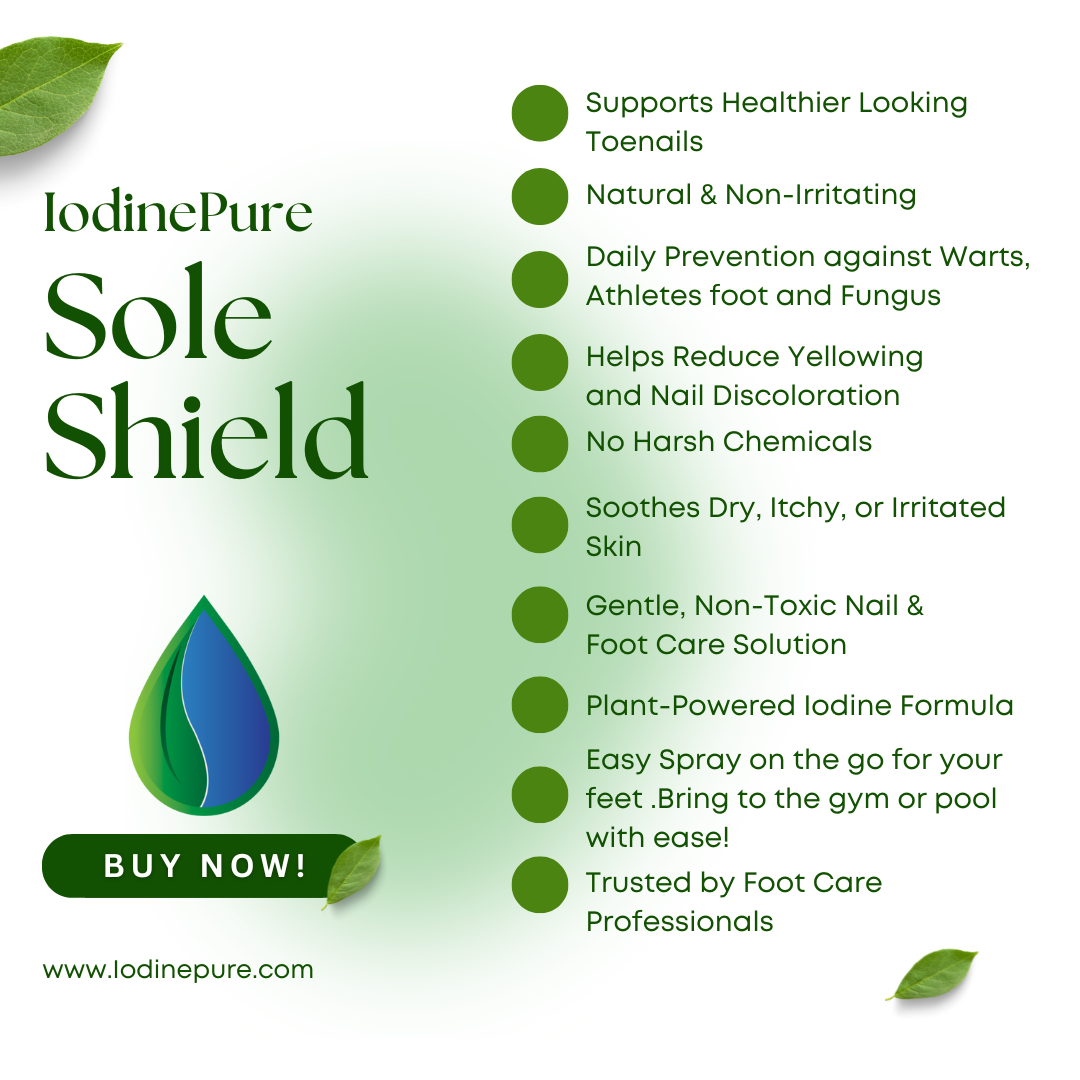
Sole Shield is the daily iodine spray we make for feet and shoes, and it sits in that routine on the skin and inside the footwear. More on where warts come from in the first place is in warts on feet: what causes them.
Common questions
Can you get a plantar wart without having HPV?
No. Every plantar wart is caused by human papillomavirus. What varies is which of the more than 150 types you met and how your immune system responded to it.
Why do my plantar warts keep multiplying?
Usually autoinoculation. Picking, scratching or filing moves live virus across nearby skin, which is why one wart becomes a cluster. Repeated exposure in the same shared shower does the rest.
Are plantar warts a sign of poor hygiene?
No. They are a sign of having walked barefoot where the virus was, which includes clean gyms, clean pools and clean family bathrooms. DermNet lists school-aged children as the most affected group.
Can you play sport or run with plantar warts?
Yes, in shoes. Cover the wart with a waterproof plaster for anything barefoot on a shared surface, including gymnastics, studio yoga and mat sports, and keep your own towel.
Are plantar warts dangerous during pregnancy?
The wart itself is not a pregnancy concern. What changes is which treatments are appropriate, so ask a pharmacist or midwife before starting salicylic acid or a freezing kit rather than assuming it is fine.
Do plantar warts have seeds?
No. The dark specks are clotted capillaries, not seeds and not roots. Seed wart is just a common name for the small ones with visible dots.
Does zinc help with warts?
Zinc has been studied for warts with mixed results and is not a mainstream recommendation. Salicylic acid has the stronger evidence base among things you can buy over the counter, though the Cochrane review calls its effect modest.
Why do warts come back after they cleared?
Because immunity to HPV is likely to be type-specific, so clearing one type leaves you open to the next. DermNet also notes recurrence is more frequent in smokers and in people who are immunosuppressed.
Can warts cause nail damage?
Yes, if they sit around the nail fold. DermNet notes periungual warts can cause nail dystrophy, meaning the nail grows in distorted while the wart is present.
The bottom line
A plantar wart on a healthy foot is not a sign of anything serious. It is a sign you walked barefoot somewhere the virus was. Numerous, stubborn or fast-returning warts are worth mentioning to a doctor, particularly if you are immunosuppressed. And anything that bleeds unprovoked, changes quickly, or sits on a foot with diabetes should be looked at rather than treated at home.
References
- DermNet. Viral warts. Risk groups, HPV types, recurrence, complications and outcomes.
- NHS. Warts and verrucas.
- American Academy of Dermatology. Warts: diagnosis and treatment.
- Kwok CS, Gibbs S, Bennett C, Holland R, Abbott R. Topical treatments for cutaneous warts. Cochrane Database of Systematic Reviews, 2012. PMID 22972052.