By Dr. Evan Lewis, PhD · Last updated 9 August 2026
That hard, painful bump on the bottom of your foot may not be a callus at all. If it is a wart, it behaves completely differently: it can spread to other parts of your foot, to your family, and to anyone who walks barefoot where you do.
Most people ignore foot warts for months, assuming they will go away on their own. Sometimes they do. More often they multiply, grow deeper, and become harder to deal with. Knowing which one you are actually looking at is the first useful thing you can do, and it takes about ten seconds.
Wart or Callus? The Squeeze Test
The quickest way to tell a plantar wart from a callus is the lateral squeeze test. Pinch the lump from the sides, between your thumb and forefinger, rather than pressing straight down on it. A callus is not painful squeezed this way. A wart usually is. Calluses hurt under direct downward pressure; warts hurt from the sides.
Three more differences settle it:
- Dark dots. Look at the centre of the growth. Small black, brown or dark red pinpoints are thrombosed capillaries, tiny clotted blood vessels. Calluses do not have them. This is the single most reliable sign.
- Skin lines. The fingerprint-like ridge pattern on your sole runs straight across a callus. It stops at the edge of a wart and picks up again on the other side.
- Texture. A callus is smooth and waxy. A wart is rough and grainy under the thumb.
If you are still not certain, that is a good reason to see a foot care specialist rather than to start filing at it. Corns, calluses, warts and a few less common things can look alike, and the care each one needs is not the same.
What Are Plantar Warts?
Plantar warts are benign skin growths on the sole of the foot caused by the human papillomavirus, commonly known as HPV. The spelling most people type into Google is planters wart, and it means the same thing. DermNet separates the two you are most likely to meet: "tender inwardly growing myrmecia on the sole caused by HPV 1, and clusters of superficial less painful mosaic warts due to HPV 2." These are skin-surface types, with no connection to the strains associated with cervical or genital infection.
What makes plantar warts different from warts elsewhere on the body is their location. Because they grow on the sole, a surface that bears your entire body weight with every step, they are pressed inward rather than allowed to grow outward. That inward growth is what makes them painful. You are effectively walking on a hard viral lesion embedded in the skin.
The virus enters through tiny cuts, scrapes, cracks in dry skin, or softened skin on the sole, openings usually too small to see. Once inside, it infects cells in the outer layer of the skin and causes them to multiply abnormally, forming the rough, thickened growth you feel when you press on the ball of your foot or your heel.
What Do Foot Warts Look Like?
Flat or slightly raised, hard, skin-coloured or slightly yellowish, with a rough grainy surface. Most sit on the heel, the ball of the foot, or the toes. Alongside the dark dots and the interrupted skin lines described above, you may also notice pain when walking that feels like standing on a small stone, or a cluster of smaller warts grouped together, which is called a mosaic wart.
Can You Get Warts Between Your Toes?
Yes, and they look different when you do. Because the skin between toes is warm, moist and subject to friction, any HPV present on the foot can take hold there as easily as on the bottom.
Warts in this location tend to have a softer, more spongy texture than their plantar counterparts. They are sometimes called kissing warts, because two adjacent toes can develop warts that face each other, the result of the virus transferring from one surface to the other through constant skin-to-skin contact. Despite the different texture and location, the underlying cause is identical.
What Are Mosaic Warts?
Mosaic warts are clusters of individual plantar warts that have fused into a larger plaque. They are considerably more stubborn than a single wart, and they are very commonly the result of someone attempting to cut, file or pick at a wart at home.
The mechanism is not a mystery. DermNet describes warts spreading by "direct skin-to-skin contact or autoinoculation; if a wart is scratched or picked, a wart may develop under the fingernail (subungual wart) or virus may be spread to another area of skin." Cut or file a wart and you move live virus across the surrounding skin and onto whatever tool touched it. One wart becomes a patch. Mosaic warts are also more likely to appear between toes or around the heel, where skin is regularly softened by moisture.
Where Do You Catch Foot Warts?
HPV does not float through the air. It needs a surface, ideally one that is warm, moist and frequently touched by bare skin:
- Pool decks and changing rooms at public swimming facilities
- Gym locker rooms and shower floors, particularly busy commercial gyms
- Yoga studios and martial arts gyms where people train barefoot on shared mats
- Hotel bathrooms and spa facilities
- Your own home, if someone in the household already has a wart: shared bath mats, showers and floors can all transmit it
The virus can survive on surfaces for hours. It is patient. All it needs is a tiny opening in your skin: a small cut, a patch of softened skin after a long shower, a blister from new shoes.
Who Is Most at Risk?
Anyone whose bare feet meet a shared wet floor, and children most of all. DermNet notes warts are "particularly common in school-aged children, however they may occur at any age."
- Children and teenagers, whose immune systems have not yet met these HPV strains
- Athletes who train in shared spaces, particularly swimmers, runners, martial artists and gym-goers
- Anyone who walks barefoot in public, including pools, communal showers and change rooms
- People with sweaty feet, because softened, moist skin is a much easier entry point
- People with compromised immune systems, who may develop warts more readily and find them harder to clear
What Are the Treatment Options for Foot Warts?
Six of them are in common use, and the evidence behind each is not equal. Here is an honest read.
Does Salicylic Acid Work on Plantar Warts?
Better than anything else you can buy over the counter, though not dramatically. The 2012 Cochrane review of topical wart treatments by Kwok and colleagues found salicylic acid "significantly increased the chance of clearance of warts" against placebo, while calling the therapeutic effect modest. It also worked better on hand warts (risk ratio 2.67) than on plantar warts (risk ratio 1.29), which is worth knowing before you start. It needs daily application, filing away dead tissue between applications, and patience.
Cryotherapy (Freezing) at a GP or Podiatrist
Liquid nitrogen freezes the wart tissue, which then blisters and separates from the skin underneath. One of the most effective clinical options, usually needing several sessions two to three weeks apart. It can be uncomfortable.
Is the Duct Tape Trick Real?
The evidence says no. The same Cochrane review is blunt about it: two trials of clear duct tape with 193 participants "demonstrated no advantage over placebo". It is cheap and low-risk, so people keep trying it, but it should not be the plan.
Laser
Reserved for warts that have not responded to first and second-line options. Effective for some resistant mosaic warts, more expensive, and not a first step.
Surgical Excision
A last resort, for warts that have failed everything else. Not a starting point.
Home Remedies
Apple cider vinegar, tea tree oil, banana peel. Popular, but the clinical evidence is thin. They should not be relied on as the primary approach for an established wart.
What Does a Realistic Timeline Look Like?
Months, not days, and that is true whether you do anything or not. DermNet's figures for untreated warts in children are the honest baseline: "50% of warts disappear within six months, and 90% are gone in 2 years", and it notes they are more persistent in adults. Unrealistic expectations are the most common reason people abandon a routine before it has had time to do anything. For a standard salicylic acid course, this is roughly what the weeks look like:
- Weeks 1 to 2. Surface tissue softens. The wart may briefly look larger or more defined as the upper layers come away. That is normal, not a sign of things getting worse.
- Weeks 3 to 6. Gradual reduction in size with consistent daily use. The dark dots may become more visible as the capillary tissue is disrupted.
- Weeks 6 to 12. For most plantar warts treated consistently, this is the window where significant change shows, provided the routine has not been interrupted.
- Beyond 12 weeks. A wart that has not budged by now is worth a GP or podiatrist appointment for cryotherapy or another clinical option. Mosaic warts and warts in high-pressure areas often need professional management.
What Makes Foot Warts Worse?
Four habits, and the first one is by far the most damaging.
Filing or Cutting the Wart at Home
The most common mistake, and the one that most often turns a single wart into a mosaic cluster. Filing or cutting disperses live virus across the surrounding skin and onto any tool that touches the tissue, which is the autoinoculation route DermNet describes. If you do debride the surface so a topical can reach it, use a dedicated emery board kept entirely separate from every other personal care tool, and dispose of it afterwards. Never use nail scissors or clippers on wart tissue.
Stopping Too Early
Warts frequently look resolved before they are. The surface can appear normal while viral activity continues in deeper skin layers. Standard guidance is to keep going for at least two weeks past the point where the wart appears gone. Stopping at the first sign of improvement is one of the leading causes of a fast return.
Ignoring the Inside of Your Shoes
Virus can persist on the fabric and insole surfaces inside footwear, particularly in the warm, moist environment shoes create after a long day. Going back into the same untouched shoes every morning undermines every other step you take.
Sharing Towels, Tools or Footwear
Anything that touches the sole of an affected foot becomes a possible transmission surface: bath towels, pumice stones, nail files, sandals and slippers shared around the house. If someone at home has an active wart, none of those should be shared until it has fully cleared.
Does Iodine Help With Foot Warts?
Iodine is one of the oldest antiseptics in continuous use, applied to human skin since the 1800s, and the literature on how it behaves is well developed. Writing in Antimicrobial Agents and Chemotherapy, Lepelletier and colleagues (2020) describe iodine as rapidly penetrating microorganisms and oxidizing key proteins, nucleotides and fatty acids, with no observed link to resistance development. Dr. Evan Lewis, PhD reviewed the wider body of research in his white paper on the clinical applications of elemental iodine in wart and fungal nail management. That research describes what the ingredient is understood to do. It is a separate question from what any cosmetic product does, and the two should not be blurred together.

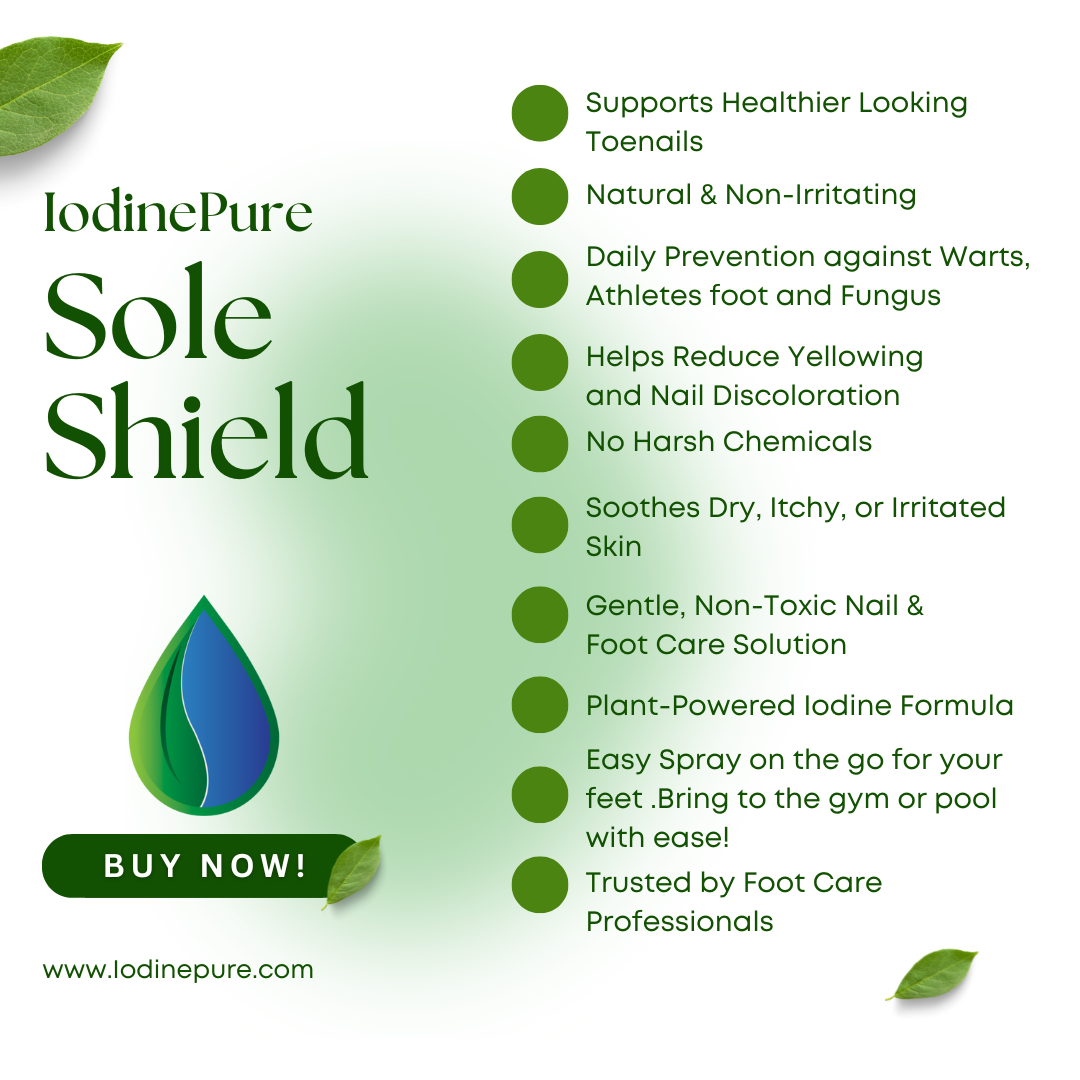
What Sole Shield does is physical and easy to describe. Two ingredients, elemental iodine stabilised in pure water, sprayed onto clean dry feet and into the inside of your shoes. No alcohol, no sting, no brown staining on skin. It covers the soles, the spaces between the toes and the inside of the footwear you put back on tomorrow, which is the part of the day almost every foot routine skips. Warts are one of the concerns foot care clinics most often tell us they reach for it on, and one of our partner nurses started using it in her own household before she ever recommended it to a patient.
This is a habit rather than an event. As with anything involving skin, it is the daily repetition across weeks that counts, not the first few days.
How Do You Stop Warts Spreading in Your Household?
By treating every shared wet surface as a transmission route, because that is exactly what they are. If someone at home has plantar warts, a few straightforward habits cut the risk down:
- Never share towels, particularly foot towels or bath towels
- Use separate bath mats. The person with the wart should have their own, laundered regularly at high heat
- Spray the inside of shared footwear. The inside of a shoe is a warm, dark environment where virus can linger
- Cover the wart with a waterproof dressing before using shared showers or baths
- Avoid walking barefoot on shared floors until it has fully cleared
What Does a Daily Foot Routine Look Like for Active People?
Three steps and under a minute. If you train at a gym, swim, practise yoga, or spend any time barefoot in a shared space:
- After any shared barefoot exposure, gym, pool or locker room, spray Sole Shield onto clean, dry feet, covering the soles and between the toes
- Spray inside your shoes and gym bag after each use
- Allow to dry before putting on socks
It is water-based, with no alcohol and no sting. Natural iodine is listed with Health Canada as a cosmetic. For anyone whose feet are regularly in shared environments, it slots neatly into the daily hygiene habits already worth building.
When Should You See a Doctor?
Book an appointment with a GP or podiatrist if any of the following apply:
- The wart is large, deep, or part of a rapidly spreading cluster
- It is causing significant pain when walking or standing
- Nothing has changed after two to three months
- You are immunocompromised, because warts in this group can behave differently
- You are not certain whether the growth is a wart, a callus, a corn or something else
A podiatrist can also advise on footwear, orthotics and pressure distribution, which can reduce the discomfort a wart causes while care is ongoing.
Frequently Asked Questions
How do you tell a wart from a callus on your foot?
Squeeze it from the sides rather than pressing down. A callus is not painful squeezed laterally; a wart usually is. Then look for small dark dots in the centre, which are clotted capillaries and appear in warts but not calluses, and check whether the fingerprint-like skin lines run across the lump or stop at its edge. Lines that stop and restart point to a wart.
What gets rid of warts on feet fast?
Nothing gets rid of an established plantar wart quickly. Cryotherapy at a clinic tends to move faster than at-home options but still usually takes two to four sessions. Salicylic acid has the better over-the-counter evidence base, with the Cochrane review reporting a modest effect and a lower risk ratio on plantar warts than on hands, and it works only with consistent daily use over weeks. Starting early matters more than the method: the longer a wart is left, the deeper and more stubborn it becomes.
Can foot warts spread to my hands?
Yes. DermNet describes autoinoculation directly: pick or scratch a wart and virus can be carried to another area of skin, including under a fingernail. Wash your hands after applying anything to a wart, and do not use the same file on both.
Does iodine help with warts?
Research on elemental iodine describes it as rapidly penetrating microorganisms and oxidizing key proteins, nucleotides and fatty acids, with no observed link to resistance development (Lepelletier and colleagues, 2020). Dr. Evan Lewis, PhD reviewed the wider literature in his white paper on elemental iodine in wart and fungal nail management. Sole Shield by IodinePure is a two-ingredient cosmetic spray, elemental iodine in water, applied daily to clean dry feet and inside footwear. What the research says about the ingredient and what a cosmetic product does are two separate things, and worth keeping separate.
How do I stop getting warts at the gym?
Wear flip-flops or shower shoes in any shared changing room, shower or pool area. Dry your feet thoroughly afterwards, including between the toes. Spray your feet and the inside of your gym shoes as part of the routine. Those three habits cover the main transmission routes in athletic environments.
How do I stop getting warts on my feet?
Cover the routes the virus uses. Wear sandals in shared showers, pools and changing rooms, dry your feet properly including between the toes, keep your own towel and bath mat, and do not pick or file at anything on your sole. Shoes matter as much as floors, because the inside of a shoe stays warm and damp all day. Intact skin is a much harder way in, so deal with cracks, blisters and rubbing early rather than later.
Are plantar warts contagious?
Yes, though not dramatically so. HPV spreads through contact with contaminated surfaces or skin, not through casual contact like a handshake. Risk is highest in warm, moist, shared environments and when skin has a break. Intact skin is a reasonable barrier; softened skin after bathing, or small abrasions, make it much easier for the virus to get in.
Why do my warts keep coming back?
Either the original wart was never fully cleared, with virus persisting in surrounding skin, or you are being re-exposed in the same environments where you picked it up. Both are common, which is why the footwear-and-hygiene habits matter as much after clearance as during.
How do you stop toenail fungus from coming back?
The same way you stop warts finding you again, by dealing with what you put your feet back into. Gupta and Versteeg (2019) report recurrence and relapse rates of 10% to 53% for superficial fungal infections of the feet. Shoes, socks and shared floors are the reservoir most people never touch. Wash socks hot, rotate shoes so they dry out fully between wears, and keep going with the footwear step after the nail looks better, because a toenail only grows out at 1.62mm a month.
References
- DermNet. Viral warts. HPV types in plantar and mosaic warts, autoinoculation, and spontaneous clearance rates.
- Kwok CS, Gibbs S, Bennett C, Holland R, Abbott R. Topical treatments for cutaneous warts. Cochrane Database of Systematic Reviews. 2012. PMID 22972052.
- Lepelletier D, Maillard JY, Pozzetto B, Simon A. Povidone Iodine: Properties, Mechanisms of Action, and Role in Infection Control and Staphylococcus aureus Decolonization. Antimicrob Agents Chemother. 2020. PMC7449185.
- Gupta AK, Versteeg SG. The Role of Shoe and Sock Sanitization in the Management of Superficial Fungal Infections of the Feet. J Am Podiatr Med Assoc. 2019. PMID 29521517.
What Do Most People Skip?
The shoes. Foot warts are far easier to avoid than to deal with once they have settled in, and once HPV establishes itself in the skin, clearing it takes time, consistency and sometimes a clinic. Sandals in shared showers, dry feet, your own towel, and not picking at anything cover most of the risk, and they cost nothing.
But feet get washed and shoes do not. Sole Shield by IodinePure is a two-ingredient iodine and water spray built for that gap: on the feet after the gym or the pool, and inside the shoes you will put back on tomorrow. Listed with Health Canada as a cosmetic, and it takes under a minute.