Reviewed by Evan Lewis, PhD. Last updated 8 August 2026.
Iodine itself does not sting. The alcohol that most iodine products are dissolved in does. Tincture of iodine is iodine in alcohol, and even the clear "decolorized" iodine sold as the gentle option lists 45% alcohol on its own FDA-registered label. Water-based aqueous iodine contains no alcohol, so there is nothing there to sting with.
The short version
- The sting is the solvent, not the iodine.
- "Decolorized" describes the colour, not what the iodine is dissolved in. One registered label lists 45% alcohol.
- Stinging is not evidence that anything is working. It is evidence of alcohol on broken skin.
- On intact skin, most people feel nothing from any of them. The difference shows up on cuts, cracks and the face.
- Read the solvent line on the back, not the word on the front.
Why does iodine sting?
Because of what it is mixed with. Tincture of iodine is iodine dissolved in alcohol, and alcohol on exposed nerve endings is a familiar feeling to anyone who has ever put an antiseptic wipe on a graze.
Iodine is delivered in three main ways, and the delivery decides the experience.

| Preparation | Dissolved in | Stings on broken skin | Stains |
|---|---|---|---|
| Tincture of iodine | Alcohol | Yes | Yes, deep amber |
| "Decolorized" iodine | Alcohol, 45% on one registered label | Yes | Its own label says it will |
| Povidone-iodine (Betadine) | A polymer carrier, aqueous or alcoholic versions exist | Depends on the version | Yes, temporarily |
| Aqueous iodine | Water | No alcohol in it to sting | No |
Does clear or decolorized iodine sting?
Often, yes, and this catches people out because clear sounds gentle. Decolorized only means the brown colour has been chemically removed. It tells you nothing about the solvent.
Pull up an actual FDA-registered decolorized iodine label on DailyMed and the active ingredients are listed as "Alcohol 45% (denatured with ammonia), Ammonium Iodide, Potassium Iodide". The warnings on that same page include the line "Will stain skin and clothing".
Clear, 45% alcohol, and staining, all on the manufacturer's own document. Anyone can check it in thirty seconds, which is why it is the most useful fact on this page.
Povidone-iodine sits in the same trap from the other direction, because Betadine is sold in both aqueous and alcoholic versions under the same familiar name. We read those labels side by side in what the labels actually say about Betadine and its alternatives.
Does stinging mean it is working?
No. This is worth being firm about, because the belief costs people a lot of unnecessary discomfort.
Stinging tells you there is alcohol on nerve endings that are exposed. It says nothing about the iodine, which is a separate ingredient doing a separate thing. A 2020 review in Antimicrobial Agents and Chemotherapy describes iodine's mechanism this way: as a small molecule, iodine "rapidly penetrates into microorganisms and oxidizes key proteins, nucleotides, and fatty acids, eventually leading to cell death". Nothing in that description requires you to feel anything.
The same idea runs through the rest of the medicine cabinet. Hydrogen peroxide fizzes and people read the fizz as proof. It is not.
Where does it sting, and where does it not?
On intact, unbroken skin, most people barely notice any of them. The difference shows up in exactly the places people use antiseptics.
- Cuts, grazes and cracked heels. Alcohol on an open surface is where the sharp sting comes from.
- Around a nail fold that is already sore. The skin there is thin and often split.
- The face. Alcohol-based products on an active spot are the version people describe as burning.
- Skin between the toes. Softened, sometimes fissured, and very quick to complain.
Pets run into the same thing, since the bottle in the cupboard is usually the alcohol-based one and a dog's paw or hot spot is broken skin. Using iodine on a dog is its own set of rules, and the solvent question is the first of them.
Even in clinical guidance the two forms are separated by where they go.
The 2020 review recommends "10% PVP-I in aqueous solution for use on mucous membranes, whereas we recommend 5% PVP-I in alcoholic solution for use on healthy skin". The water-based version is the one sent to the delicate places.
Which iodine does not sting?
Water-based, or aqueous, iodine. If the ingredients list is iodine and water, there is no alcohol in the bottle, so there is nothing to produce the sting.
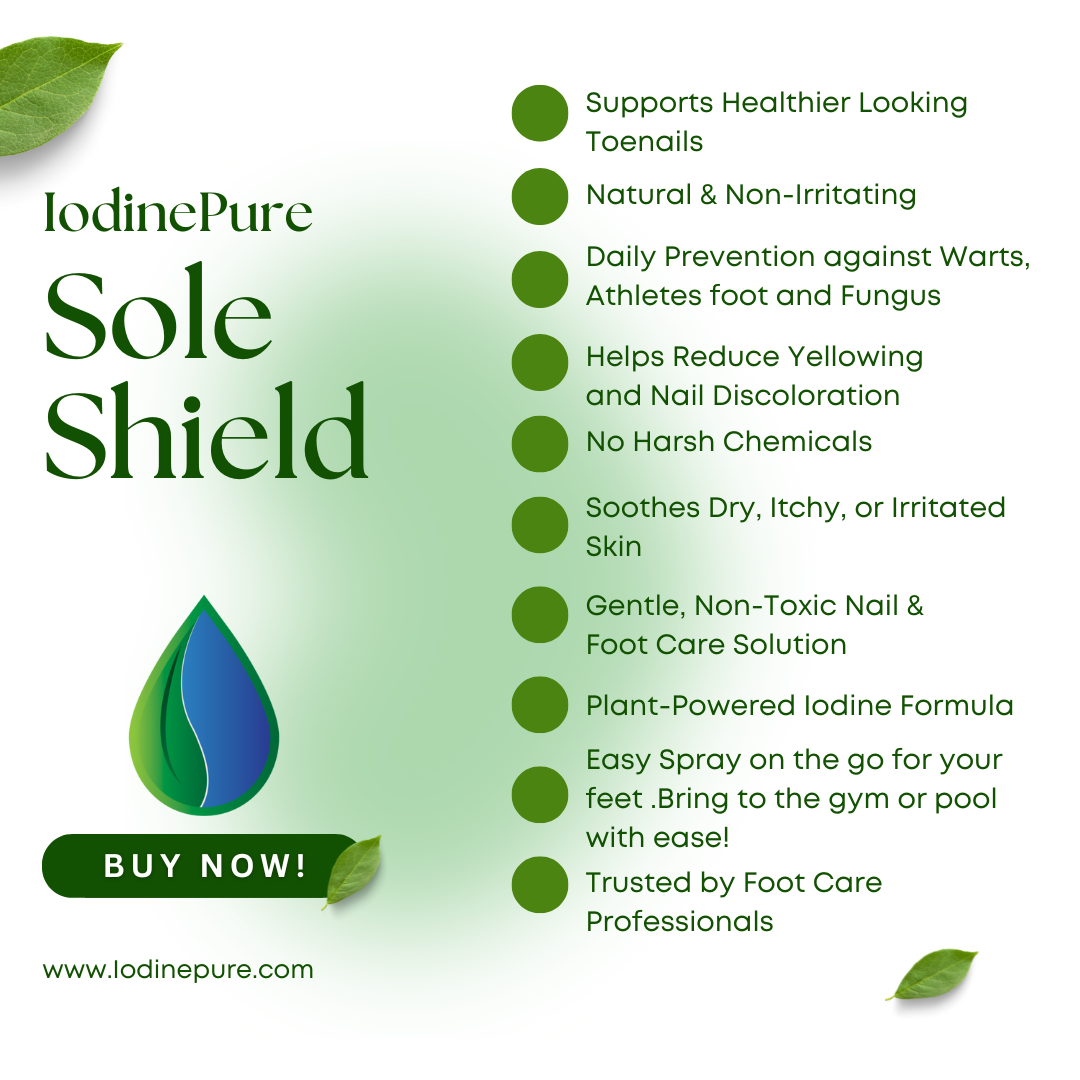
That is what IodinePure makes. EZ Clear Skin for face and body, EZ Clear Nails for toenails, and Sole Shield for feet and footwear are all two ingredients: iodine and purified water. All three are listed with Health Canada as cosmetics and made in a GMP-certified facility.
The practical argument matters more than the comfort one. In a study of 250 people using a topical, 45.6% stopped early, and 37.7% of those stopped because of irritation, redness, scaling, itching or stinging. A product that stings and stains is a product you stop using in week two. Anything that depends on doing it daily for months only works if you can stand doing it daily for months.
Is there an antiseptic that doesn't sting?
Yes, and finding one comes down to reading the solvent line rather than the front of the bottle. Anything dissolved in alcohol will sting broken skin. Anything dissolved in water will not.
That rules in more than people expect. Saline, aqueous povidone-iodine, aqueous chlorhexidine and plain aqueous iodine are all water-based. It rules out surgical spirit, alcohol wipes, tincture of iodine, and the clear decolorized iodine on the pharmacy shelf whatever the front of the box says. Hydrogen peroxide is its own case: it does not sting the way alcohol does, but it fizzes, and the fizz gets read as proof of something it is not.
Does a non-stinging product mean a weaker one?
Sting is a property of the solvent. Colour is a property of the preparation. Neither is a measure of how much iodine is in the bottle or what iodine does, which the published mechanism attributes to the iodine molecule itself rather than to anything you feel on the skin.
Sold to you the other way round, "it stings so it must be strong" is marketing, not chemistry.
How to check a bottle before you buy it
- Turn it over. Read the active ingredients, not the front label.
- Look for the word alcohol and a percentage. That is your answer on stinging.
- Ignore "decolorized", "white iodine" and "clear". Those describe colour only.
- Check the warnings section. Staining is usually declared there in plain language.
- Count the ingredients. Two is a short list for a reason.
If your actual question is about marks on skin and fabric rather than the feeling, the guide to iodine staining covers that side, including how to lift a stain you already have.
Frequently asked questions
Does iodine sting when you put it on?
Iodine itself does not. The alcohol that most iodine products are dissolved in does. Tincture of iodine is an alcohol solution, and one FDA-registered decolorized iodine label lists 45% alcohol. Water-based aqueous iodine has no alcohol, so there is nothing in it to sting.
Does iodine sting on an open cut?
An alcohol-based iodine will, because the alcohol reaches exposed nerve endings. A water-based iodine has no alcohol to do that. For any deep wound, puncture, animal bite or serious burn, follow the product warnings and get it looked at rather than self-treating.
Does clear iodine still sting?
Often yes. Clear and decolorized describe colour, not solvent. A typical pharmacy decolorized iodine is an alcohol solution at 45% per its own registered label. The only way to know is to read the active ingredients on the back.
Does stinging mean the iodine is working?
No. Stinging means there is alcohol on exposed nerve endings. Published reviews attribute iodine's activity to the iodine molecule penetrating microorganisms and oxidising proteins, nucleotides and fatty acids, which is not a process you can feel on your skin.
What is the difference between decolorized and water-based iodine?
Decolorized means the brown colour was chemically removed. Water-based, or aqueous, means the iodine is dissolved in water rather than alcohol. A product can be decolorized and still be an alcohol solution, which is exactly what the registered labels show.
Which iodine is safe for sensitive skin and the face?
A water-based, two-ingredient aqueous iodine is the practical choice, because there is no alcohol base. Avoid brown alcohol-based products on the face. Patch-test first if you have very sensitive skin or a known iodine sensitivity, and stop if irritation develops.
Is a non-stinging iodine weaker?
Sting comes from the solvent, not from the iodine content. Colour and sensation are both properties of how the product is made up rather than measures of the active ingredient, so neither one tells you how much iodine is in the bottle.
Does iodine sting your eyes?
Yes, and none of these products belong anywhere near an eye. Any antiseptic in an eye stings, an alcohol-based one sharply. If iodine gets in an eye, rinse it with plenty of clean water for several minutes and get it looked at if the irritation carries on or vision changes. IodinePure products are made for skin and nails, so keep them away from the eyes.
Why does hydrogen peroxide fizz and iodine not?
Fizzing is oxygen being released as peroxide breaks down on contact with tissue. It is a chemical reaction you can see, not a report on how well anything is working. The same mistake gets made with stinging.
Iodine without the sting
EZ Clear Skin (face and body), EZ Clear Nails (toenails) and Sole Shield (feet and footwear) are all two ingredients: iodine and purified water. No alcohol, so no sting. No colour, so no stain. Listed with Health Canada as cosmetics and used in 200+ foot care clinics across North America.
Related reading
- Does iodine stain skin? Clear versus brown explained
- Iodine versus iodide versus Betadine versus aqueous iodine
- Lamisil versus Lotrimin: what each label actually says
- Why a two-ingredient list is the point
References
- DailyMed (US National Library of Medicine). Private Label Decolorized Iodine, Pharma Nobis LLC, drug label. dailymed.nlm.nih.gov
- Lepelletier D, Maillard JY, Pozzetto B, Simon A. Povidone iodine: properties, mechanisms of action, and role in infection control and Staphylococcus aureus decolonization. Antimicrob Agents Chemother. 2020;64(9). PMC7449185
- Sevimli Dikicier B. Topical treatment of acne vulgaris: efficiency, side effects, and adherence rate. J Int Med Res. 2019;47(7):2987-2992. PMID 31122106
About the author
Reviewed by Evan Lewis, PhD, who specialises in natural and nutritional therapies for the prevention and management of chronic diseases and complications, with a focus on chronic disease, diabetes complications, clinical nutrition, and nerve health.
This page compares preparation types. It describes what is in each bottle, not what any product does. IodinePure products are cosmetics, used alongside professional care and never in place of it.