Last updated 9 August 2026. Written and reviewed by Dr. Evan Lewis, PhD.
Most people searching for a Betadine alternative have already been told to use iodine on something and want a version that behaves better on skin. The three options on a pharmacy shelf are povidone-iodine, so-called decolorized iodine, and aqueous iodine. The fastest way to tell them apart is to read what each one prints on its own bottle.

This page is about skin, feet and nails. If you were sent looking for an alternative for an eye procedure, a catheter, a gargle or anything else a clinician is doing to you, that decision belongs to them and not to a web page.
What is Betadine, exactly?
Betadine is a brand name for povidone-iodine, which is elemental iodine carried on a polymer that releases it slowly. It is the brown liquid in every surgical prep tray in the world, and it has been for decades. When someone says povidone-iodine, Betadine or PVP-I, they are talking about the same chemistry.
That is worth saying because a lot of people looking for an alternative are not actually trying to leave iodine behind. They are trying to leave the brown, the sting or the specific product behind.
What does the povidone-iodine label actually say?
More narrowly than most people assume. A standard 10% povidone-iodine topical solution is registered as a healthcare antiseptic for preparation of the skin prior to surgery. The same label says to stop and ask a doctor if irritation and redness develop, or if the condition persists for more than 72 hours.
Read that again with a foot in mind. It is a prep product with a three-day horizon written into it, and the label already anticipates that skin may not enjoy it. Clinics prescribe longer courses deliberately and that is their call to make. But if you were planning to use it daily for months on your own, the bottle is telling you something.
Is decolorized iodine the gentle version?
This is the one that surprises people. Clear iodine is usually sold as the tidy alternative to brown iodine, and it is often assumed to be milder. The FDA-registered DailyMed label for a product marketed as Decolorized Iodine lists 45% alcohol and still warns that it "will stain skin and clothing".
So the clear one is nearly half alcohol, and it stains anyway. Whatever you think of that, it is printed on the bottle rather than argued by anyone, and it is the single most useful fact on this page.
What is aqueous iodine, and how is it different?
Aqueous means water-based. Iodine dispersed in distilled water, with nothing else in it. No alcohol as a carrier, no povidone polymer, no surfactants.
That is what IodinePure is: two ingredients, iodine and distilled water. The iodine is processed so it disperses into water rather than needing alcohol to hold it. The consequence people notice first is that it does not sting on broken or freshly healed skin and does not leave a brown mark on a toe or a shirt cuff.
On the ingredient itself, published research is unambiguous about how iodine behaves. Lepelletier and colleagues, writing in Antimicrobial Agents and Chemotherapy in 2020, describe iodine as a molecule that "rapidly penetrates into microorganisms and oxidizes key proteins, nucleotides, and fatty acids", with no observed link to resistance development. That is a finding about iodine as an ingredient, in the preparations those authors studied. It is why the ingredient has stayed in use since the 1800s.
Can I use plain iodine instead of Betadine?
It depends entirely on what for, and this is where the honest answer splits.
For a clinical procedure, no. Surgical prep, wound packing, a catheter, anything a clinician is doing: they chose that product at that concentration for reasons, and swapping it is their decision and not yours.
For daily cosmetic care of skin, feet and nails, that is a different job entirely, and it is the job aqueous iodine was built for. Daily use over months is a requirement there, which makes staining and stinging a practical problem rather than a preference.
One more split is worth naming, because people land here from both sides of it. Everything on this page is iodine going on skin. Iodine you swallow is a separate subject with its own dosing rules, so if that is what you came for, read how to take iodine drops instead of picking a topical off this list.
What about a Betadine allergy?
If you have reacted to povidone-iodine before, that is a conversation with your doctor or pharmacist rather than a shopping decision. Reactions can be to the iodine, to the povidone carrier, or to something else in a particular formulation, and only they can sort out which. Do not test it on yourself to find out.
Is it different in Canada and the United States?
The chemistry is identical. What differs is what is on the shelf and how it is regulated.
In Canada, topical antiseptics are handled by Health Canada, and cosmetic products are notified rather than approved as drugs. IodinePure is listed with Health Canada as a cosmetic. Prices and pack availability run through Canadian retail, which is why the Canadian and US catalogues do not match line for line.
In the United States, povidone-iodine sits under the FDA over-the-counter antiseptic framework, which is where those DailyMed labels come from, and store-brand 10% solutions are widely stocked. Products marketed as decolorized iodine are far more common in US pharmacies than in Canadian ones.
If you search from either country you will see the same three categories. You will not always see the same brands.
Which one for which job?
Three products, three jobs, and mixing them up is the most common mistake we see.
- Nails. Thick, yellowed or damaged-looking toenails want a soak that gets under the free edge and around the nail folds, which is what the EZ Clear Nails routine is built around. A brush or a paint only ever reaches the top of the plate.
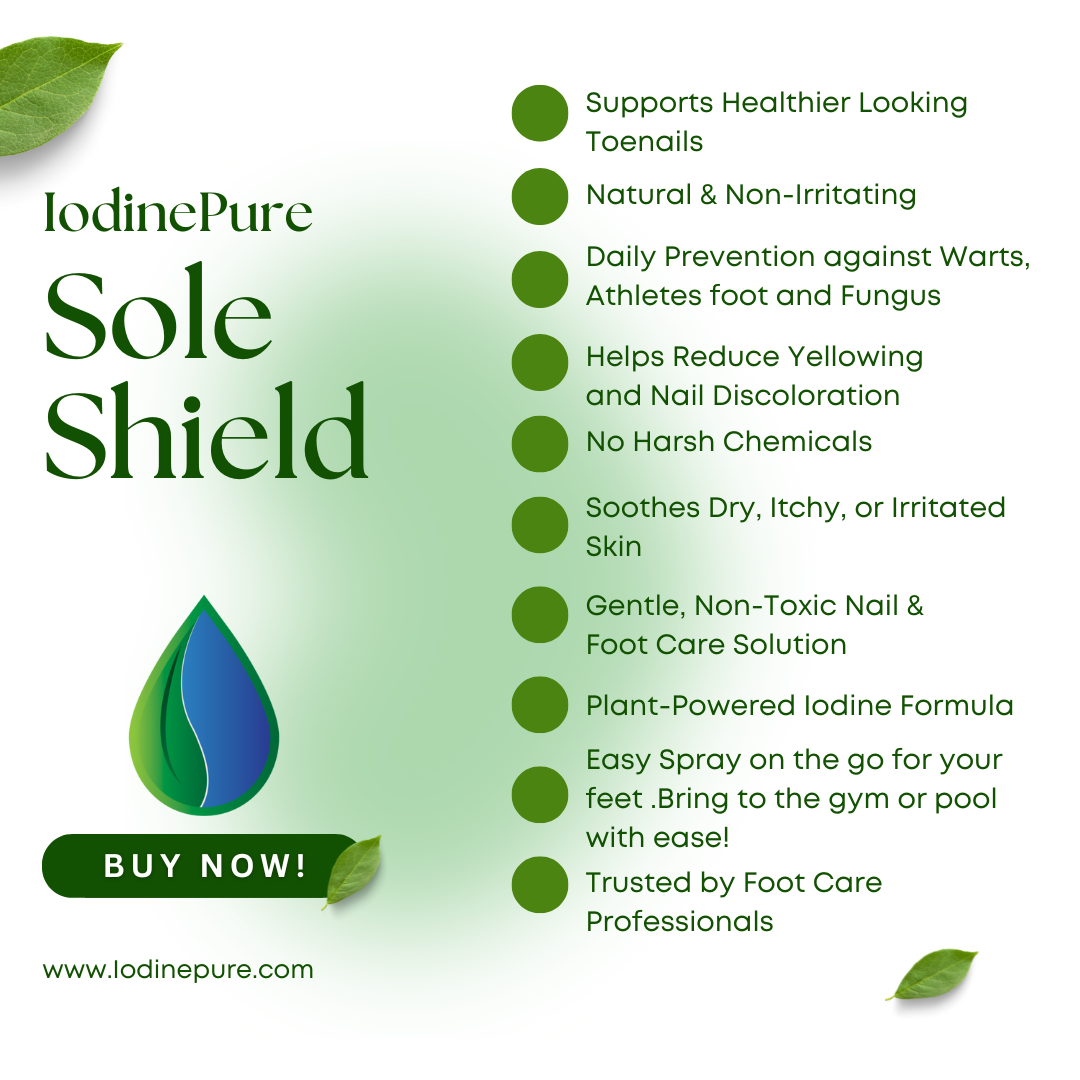
- Feet and shoes. The daily exposure side, gym floors, hotel bathrooms, the inside of a work boot, is Sole Shield.
- Skin, minor cuts and scrapes. That is EZ Clear Skin, and it is the one that belongs in a family first aid kit, because it does not sting and does not stain a child's arm brown. If the reason you are standing in that aisle at all is that the antibiotic ointment you grew up with has quietly fallen out of favour, here is why Neosporin is no longer recommended the way it once was.
The thing that decides whether any of them is worth buying is whether you are still using it in week three. People rarely walk away from iodine because it stopped doing anything. They walk away because it hurt, or because it left a brown mark on everything, and a routine you quit in week two was never a routine.
And if you have already narrowed it down to two sprays rather than three iodine types, we put ours next to one of the better known ones in this comparison with Active Skin Repair.
Who this is not for
If you need a surgical prep, buy the surgical prep. If a clinician has specified a product and a concentration, use theirs. And if you want the brown to show you where you have painted, povidone-iodine does that and aqueous iodine does not, which for some people is a genuine reason to stay put.
For clinics and foot care practices
Professionals ask a narrower question: what can go home with a patient for daily use over weeks without an irritation call in between. IodinePure is listed with Health Canada as a cosmetic, made in a GMP-certified facility, and carried by more than 200 foot care clinics across North America. Wholesale terms and the commission structure are on the For Clinics page.
Related reading: iodine vs iodide vs Betadine vs aqueous iodine, and why some iodine stains and some does not.
Frequently Asked Questions
What is a good alternative to Betadine?
It depends on the job. For a clinical procedure, use whatever your clinician specified. For daily cosmetic care of skin, feet and nails over weeks or months, aqueous iodine is water-based rather than alcohol-based, which is why it does not sting or leave a brown stain on skin.
Is decolorized iodine gentler than Betadine?
Not in the way most people assume. The FDA-registered DailyMed label for a product sold as Decolorized Iodine lists 45% alcohol and still warns that it will stain skin and clothing.
Can I use iodine instead of Betadine?
Not for a clinical procedure, where the product and concentration were chosen for a reason. For daily cosmetic use on skin, nails and feet, a water-based aqueous iodine is designed for exactly that repeated, long-term use.
What is the difference between povidone-iodine and aqueous iodine?
Povidone-iodine carries iodine on a polymer that releases it slowly, and standard 10% labels register it as a healthcare antiseptic for skin preparation prior to surgery. Aqueous iodine is iodine dispersed in distilled water with nothing else added.
What can I use instead of Betadine on a wound?
For anything deep, dirty or slow to close, ask a clinician rather than choosing from a shelf. For minor everyday cuts and scrapes, EZ Clear Skin is the IodinePure product intended for skin, and it does not sting, which matters most on children.
I am allergic to Betadine. What should I use?
Speak to your doctor or pharmacist. A reaction may be to the iodine, to the povidone carrier or to another component of a specific formulation, and working out which one is a clinical question rather than a shopping one.
Is there a Betadine alternative at home?
Not a good one, and the usual kitchen suggestions do not hold up. Salt water is a rinse rather than an antiseptic. Hydrogen peroxide foams on contact and is rough on healthy tissue at the same time, which is why most modern wound care guidance moved away from it. Tea tree oil sensitises plenty of people. If you want a Betadine alternative at home in the sense of something already in the cupboard, clean running water and a clean dressing beat all three.
What is a povidone iodine substitute?
In a clinic, chlorhexidine and alcohol preps are the two most likely swaps, and both are the clinician's call rather than yours. If what you want is a povidone iodine substitute for daily use at home on skin, feet and nails, that is aqueous iodine: the same element carried in water instead of on a polymer.
What is the best Betadine alternative in Canada?
Canadian pharmacies stock povidone-iodine widely and decolorized iodine barely at all, so a Betadine alternative in Canada usually comes down to povidone-iodine or a cosmetic aqueous iodine. IodinePure is listed with Health Canada as a cosmetic and sells in Canadian dollars on the Canadian storefront, which is the practical difference at the till.
What is the best Betadine alternative in USA pharmacies?
US shelves carry more of everything, including the decolorized iodine that Canadian pharmacies mostly skip, so a Betadine alternative in USA searches turns up a longer list. That widens the choice without changing the decision. A store-brand 10% povidone-iodine is the like-for-like swap, and aqueous iodine is the option built for daily use rather than a three-day prep window.
About the Author
This article was written and reviewed by Evan Lewis, PhD, who specialises in natural and nutritional therapies for the prevention and management of chronic disease and its complications, with a focus on clinical nutrition and nerve health.
IodinePure products are listed with Health Canada as cosmetics and support the appearance of clearer, healthier looking nails and skin. Label details quoted above come from each manufacturer's own published labelling.