Last updated 9 August 2026. Written and reviewed by Dr. Evan Lewis, PhD.
Ingrown toenail surgery aftercare is mostly dressing changes and a soak for the first two to four weeks, exactly as your clinic instructed, and then a much longer stretch where the toe is closed and the nail edge is growing back. What was done to the base of the nail decides how that second stretch goes.

Which procedure did you actually have?
Three things get called ingrown toenail surgery, and they are not the same operation.
Partial nail avulsion removes the offending strip of nail and leaves the matrix underneath alone, so that strip grows back. Chemical matrixectomy removes the strip and then treats the matrix beneath it with phenol so it does not. Laser matrixectomy does the same job with a different tool.
The reason to know is in the numbers. StatPearls reports that simple nail avulsion has the highest recurrence rate at 70%, and that chemical and laser matrixectomy both come in lower than mechanical matrixectomy. If your clinic used phenol, you have bought yourself a permanently narrower nail and a much better chance of never doing this again.
Does chemical matrixectomy aftercare differ from partial matrixectomy aftercare?
The daily routine is the same for all three. What changes is how long it runs and what you are watching for. Partial matrixectomy aftercare, where only the strip of nail came out, is usually the shortest, because there is no chemical involved and the strip starts regrowing straight away.
Phenol matrixectomy aftercare tends to run longer, commonly three to six weeks of dressing changes and soaks. Phenol works by destroying the sliver of matrix under the removed strip, and that treated spot often weeps clear fluid for a couple of weeks afterwards. Clinics expect that. It is the thing patients ring about most.
Chemical matrixectomy aftercare and laser matrixectomy aftercare look much the same day to day. Whichever you had, the sheet from the clinic that did it beats anything you read online, including this page.
What is the ingrown toenail surgery aftercare soak for, and what goes in it?
The soak keeps the area clean and softens the dressing so it lifts off without pulling. Clinics differ on what they put in it. Warm salt water is common. So is a dilute povidone-iodine soak, which is what most people mean when they say a Betadine soak.
Use what your clinic told you to use, in the dilution they gave you, for as long as they said. This is the one part of the process where improvising is genuinely a bad idea, because the concentration and the duration are the whole point of the instruction.
One detail worth knowing if you were sent home with a povidone-iodine product: the standard 10% label lists it as a healthcare antiseptic for preparation of the skin prior to surgery, and tells you to stop and ask a doctor if irritation and redness develop, or if the condition persists more than 72 hours. Your clinic is prescribing a longer course than the retail label describes, on purpose. That is normal, and it is also why you follow their timeline rather than the box.
How long before it stops hurting?
The first night is usually the worst of it once the local anaesthetic wears off. Most people are markedly better within three or four days and describe it as tender rather than painful by the end of the first week.
Keep the foot up when you can for the first day or two. Throbbing is largely a gravity problem.
When can I swim, shower, or get it wet?
Showering with the dressing handled the way your clinic described is usually allowed early. Swimming is the part of ingrown toenail surgery aftercare people ask about most, and it is not the same thing as a shower. A pool, a lake, a hot tub or the sea means a healing toe sitting submerged in water you do not control, and that is the one to hold off on until your clinic confirms the skin has closed. For most people that is a matter of weeks, not days.
When can I go back to normal shoes and sport?
When nothing presses on the toe. Open shoes or a surgical shoe first, then a wide trainer with the laces slack across the toe box, then whatever you normally wear. Running and anything with a toe-off or a sudden stop comes last, and it is worth asking at your follow-up rather than guessing.
If you play a sport where the front of the shoe takes repeated impact, football and racket sports especially, that is exactly the load that produced the ingrown nail for a lot of people in the first place.
What does the nail look like as it comes back?
After a phenol matrixectomy the nail regrows narrower on the treated side, permanently. That is the intended result rather than a complication, although the first sight of it surprises people who were not told.
Growth is slow. Measured toenail growth is around 1.62mm a month (Yaemsiri and colleagues, JEADV 2010), so the edge takes months rather than weeks to look settled. Our fuller guide to the at-home care window after a nail is removed covers that regrowth stretch in detail.
Worth being clear about the division of labour here. The surgery deals with the nail edge. Whether the toe stays comfortable after that is decided by how the nail is cut and what goes in the shoe for the next year, and both of those are yours.
How do I stop it happening on the other side, or the other foot?
Cut straight across, not curved down into the corners, and not shorter than the end of the toe. Leave the corner alone even when it is tempting. Give the toe box room, because a shoe that squeezes the forefoot pushes the nail fold into the nail all day.
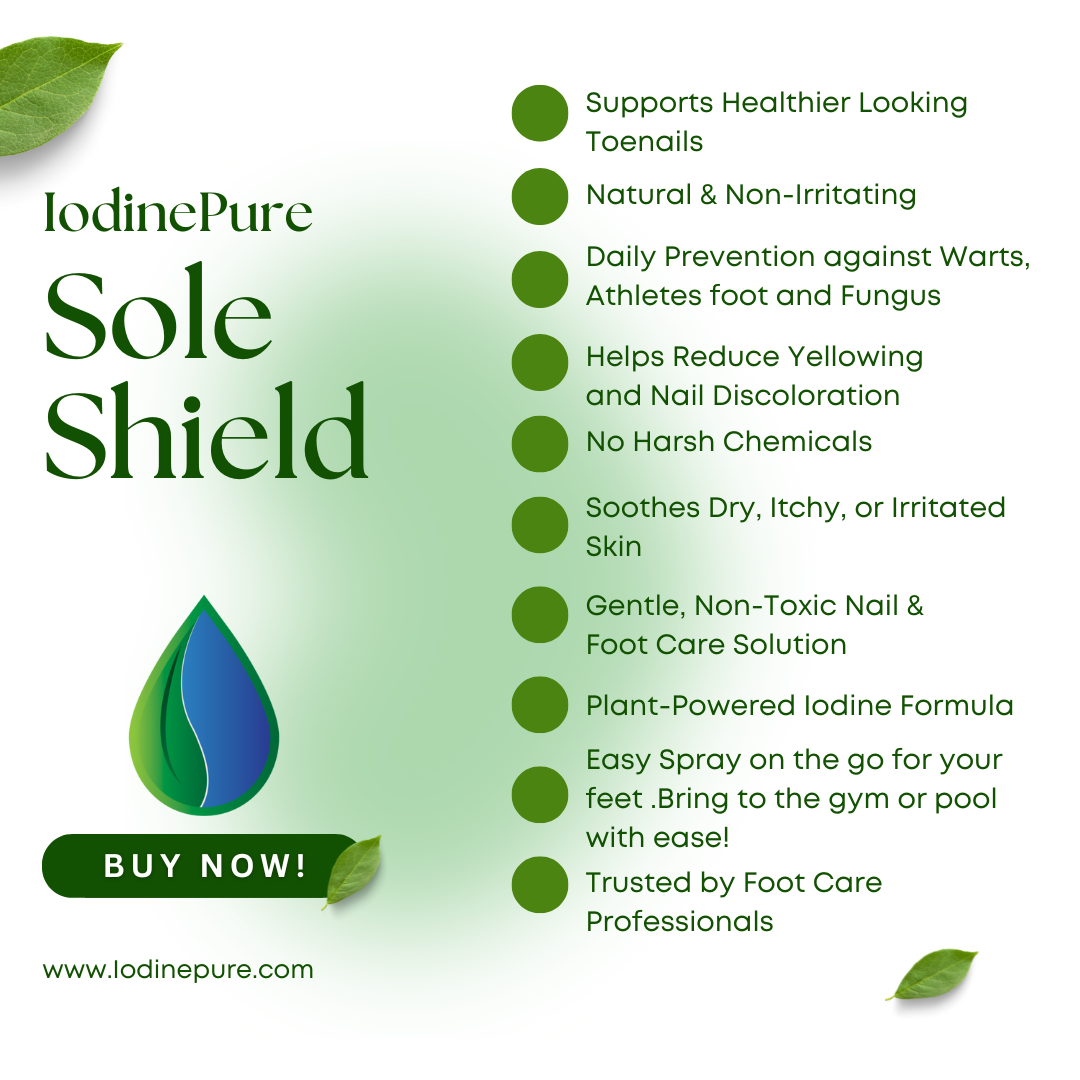
Damp is the other half. A foot that spends the day sweating inside a work boot has softer skin at the fold and takes an ingrowing edge more easily. Drying properly between the toes is the free part of that, and a daily spray such as IodinePure Sole Shield on the feet and inside the boot is the part most people skip.
Is aftercare handled differently in Canada and the United States?
In Canada, the procedure may have been done by a podiatrist, or by a chiropodist if you are in Ontario, where that is a separate regulated profession. Routine nail care afterwards is very often an advanced foot care nurse, sometimes visiting you at home. Our guide to what a foot care nurse does sets out who does what.
In the United States it was almost certainly a podiatrist, and the letters DPM mean a physician who prescribes and operates. What DPM actually means covers that.
The toe heals the same way in both countries. Who you call about it is what differs.
When to ring the clinic
Spreading redness, worsening swelling after the first couple of days, discharge, a smell, a fever, bleeding that will not settle, or pain that climbs after it had begun to fall. Call rather than wait it out. If you have diabetes, reduced circulation or reduced sensation, call earlier than you think you need to.
The months after, once the skin has closed
The wound stops being the subject fairly quickly. What is left is a nail edge growing back, the fold beside it, and a shoe going back on every morning for the next year.
IodinePure EZ Clear Nails is aqueous iodine, two ingredients, iodine and distilled water, used daily on the nail and the skin around it once the toe has closed. Being water-based rather than alcohol-based is the practical part here: it does not sting on skin that has just been through a procedure, and it does not leave a brown mark on the toe. It is listed with Health Canada as a cosmetic and over 200 foot care clinics across North America keep it on the shelf.
Who this is not for: anyone whose toe is still dressed, weeping or open. In that phase there is one instruction sheet that matters and it is the one your clinic gave you.
Is there an ingrown toenail removal aftercare PDF I can print?
There is a printable sheet on this site. It is a web page rather than a download, so print it from your browser and it does the job people want a PDF for. Our after a nail procedure take-home sheet puts the ingrown toenail surgery aftercare instructions, the healing weeks and the regrowth months on one page. Clinics are welcome to print it and hand it out at discharge.
For the clinics doing these procedures
The pattern is familiar: the patient follows week one to the letter, then does nothing for the eight months the nail is actually growing. IodinePure exists for that gap, and partner clinics earn a commission on what their patients buy at home rather than a discount on stock they have to carry. The For Clinics page has the terms.
Frequently Asked Questions
How long does ingrown toenail surgery take to heal?
The skin usually closes over within two to four weeks, and most people are comfortable within the first week. The nail edge itself takes months to regrow, at a measured rate of about 1.62mm per month.
What should I soak my toe in after ingrown toenail surgery?
Whatever your clinic told you to use, at the dilution and for the duration they specified. Warm salt water and dilute povidone-iodine are both common instructions. This is not a step to improvise on, because the concentration and the timeline are the instruction.
When can I swim after ingrown toenail surgery?
Not until your clinic confirms the skin has closed, which is usually weeks rather than days. Showering with the dressing managed as instructed is generally fine much earlier, but submerging a healing toe in a pool, lake or hot tub is a different thing.
Will my toenail be narrower after a phenol matrixectomy?
Yes, permanently on the treated side. That is the intended outcome. Phenol treats the matrix under the removed strip so that edge does not grow back, which is why recurrence is lower than after a simple avulsion.
Why does an ingrown toenail come back after surgery?
Most often because the matrix was left intact. StatPearls reports simple nail avulsion has the highest recurrence rate at 70%, with chemical and laser matrixectomy lower than mechanical matrixectomy. Cutting technique and shoe width also play a part.
When can I wear normal shoes after ingrown toenail surgery?
When no shoe presses on the toe. Work up from an open or surgical shoe to a wide trainer with slack laces before returning to your usual footwear, and leave running and stop-start sport until your follow-up appointment.
About the Author
This article was written and reviewed by Evan Lewis, PhD, who specialises in natural and nutritional therapies for the prevention and management of chronic disease and its complications, with a focus on clinical nutrition and nerve health.
IodinePure products are listed with Health Canada as cosmetics and support the appearance of clearer, healthier looking nails and skin. This article is general information and does not replace the instructions given to you by the clinician who performed your procedure.