Last updated 9 August 2026. Written and reviewed by Dr. Evan Lewis, PhD.
Toenail removal aftercare runs in two stages. For the first two to six weeks the toe is a healing wound, and your dressing, your soaks and any antiseptic come from the clinic that did the procedure. After the skin closes, it turns into a months-long cosmetic job: the new nail growing back in.

Most people leave the appointment with a sheet about the first week and nothing at all about the next nine months. That second stretch is the one nobody prepares you for, and it is where this guide spends most of its time.
What happens in the first window, and who decides it?
Your clinician does. The dressing, how often it changes, whether you soak the toe and in what, whether you need antibiotics, when you can get it wet: all of that belongs to the person who performed the procedure, because they saw what the nail bed looked like when they finished.
Standard practice varies between clinics and between countries. Some send you home with a salt-water soak. Many still use a dilute povidone-iodine soak, which is what most people mean when they say Betadine. Follow the sheet you were given. Nothing new goes near an open toe without asking them first.
How long does it take to heal after toenail removal?
The skin usually closes over in a couple of weeks for a partial removal, and can take up to about six weeks when the whole nail came off. Healing is not the same as finished. The toe can look completely normal months before the nail does.
Pain drops off fastest. Most people are noticeably more comfortable within a few days, and the throb that makes the first night unpleasant is usually gone by the end of the week.
When can I wear shoes and socks again after toenail removal?
Usually as soon as the dressing has come down to something a shoe will accommodate without pressing on it, which for a lot of people is the second week. The rule that matters is pressure, not time. If the toe box touches the toe, that shoe is too soon.
Practical order of return: open sandal or surgical shoe first, then a wide trainer with the laces slack over the toe box, then normal footwear last. Buy nothing new until the swelling has settled, because the toe you are fitting today is not the toe you will have in a month.
What about walking, driving, showering and swimming?
Walking is usually fine straight away in whatever footwear does not press on the toe, and elevating the foot for the first day or two takes the throb down. Driving depends on which foot and on whether you can brake hard without hesitating.
Showering and swimming are the two people get wrong. A quick shower with the dressing managed the way your clinic told you is one thing. Sitting in a pool, a lake or a hot tub with a healing toe is another, and that is the one to leave until they say the skin has closed.
What is a nail avulsion, and how is it different from a matrixectomy?
Nail avulsion means the nail plate, or a strip of it, is lifted off. The matrix at the base is left alone, so the nail is expected to grow back. Matrixectomy means the matrix under that strip is treated as well, chemically with phenol or with a laser, so that edge does not come back at all.
The distinction decides your next year. StatPearls reports that simple nail avulsion has the highest recurrence rate at 70%, with chemical and laser matrixectomy both lower than mechanical matrixectomy. If nobody told you which one you had, ask. It is a one-line answer and it changes what you are waiting for.
Most partial avulsions in adults are done for an ingrown nail, and if that is why you were in the chair, our home routine after ingrown toenail surgery walks the same two windows from that angle, including the soak question and when the shoe goes back on.
How long does a toenail take to grow back?
Longer than almost anyone expects. Measured toenail growth is about 1.62mm per month (Yaemsiri and colleagues, JEADV 2010). A big toenail is roughly 20 to 25mm from cuticle to tip, so a full replacement is somewhere around nine to twelve months of arithmetic.
That is the number to hold onto at week six, when the toe feels fine and the nail still looks like nothing. It is not going badly. It is going at 1.62mm a month.
It is worth setting the expectation before you get there, because six weeks is when most people quietly decide the whole thing has failed. The nail has barely started by then. Once you know the rate, week six stops being a disappointment and becomes a checkpoint.
What does the new nail look like on the way in?
Thicker at first, often ridged, sometimes a slightly different shape at the edge if a matrixectomy narrowed it. The first few millimetres out of the fold can look nothing like the rest of the nail and then even out as it lengthens.
If you want to cover the gap while it grows, read what to know before gluing anything to a damaged nail first, because the timing matters more than the product does.
Is aftercare different in Canada and the United States?
In Canada, the procedure may have been done by a podiatrist, by a chiropodist if you are in Ontario, or in some cases by a physician. Follow-up is often a short visit back to the same clinic, and in between, routine nail care is frequently handled by an advanced foot care nurse, including in your own home. If that is your situation, our guide to what a foot care nurse actually does explains who does what.
In the United States, it was almost certainly a podiatrist, and the letters after their name are DPM. That is a physician, and the follow-up structure usually reflects it. Our explainer on what DPM means covers the difference.
The wound care itself does not change at the border. The people and the paperwork do.
When should you call the clinic instead of managing it at home?
Spreading redness, swelling that gets worse rather than better after the first couple of days, discharge, a smell, fresh bleeding that will not settle, a fever, or pain that climbs after it had started to drop. Any of those, ring them.
If you have diabetes, reduced circulation or reduced sensation in your feet, keep the threshold low and stay on the follow-up schedule your clinic set. That is not caution for its own sake. It is the whole reason those schedules exist.
The routine that starts once the skin has closed
This is the second window, and it is the one you own. The toe is closed, the nail is coming in, and for the next several months the job is the appearance of the new growth, the skin around it, and the shoe it goes back into.
That is what IodinePure EZ Clear Nails is built for. It is aqueous iodine, two ingredients, iodine and distilled water, applied daily to the nail surface and the fold around it. Water-based means no alcohol, so no sting on skin that has recently been through something, and no brown stain on a toe you are about to put in a sock. It is listed with Health Canada as a cosmetic and it is on the shelf in over 200 foot care clinics across North America.
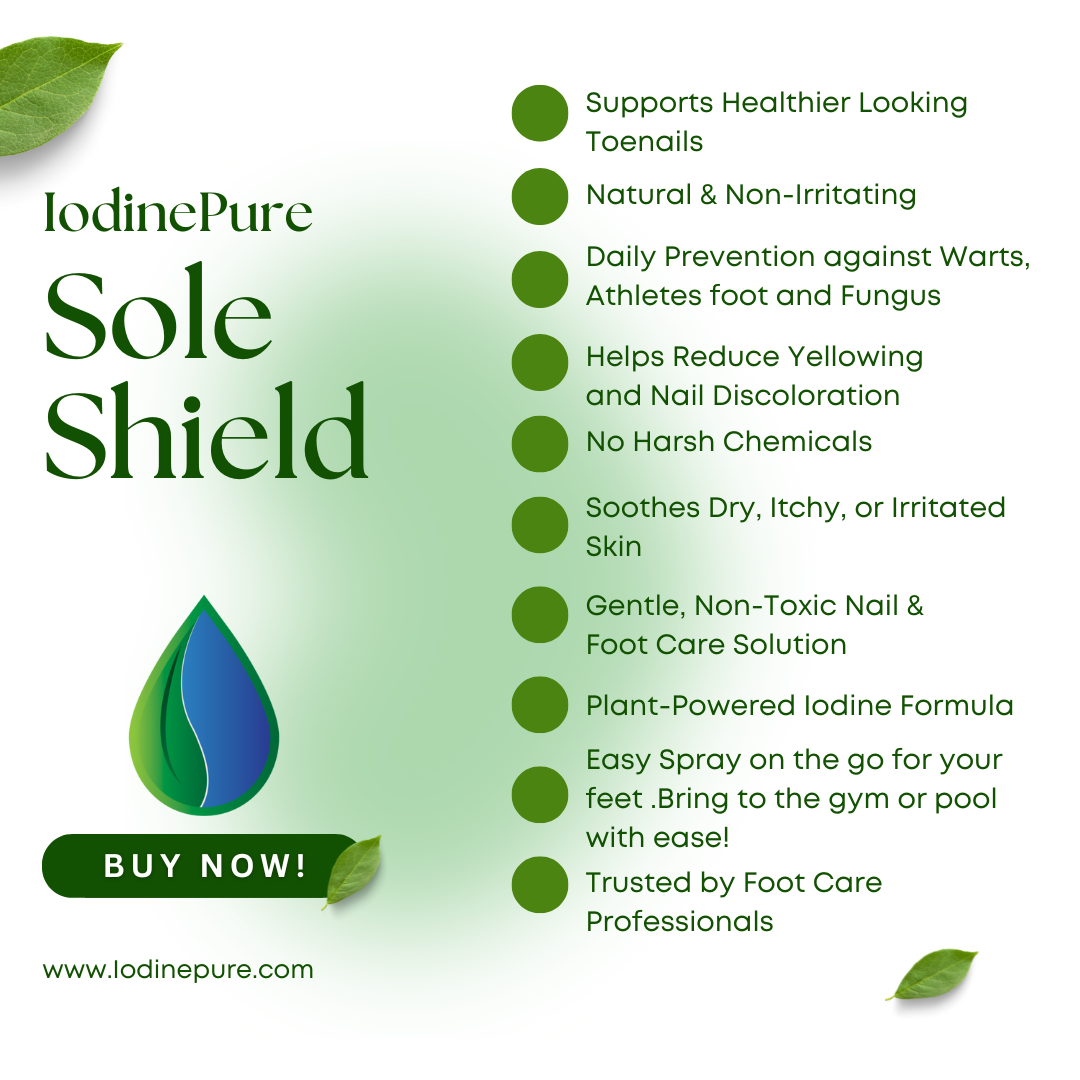
The shoe is worth a thought too. Footwear worn through the weeks before a procedure does not reset itself afterwards, and Gupta and Versteeg reported in JAPMA that recurrence and relapse rates for superficial fungal infections of the feet run between 10% and 53%. Spraying IodinePure Sole Shield inside the toe box is a thirty-second habit that deals with the half of the routine most people never think about.
Who this is not for: anyone still in the first window. If the toe is dressed, weeping or open, none of this applies yet. Wait for the skin, and wait for your clinician to say so.
Take the sheet with you
People search for a toenail removal aftercare PDF because the clinic sheet covers week one and stops. We wrote a plain-language take-home sheet for after a nail procedure that covers both windows on one page, and it prints cleanly. Clinics are welcome to hand it out.
It doubles as a nail avulsion after care instruction sheet, because the healing window is the same whether a strip of nail came off or the whole plate did. If the clinic already gave you a patient guide, keep it and follow it. This one is written to sit beside it and cover the nine months it does not mention.
For foot care nurses, chiropodists and podiatrists
If you perform these procedures, the sheet above is yours to use, and the gap it fills is the one you already see: the patient who follows week one perfectly and then does nothing for eight months. IodinePure is the take-home half of the appointment, and partner clinics earn a commission on what their patients buy rather than a discount on what they stock. Details are on the For Clinics page.
Frequently Asked Questions
How long does toenail removal aftercare last?
The wound part is roughly two to six weeks, depending on whether it was a partial or total removal. The regrowth part runs far longer. At a measured growth rate of about 1.62mm per month, a big toenail takes somewhere around nine to twelve months to grow out completely.
When can I wear normal shoes after toenail removal?
When the dressing is small enough that no shoe presses on the toe, which is often around the second week. Pressure is the test, not the calendar. Work up from an open shoe to a wide trainer with slack laces before going back to your usual footwear.
Can I put anything on the toe myself after the procedure?
Not while it is still an open or dressed wound. Everything that goes on it in that period should come from the clinic that performed the procedure. Once the skin has closed and the nail is regrowing, a daily cosmetic routine for the nail and surrounding skin makes sense.
Will my toenail grow back after it is removed?
After a simple avulsion, yes, because the matrix at the base is left intact. After a chemical or laser matrixectomy, that treated strip is meant not to return, so the nail regrows permanently narrower. Ask your clinic which procedure you had.
Why does my new toenail look thick and ridged?
New growth often comes in thicker and ridged for the first few millimetres, and can look quite unlike the rest of the nail before it evens out with length. A matrixectomy also changes the shape at the treated edge, which is expected rather than a problem.
What does post nail avulsion care involve?
Two different jobs, in order. While the toe is still a dressed wound, post nail avulsion care is whatever your clinic set out: the dressing schedule, the soak if they gave you one, keeping pressure off it, and the follow-up visit. Once the skin has closed, it becomes regrowth care, which is looking after the nail plate coming in and the fold of skin around it for the nine to twelve months a big toenail takes to fill back out. Ask your clinic which of the two you are in before you change anything.
Is there a printable toenail removal aftercare sheet?
Yes. Our take-home sheet covers both the healing weeks and the regrowth months on a single printable page, in plain language, and clinics are welcome to give it to patients.
About the Author
This article was written and reviewed by Evan Lewis, PhD, who specialises in natural and nutritional therapies for the prevention and management of chronic disease and its complications, with a focus on clinical nutrition and nerve health.
IodinePure products are listed with Health Canada as cosmetics and support the appearance of clearer, healthier looking nails and skin. This article is general information and is not a substitute for the instructions given to you by the clinician who performed your procedure.