By Dr. Evan Lewis, PhD. Last updated 9 August 2026.
Athlete's foot is embarrassing, persistent, and contagious. You don't have to be an athlete to get it. You just need to take your shoes off in a locker room. Here's what the evidence supports, and how to stop the cycle restarting.
Most people treat athlete's foot once, feel relief after a few days, and then stop. Within weeks, it's back. This cycle isn't bad luck. It's biology. Understanding how this infection works is the difference between temporary relief and actually getting on top of it.
What Is Athlete's Foot?
Athlete's foot, medically known as tinea pedis, is a fungal infection of the skin caused by a group of organisms called dermatophytes. These are the same organisms responsible for ringworm, jock itch, and fungal nail infections. They're not dangerous in a life-threatening sense, but they're tenacious, uncomfortable, and highly transmissible. StatPearls puts tinea pedis at roughly 10% of the total population, which makes it one of the most common infections most people never mention to anyone.
Dermatophytes thrive in warm, moist, dark environments. The inside of a shoe after a workout is essentially a perfect incubator, and the same StatPearls review states plainly that "wearing occlusive shoes for extended periods predisposes patients to dermatophyte infections" and that "the risk of tinea infections is elevated with excessive sweating". Once the fungus takes hold on the outer layers of skin, it feeds on keratin, the protein that makes up your skin, hair, and nails, and spreads if left untreated.
The key thing to understand about athlete's foot is that it isn't a skin condition in the way dry skin or eczema is. It's an active infection with a living organism. That means it responds to treatment differently, and it means incomplete treatment leaves the infection in place to recover and spread.
What Are the Symptoms of Athlete's Foot?
Itching and burning between the toes after your shoes come off, with peeling or flaking skin in the toe webs. It is very commonly mistaken for dry skin, and moisturising it makes things worse rather than better.
The most common symptoms include:
- Itching, burning, or stinging between the toes, especially after removing shoes and socks
- Peeling, cracking, or flaking skin between the toes or on the soles
- Dry, scaly patches on the bottom or sides of the foot (often called the "moccasin" pattern)
- Redness and inflammation, particularly in the toe webs
- Blisters that weep fluid, more common in an acute vesicular presentation
- Thickened, discoloured skin in chronic cases
How to tell it apart from dry skin or eczema: dry skin usually responds to moisturiser within a few days and doesn't itch intensely after shoe removal. Eczema typically has a history of flare-and-remission linked to allergens or stress, and it often affects other body areas. Athlete's foot tends to be asymmetric (affecting one foot more than the other), clusters between toes, and worsens in warm weather or after prolonged shoe wear.
If you're unsure, a podiatrist or dermatologist can confirm the diagnosis, often from a visual exam alone, sometimes with a skin scraping.
Where Are You Most Likely to Catch Athlete's Foot?
Anywhere warm, wet and walked on barefoot. Pool decks and gym showers top the list, followed by hotel and dormitory bathrooms and shared training mats.
Tinea pedis spreads through contact with infected skin cells shed onto surfaces. The organisms can survive on floors, mats, and in footwear for extended periods, which is why certain environments are reliably higher risk than others.
1. Public Swimming Pools
Pool decks and changing rooms are consistently warm and wet. People walking barefoot shed skin cells continuously. Chlorinated pool water doesn't eliminate fungal spores on surrounding surfaces.
2. Gym Changing Rooms and Shower Stalls
High foot traffic, shared surfaces, and warm humid air make gym facilities one of the most common sources of transmission. Shower floors are the single highest-risk contact surface.
3. Hotel Showers and Bathrooms
Even well-cleaned hotel bathrooms pose a risk. Multiple guests use these spaces daily, and standard cleaning protocols are not designed to eliminate fungal organisms from grout and floor tiles.
4. University and Dormitory Bathrooms
Shared bathrooms with high turnover and variable cleaning frequency are a significant risk for students. First-year students who haven't previously been exposed are particularly vulnerable.
5. Yoga Studios and Martial Arts Gyms
Any space where barefoot practice happens on shared flooring, whether mats, hardwood, or carpet, creates transmission risk. Yoga studios and dojos are less commonly thought of as risk environments, but the combination of bare feet and group use makes them relevant.
Why Do Your Shoes Matter More Than the Floor?
Because the floor exposes you once, and the shoe re-exposes you every morning. The lining holds fungal material long after the skin looks better, which is what turns one infection into a recurring one.
Here's the reinfection cycle that keeps athlete's foot coming back:
- You pick up the fungus from a shared surface
- It takes hold on your skin and begins to colonise
- You treat the visible infection on your skin, and symptoms improve
- But the fungus has already shed into the lining of your shoes
- Every time you put those shoes on, you reintroduce the organism to freshly treated skin
- The infection comes back, and you assume the treatment failed
This is the single most overlooked factor in persistent athlete's foot. Treating only the skin without addressing the footwear environment means you are continuously reinfecting yourself. Effective athlete's foot care has to include the inside of your shoes.
Laundry is the other half of it, and the temperature matters more than people assume. Akhoundi and colleagues found dermatophyte conidia survived a 40 °C household wash and were removed at 60 °C, with freezing and heat drying both failing. Direct person-to-person transmission also occurs: Jazdarehee and colleagues, reviewing 90 papers, put transmission between household members at 44 to 47%, naming shared bathroom surfaces, footwear, towels and nail tools among the routes. Towels, socks and bath mats should be washed hot and separately during an active infection.
Athlete's Foot vs. Foot Fungus vs. Toenail Fungus
These three terms are often used interchangeably, but they describe different stages and locations of what is frequently the same infection.
Athlete's foot (tinea pedis) refers specifically to a dermatophyte infection of the skin of the foot, most commonly between the toes or on the sole.
Foot fungus is a general term that typically means the same thing as athlete's foot, though it's sometimes used loosely to describe any fungal issue on the foot, including nail involvement.
Toenail fungus (onychomycosis) is a fungal infection of the nail itself, the nail plate, nail bed, or both. It most commonly develops when athlete's foot on the surrounding skin is left untreated and the organism spreads to the nail. This is why the two conditions so frequently appear together.
The progression from skin to nail is important to understand. Skin infections respond much more readily to topical care. Once the fungus establishes itself in the nail, it is significantly harder to address because topical products have difficulty penetrating the nail plate, and because the nail itself only grows about 1.62mm a month, making a full grow-out a 12 to 18 month job on a big toenail. If you notice your toenails becoming thickened, discoloured (yellow, white, or brown), brittle, or separating from the nail bed alongside your skin symptoms, the infection has likely progressed, and you'll need to address both simultaneously.
Which Athlete's Foot Treatments Have Evidence Behind Them?
Four categories, in rough order of how they fit a daily routine: aqueous iodine, tea tree oil, OTC azoles and terbinafine, and prescription oral antifungals for severe cases. The right choice depends on severity, how long you have had it, and whether the nails are involved.
1. Aqueous Iodine (Daily Topical Use)
Iodine has one of the longest track records in wound care and skin antisepsis of any compound in medicine, going back to the 1800s. Reviewing the evidence in Antimicrobial Agents and Chemotherapy, Lepelletier and colleagues describe iodine as rapidly penetrating microorganisms and oxidising key proteins, nucleotides and fatty acids, with no observed link to resistance developing. These are findings about iodine as an ingredient, in the preparations each research group used. Unlike alcohol-based solutions, aqueous iodine, where iodine sits in water rather than alcohol, does not dry or sting skin with consistent daily application, which is the difference between a routine you keep and one you abandon.
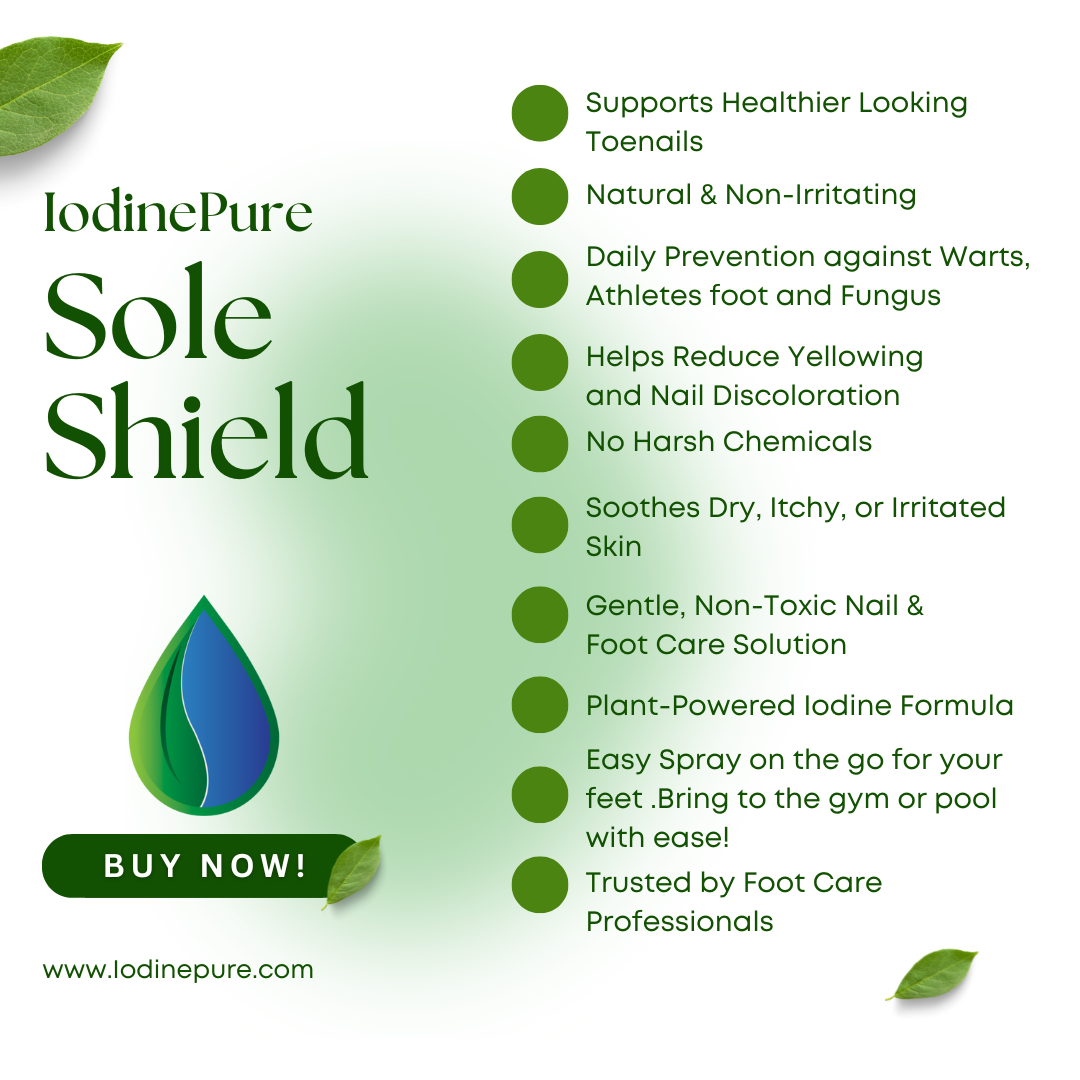
IodinePure's Sole Shield uses aqueous iodine in a cosmetic formulation listed with Health Canada. It's used in over 200 foot care clinics across North America and is designed for daily use on the feet and inside footwear, covering both the skin and the shoe in a single step.

2. Tea Tree Oil
Tea tree oil (Melaleuca alternifolia) has solid peer-reviewed evidence supporting its activity against dermatophyte fungi in controlled studies, with fewer side effects than pharmaceutical antifungals for most people. It's a well-supported home remedy option, though concentration and carrier matter; diluted, poorly formulated products may underperform.
3. Over-the-Counter Antifungals (Clotrimazole, Miconazole, Terbinafine)
These synthetic antifungal agents are effective when the diagnosis is confirmed as tinea pedis. Terbinafine in particular has strong clinical data. The main limitation is that people often stop treatment when symptoms resolve rather than completing the full course (typically two to four weeks). Irritation is the other reason courses end early: in a 250-patient study of topical treatment for another skin condition, Sevimli Dikicier found 45.6% stopped early and 37.7% of those stopped because of irritation, redness, scaling, itching or stinging.
4. Prescription Antifungals
For severe, widespread, or treatment-resistant infections, a physician may prescribe oral antifungals such as terbinafine or itraconazole. These carry systemic side effect profiles that aren't appropriate for routine athlete's foot but may be necessary when topical treatment has failed or when the infection involves the nails extensively.
Why Does Athlete's Foot Keep Coming Back?
Because recurrence is the norm, not a personal failure. Gupta and Versteeg, writing on shoe and sock sanitisation, report that "recurrence and relapse rates associated with superficial fungal infections are high (10%-53%)". The reasons are structural:
- The shoe problem. As described above, the shoe lining retains fungal material long after the skin infection clears. Without addressing footwear, reinfection is almost inevitable.
- Incomplete treatment duration. Skin that looks and feels better is not necessarily clear of infection. Dermatophytes retreat to lower skin layers before they are fully eliminated, and stopping too early gives them the opportunity to re-establish.
- Shared home environments. Bath mats, shower floors, and towels in a shared household can transmit the infection between household members, at rates Jazdarehee and colleagues put at 44 to 47%. One person treating while others don't creates a cycle.
- Continued exposure without protection. If you frequent gyms, pools, or communal showers without protective footwear, you are regularly reexposed to the organism regardless of whether your current infection is clear.
- Skin-only care when nails are involved. If athlete's foot has spread to a toenail, treating only the surrounding skin will not resolve the nail reservoir. The nail continues to shed fungal material onto cleared skin, restarting the cycle.
What Does a Daily Foot Routine Look Like for Active People?
Three principles: keep feet dry, cover them in shared spaces, and treat the shoe as part of the routine rather than an afterthought.
The daily routine that works for active people:
- Apply Sole Shield to feet and the inside of shoes daily, before or after your workout, as part of your existing hygiene routine. This is the 60-second habit most people skip.
- Wear moisture-wicking socks and change them after exercise. Cotton retains moisture; merino wool and synthetic athletic fibres wick it away. Wash them at 60 °C on the evidence above.
- Wear sandals or flip-flops in all communal shower and pool deck areas. This is non-negotiable if you're in a high-risk environment regularly.
- Rotate your footwear. Shoes need time to dry between uses. Wearing the same pair daily keeps the interior environment chronically damp, ideal for fungal survival.
- Wash gym bags, yoga mats, and sports gear regularly. These surfaces carry and transmit fungal material just as floors do.
Which Groups Are Most at Risk?
Anyone whose feet spend long hours in closed shoes, or bare on shared floors. Four groups see it most.
Nurses and Healthcare Workers
Long shifts in closed footwear on hard floors create persistently warm, moist shoe environments, exactly the occlusion-plus-sweat combination StatPearls names. Frequent hand-washing and general hygiene awareness doesn't translate to foot care. Compression socks, while excellent for vascular health, further reduce air circulation. A daily routine for footwear and feet before and after shifts matters most for this group.
Martial Artists
Barefoot training on shared mats, sometimes for years, means consistent high-level exposure. Many martial arts gyms clean mats regularly but cannot eliminate fungal material entirely. Athletes who train multiple times per week need a consistent daily routine rather than reactive treatment after symptoms appear.
Swimmers
Pool decks and change rooms are the highest-risk environments in sports. The combination of wet surfaces, bare feet, and high volumes of people creates near-ideal transmission conditions. Wearing sandals to and from the pool and applying Sole Shield daily covers both the exposure and the footwear.
Gym-Goers
The average gym member uses shared shower facilities two to four times per week during active training periods. That's regular, repeated exposure. Weight rooms, stretching areas, and locker rooms all involve the same floor surfaces. Barefoot training in CrossFit-style facilities adds additional mat contact. A consistent daily foot care routine works better for this group than intermittent treatment after symptoms appear.
Frequently Asked Questions
What helps target athlete's foot most effectively?
There is no single option that works immediately for everyone. Aqueous iodine, tea tree oil, and OTC antifungals like clotrimazole or terbinafine all have evidence behind them. The key factor isn't which product you choose. It's consistency and duration. You need to continue for several weeks even after symptoms resolve, and you need to address your shoes, not just your skin.
How do people get athlete's foot?
By walking barefoot somewhere another person already has it. The fungus travels in shed skin cells, so it sits on pool decks, shower floors, changing room benches, hotel bathrooms and training mats, and it transfers on contact. After that the shoe does most of the work of keeping it. Households matter as much as public floors, with one review putting transmission between household members at 44 to 47%.
Can you get athlete's foot from swimming?
Not from the water. Chlorinated pool water is not where the risk sits. It is the deck, the changing room floor and the shower stall, all warm, wet and walked on barefoot by everyone else who swims there. Sandals from the changing room to the pool edge and back remove most of the exposure.
Can you get athlete's foot from sharing a shower?
Yes, and it is one of the more common routes inside a household. A shared shower floor, a shared bath mat and a shared towel all move skin cells between people. During an active infection, wash towels, socks and bath mats hot and separately, and have the affected person shower last where that is practical.
Can kids get athlete's foot?
They can, and it shows up most in school-age children who swim, do gymnastics, or play sport in closed shoes. It looks the same as it does on an adult, peeling and itching in the toe webs, and it gets blamed on dry skin just as often. A child with a spreading, blistering or painful rash should be seen rather than self-treated, and anything on a toddler is a doctor's call.
Do nurses get athlete's foot?
More than most groups, for structural reasons rather than hygiene ones. Twelve hours in closed non-slip footwear on hard floors is exactly the occlusion-plus-sweat combination StatPearls names as a risk factor, and compression socks reduce air circulation further. The step that helps is the one done at the end of a shift, on the feet and inside the shoes, rather than at the start of the next one.
What do athlete's foot small blisters on feet mean?
Usually the vesicular form of it, which behaves differently from the peeling-between-the-toes version. Small fluid-filled blisters appear in a crop, often on the instep or the sole, and they can itch or sting hard. Do not deliberately pop them, because open skin is a route in for bacteria. If they are spreading, weeping, painful, or there is redness climbing the foot, that is a same-week appointment rather than a shelf product.
Can athlete's foot go away on its own?
Occasionally very mild cases resolve without treatment, but this is the exception. In most people, an untreated athlete's foot infection will persist, spread to cover more of the foot, and may progress to the toenails. The longer it's left, the harder it becomes to address. Care is recommended even for mild presentations.
Does iodine help with athlete's foot?
Iodine is one of the oldest and best-studied topical antimicrobials available. Lepelletier and colleagues describe it as rapidly penetrating microorganisms and oxidising key proteins, nucleotides and fatty acids, with no observed link to resistance. Those are findings about iodine as an ingredient, in the preparations the researchers used. Aqueous formulations suit daily use because they don't sting or dry the skin the way alcohol-based antiseptics do. IodinePure's Sole Shield is an aqueous iodine formulation developed for foot care and listed with Health Canada as a cosmetic.
How long does athlete's foot last?
With consistent care, mild to moderate athlete's foot typically shows meaningful improvement within two to four weeks. Keep the routine going for at least four weeks, or until the skin has fully returned to normal plus one additional week, because Gupta and Versteeg report recurrence and relapse rates of 10% to 53% for superficial fungal infections of the feet. Cases involving the nails take considerably longer, because the nail has to grow out at about 1.62mm a month.
Is athlete's foot the same as foot fungus?
Essentially, yes. "Foot fungus" is a colloquial term for the same condition, tinea pedis. Both refer to a dermatophyte fungal infection of the skin of the foot. "Toenail fungus" (onychomycosis) is a related but distinct condition where the infection has spread to the nail itself. They are caused by the same organisms and frequently occur together, but they need different approaches because the nail is much harder to penetrate with topical agents.
Ready to Break the Cycle?
If you've been dealing with recurring athlete's foot, the answer isn't a stronger product. It's a more complete routine. You need to cover the skin and the shoe, consistently, for long enough to break the loop.
IodinePure's Sole Shield + EZ Clear Nails combination was built for exactly this situation. Sole Shield goes on the skin and inside your shoes in a single daily step. EZ Clear Nails supports the look of clearer nails if the problem has already reached your nails, which is common in people who've had recurring athlete's foot for months or years.
If you're noticing any nail thickening, discolouration, or brittleness alongside your skin symptoms, start both. Addressing only the skin while the nail remains affected is one of the most common reasons athlete's foot keeps returning.
Both products use aqueous iodine in cosmetic formulations listed with Health Canada. They're trusted in over 200 foot care clinics across North America, and they fit into a daily routine in under 60 seconds.
References
- StatPearls. Tinea Pedis. NCBI Bookshelf NBK470421
- Lepelletier D, Maillard JY, Pozzetto B, Simon A. Povidone iodine: properties, mechanisms of action, and role in infection control. Antimicrob Agents Chemother. 2020. PMC7449185
- Akhoundi M, Nasrallah J, Marteau A, Chebbah D, Izri A, Brun S. Effect of household laundering, heat drying, and freezing on the survival of dermatophyte conidia. J Fungi. 2022;8(5):546. PubMed 35628801
- Jazdarehee A, Malekafzali L, Lee J, Lewis R, Mukovozov I. Transmission of onychomycosis and dermatophytosis between household members: a scoping review. J Fungi. 2022;8(1):60. PubMed 35050000
- Gupta AK, Versteeg SG. The role of shoe and sock sanitization in the management of superficial fungal infections of the feet. J Am Podiatr Med Assoc. 2019. PubMed 29521517
- Sevimli Dikicier B. Topical treatment of acne vulgaris: efficiency, side effects, and adherence rate. J Int Med Res. 2019;47(7):2987-2992. PubMed 31122106
- Yaemsiri S, Hou N, Slining MM, He K. Growth rate of human fingernails and toenails in healthy American young adults. J Eur Acad Dermatol Venereol. 2010. PubMed 19744178