Last updated 9 August 2026. Reviewed by Dr. Evan Lewis, PhD.
The top shoes for nurses in 2026 come down to six things: arch support, heel cushioning, slip resistance, breathability, a wipeable upper, and toe room. Nursing is one of the most physically demanding careers in existence. Twelve-hour shifts. Concrete-equivalent hospital floors. Minimal time to sit down. At the end of it, your feet carry evidence of every hour.
The right nursing shoe makes a measurable difference to how you feel at hour six, at hour ten, and when you finally get home. But the shoe is only part of the answer, and it is, arguably, the part most shoe companies want you to focus on because that is what they sell.
This guide covers what to look for in a nursing shoe in 2026, five picks by shift type, and, critically, the foot hygiene step that most nurses skip, which is often why athlete's foot, toenail fungus, and foot odour keep coming back regardless of how good their shoes are.
What Should You Look For in a Nursing Shoe?
Six things, in this order: arch support, heel cushioning, a slip-resistant outsole, breathability, a wipeable upper, and a toe box with room to swell into. Brand comes last.
Before brand or style, understand the mechanical requirements. Nursing shoes are solving a specific engineering problem: keeping your feet functional across a 12-hour shift in an environment that is demanding in almost every relevant way.
Arch Support and Heel Cushioning
Hospital floors are unforgiving. Beneath the vinyl or tile surface is concrete, and walking on concrete for 12 hours without adequate arch support is a direct path to plantar fasciitis, heel pain, and knee problems that compound over a nursing career.
Look for shoes with a structured EVA (ethylene-vinyl acetate) midsole. EVA is the gold standard for cushioning in footwear because it absorbs and returns energy without compressing flat over time like cheaper foam compounds. A contoured footbed, one that supports the arch rather than leaving it unsupported across a flat insole, is non-negotiable for long shifts.
Heel cushioning matters separately from arch support. The heel absorbs the initial impact of each step. In a 12-hour shift, a nurse walking moderate distances takes tens of thousands of steps. The cumulative impact load on inadequately cushioned heels is significant and is a major driver of the foot and ankle pain common in nursing.
Non-Slip Outsoles
This is not optional. Hospital floors, particularly in spill-prone areas like kitchens, patient rooms, and corridors near hand-washing stations, present real slip risk. OSHA standards for healthcare footwear address this for good reason.
A slip-resistant outsole uses a specific tread pattern and rubber compound designed to maintain grip on wet, polished, or contaminated tile. Not all "rubber soles" are the same. Look for shoes explicitly marketed as slip-resistant or with ASTM F2913 certification, which tests resistance on wet and contaminated surfaces.
Breathability
An enclosed shoe plus a 12-hour shift plus significant physical activity equals a warm, moist internal environment. This is not a speculation, it is basic thermodynamics. Body heat generated during activity raises the temperature inside the shoe; perspiration adds moisture; the enclosed design prevents evaporation.
That microclimate is not a minor detail. StatPearls, reviewing tinea pedis, states plainly that "wearing occlusive shoes for extended periods predisposes patients to dermatophyte infections" and that "the risk of tinea infections is elevated with excessive sweating", putting the condition at roughly 10% of the total population. Breathability features, like mesh panels, moisture-wicking linings, and ventilation channels, reduce (but do not eliminate) the moisture accumulation problem. This matters enormously, and it connects directly to the hygiene step covered later in this article.
Ease of Cleaning
Healthcare environments expose shoes to spills, fluids, and surfaces that require regular cleaning. Leather-equivalent or synthetic materials that can be wiped down are significantly more practical than fabric-heavy designs that absorb liquids and cannot be sanitised between shifts. Some nurses prefer a fully wipeable clog-style upper for exactly this reason.
Weight
The difference between a 300-gram shoe and a 500-gram shoe is invisible at hour one of a shift. At hour ten, lifting an extra 200 grams per step, thousands of times, translates to meaningful fatigue in the lower leg and foot. Heavier shoes are not inherently bad, they often provide better support structure, but weight is a real variable. Try to keep footwear under 350 grams per shoe for shift work where possible.
Toe Box Room
Feet swell during long shifts, typically by half a size to a full size, driven by blood pooling in the lower extremities during extended standing and walking. A shoe that fits perfectly in the morning can feel tight and painful by hour eight. Choose a toe box that allows your toes to spread naturally, and size up slightly if you are between sizes. Compression of toes over extended periods contributes to blisters, nail trauma, and ingrown toenails.

Which Nursing Shoe Suits Your Shift Type?
Clogs for general wards and long standing, athletic styles for high-movement units, fully wipeable enclosed shoes for ICU and surgical, and a proper walking shoe for community rounds.
Rather than recommending specific models that may change season to season, these are category recommendations, the type of shoe that best suits each shift scenario, with the features to look for. The brands listed are well-known representatives of each category, not paid recommendations.
1. Best Overall: The Classic Clog Style
Best for: general wards, extended shifts, nurses who want a proven format
The clog-style nursing shoe, typified by Dansko and similar Scandinavian-origin designs, has dominated nursing footwear for decades for good reasons. A rocker-bottom sole reduces the push-off effort required with each step, meaningfully reducing calf fatigue over long shifts. The structured upper provides genuine lateral ankle support. The wipeable leather or leather-equivalent exterior handles healthcare-environment cleaning requirements.
What to look for in this category: a reinforced toe box (protection in high-traffic environments), a rocker sole profile, genuine arch support in the footbed (not a flat insole in a clog shape), and a slip-resistant outsole. Weight tends to be higher in this category, so prioritise support and durability over lightness.
2. Best Athletic-Style Nursing Shoe
Best for: high-movement wards like emergency, paediatrics, surgical, any role requiring frequent rapid movement
Brands like Brooks, New Balance, and HOKA have developed healthcare-specific variants of their athletic shoe lines, combining the cushioning technology developed for running with the slip-resistant outsoles and durability needed for clinical environments. These are the best choice for nurses whose shifts involve frequent rapid movement rather than sustained standing.

What to look for: a healthcare-rated slip-resistant outsole (not just a standard athletic sole), maximum EVA or PEBA foam cushioning, a structured heel counter, and a breathable upper with moisture-wicking lining. These shoes sacrifice some lateral support for cushioning and movement, appropriate for active movement, less ideal for extended standing.
3. Best for ICU and Surgical
Best for: controlled environments, extended standing, infection control considerations
Intensive care and surgical environments have specific requirements: enclosed toe (no open-toe clogs in sterile settings), fully wipeable uppers, exceptional non-slip performance, and the ability to stand for extended periods without high steps-per-hour movement. Some surgical nurses wear two pairs on long call periods, rotating footwear to allow shoes to air out between uses.
What to look for in this category: a fully enclosed, wipeable upper (not mesh, as mesh cannot be adequately cleaned in clinical environments), ASTM-rated slip resistance, strong heel counter, and a firm but cushioned midsole suited to extended standing rather than running-style cushioning. Weight is less of a concern here given lower movement intensity, so prioritise support structure.
4. Best for Community Nursing and Home Visits
Best for: district nurses, community health, home care, with more varied terrain and more walking
Community nursing involves different physical demands: more outdoor walking, varied surfaces including uneven terrain and steps, public transport, and environments where a traditional clog or clinical shoe looks out of place. Comfort and versatility across terrain types are primary requirements.
A supportive walking shoe or light trail shoe with adequate arch support serves this category better than a traditional nursing clog. Waterproofing becomes relevant for outdoor use. Ankle support is more important than in flat hospital corridors. Look for healthcare-appropriate non-slip performance combined with genuine walking-shoe construction, a category where brands like Merrell, Ecco, and New Balance walking lines perform well.
5. Best on a Budget
For nurses who need a solid shoe without paying premium prices
Quality nursing footwear does not have to be expensive, but genuine compromises exist at very low price points. The minimum requirements for a budget nursing shoe that will not damage your feet over long shifts: a separate insole that can be replaced (flat insoles in budget shoes often compress rapidly, and a replacement insole significantly extends functional life), documented slip-resistant outsole (look for ASTM F2913 or equivalent certification on the product listing, not just "slip resistant" language), and a toe box with genuine room rather than a tight profile.
Avoid the lowest price tier entirely for nursing footwear. The cost of plantar fasciitis treatment, lost shifts, or chronic foot pain exceeds the savings on cheap shoes within a single year of nursing work.
What Are the Best Shoes for Sweaty Feet?
Whichever pair breathes best and gets a day off between shifts. If your feet sweat heavily, look for a mesh or perforated upper, a moisture-wicking lining, and a removable insole you can pull out to dry. Then buy two pairs and alternate them. A shoe that never dries fully is still damp at the start of the next shift, and damp is the condition fungus wants. In ICU and surgical settings where mesh uppers are not allowed, rotation and drying have to do the work breathability cannot.
Socks do as much work as the shoe here. Cotton holds sweat against the skin all shift. A merino or synthetic moisture-wicking sock moves it away from the foot, and a spare pair in your locker for a mid-shift change costs nothing and changes how the second half of a twelve-hour day feels.
Why Do Good Shoes Still Leave Nurses With Foot Problems?
Because the shoe is only half the loop. After twelve hours the inside of that shoe is warm, damp and enclosed, and putting clean feet back into it the next morning starts the cycle again.

Every nursing shoe list ranks the load. The seal is the half you inherit, and rotation plus a dry-skin routine is what closes it.
Every section above is about the shoe. The shoe matters, genuinely. But there is a variable in nurse foot health that has nothing to do with the shoe, and it is the reason many nurses who own excellent, expensive footwear still repeatedly develop athlete's foot, toenail fungus, and persistent foot odour.
Here is the physics of the problem: even the best nursing shoe, after 12 hours of wear, has created a warm, moist, enclosed environment on your feet. Breathability features reduce the severity, they do not eliminate the accumulation. By the end of a long shift, the interior of your shoe and the skin of your feet have been in an optimal fungal growth environment for hours.
Hospital floors are not sterile surfaces. They are high-traffic environments with consistent fungal spore and bacterial load. Healthcare workers are among the higher-risk populations for athlete's foot and toenail fungus precisely because of the combination of long enclosed shoe wear and exposure to heavily trafficked floor surfaces. Changing rooms, corridors, and locker areas add additional exposure.
The re-exposure loop is measurable. Akhoundi and colleagues found dermatophyte conidia survived a 40 °C household wash and were only removed at 60 °C, with freezing and heat drying both failing, which is why the scrubs-and-socks wash matters as much as the shoe. And Gupta and Versteeg, writing in JAPMA on shoe and sock sanitisation, note that "recurrence and relapse rates associated with superficial fungal infections are high (10%-53%)". If you take your shift home in your shoes and your laundry, the shoe you bought is doing half a job.
Most nurses who repeatedly develop foot fungal infections have perfectly good shoes. What they are missing is the post-shift hygiene step, and it takes 60 seconds.
The 60-Second Post-Shift Routine
Here is what nurses who have been doing 12-hour shifts for 10 years use on their own feet. It is not about their patients, it is about not being the one on the ward who keeps getting athlete's foot.
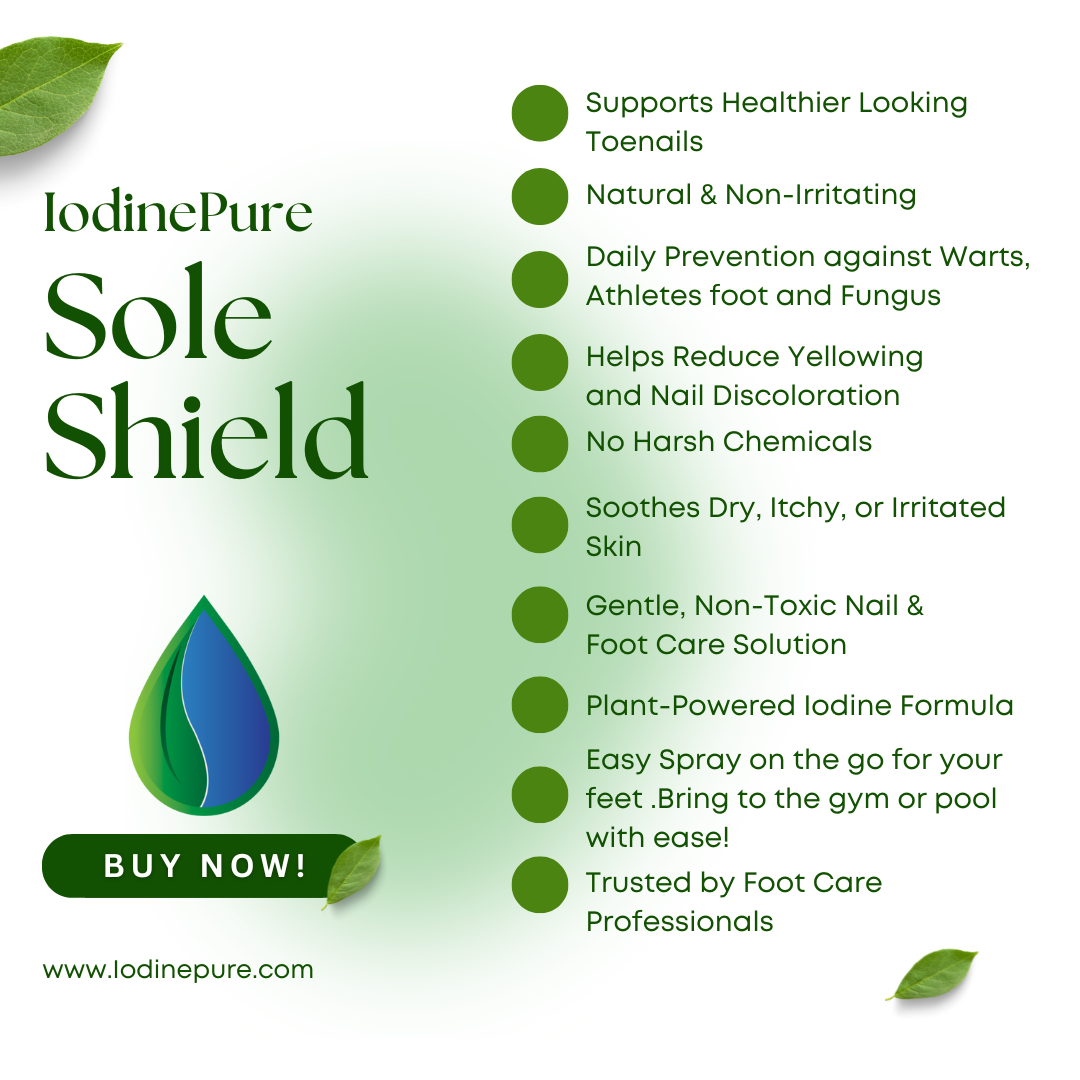
- Spray Sole Shield on your feet immediately after your shift, on soles, between toes, and around the nail margins. This is where fungal organisms establish first. The spray takes seconds to apply.
- Spray inside your nursing shoes. The interior of the shoe accumulates the same fungal load as your feet and becomes a reinfection source if left untreated between wears.
- Change to open footwear for your commute home. Sandals or open shoes allow your feet to air out after the enclosed environment of the shift. This is a simple step that makes a meaningful difference.
- Rotate your shoes. Give nursing shoes 24 hours to fully dry between shifts when possible. Fungal organisms require moisture. A dry shoe is a significantly less hospitable environment. Nurses who rotate between two pairs report far less trouble with shoe-driven reinfection.
- Wash socks and scrubs hot. On the evidence above, 60 °C is the line that matters, and a tumble dry is not a substitute.
This routine does not require significant time, investment, or lifestyle change. It requires remembering that the shoe is not the entire answer, and that the 60 seconds after you remove your shoes is the moment when the routine actually happens.
Frequently Asked Questions
What shoes do most nurses actually wear?
It varies significantly by specialty, personal preference, and budget. Clog-style shoes, particularly Dansko and comparable designs, remain extremely common in nursing because of their durability, support profile, and ease of cleaning. Athletic-style nursing shoes from brands like Brooks, HOKA, and New Balance have grown substantially in popularity over the past five years, particularly among younger nurses and those in high-movement specialties. The honest answer is that there is no single dominant choice, but the shared characteristics of well-designed nursing footwear are consistent: slip-resistant outsole, genuine arch support, and a footbed suited to extended wear.
Why do my feet hurt so much after nursing shifts?
Multiple factors converge in nursing shift foot pain. Concrete-equivalent flooring transmits impact forces that softer surfaces would absorb. Extended standing and walking without rest periods removes the recovery intervals that allow foot muscles and connective tissue to decompress. Feet swell over long shifts, increasing pressure in a fixed-volume shoe. And cumulative fatigue compounds shift by shift when recovery is inadequate. Addressing footwear is the highest-leverage intervention, specifically midsole cushioning for impact absorption, arch support to reduce plantar fascia strain, and toe box space to accommodate swelling. Beyond footwear, elevation during rest breaks and post-shift contrast soaking have evidence for recovery.
How do nurses take care of their own feet?
Nurses who maintain good foot health over long careers tend to share a few consistent habits: high-quality footwear with regular replacement (most nursing shoes lose meaningful cushioning performance after 6 to 12 months of shift use), shoe rotation to allow drying between shifts, moisture management during and after shifts, and a consistent post-shift hygiene routine. The hygiene routine, specifically addressing the fungal risk created by 12 hours of enclosed shoe wear, is the most commonly skipped step and the one with the highest return for the effort involved.
Do nurses get athlete's foot more often?
Healthcare workers, including nurses, are at higher risk for athlete's foot (tinea pedis) and toenail fungus (onychomycosis) than the general population. StatPearls notes that occlusive shoes worn for extended periods predispose people to dermatophyte infections, and that excessive sweating raises the risk further, which describes a twelve-hour shift precisely. Add heavily trafficked flooring and shared changing rooms and the exposure compounds. Many experienced nurses maintain a daily spray routine precisely because they understand what their working environment is doing to their feet.
How often should nursing shoes be replaced?
Most nursing shoes lose meaningful cushioning performance after 6 to 12 months of regular shift use, even if they still look structurally sound. Replacing footwear within this window preserves the impact absorption and support that protect against plantar fasciitis, heel pain, and knee problems. Worn outsole tread also means reduced slip resistance, which is a safety concern in clinical environments.
What is the best foot powder for nurses?
Powders absorb moisture, and for feet that sweat heavily through a shift that is worth something. Look for a plain absorbent powder, or a medicated one if your pharmacist suggests it. Two things to know. Powder cakes up once it gets wet, so it is a start-of-shift step rather than an end-of-shift one, and it sits on the surface of the skin rather than reaching the nail margins where fungal organisms take hold first. Nurses with recurring trouble tend to use powder in the morning and a spray on the feet and inside the shoes after the shift.
What Do Nurses Use on Their Own Feet After a Shift?
A two-ingredient spray, on the feet and inside the shoes, before the shoes go in the bag. IodinePure Sole Shield is that 60-second routine in a bottle: iodine and distilled water, no synthetic chemicals, no residue, no staining, applied to feet and inside shoes after every shift.

Shop Sole Shield: the post-shift foot spray nurses use on their own feet.
References
- StatPearls. Tinea Pedis. NCBI Bookshelf NBK470421
- Akhoundi M, Nasrallah J, Marteau A, Chebbah D, Izri A, Brun S. Effect of household laundering, heat drying, and freezing on the survival of dermatophyte conidia. J Fungi. 2022;8(5):546. PubMed 35628801
- Gupta AK, Versteeg SG. The role of shoe and sock sanitization in the management of superficial fungal infections of the feet. J Am Podiatr Med Assoc. 2019. PubMed 29521517
About the Author
This article was reviewed by Evan Lewis, PhD, who specialises in natural and nutritional therapies for the prevention and management of chronic diseases and complications, with a focus on chronic disease, diabetes complications, clinical nutrition, and nerve health.