Reviewed by Evan Lewis, PhD. Last updated August 2026.
To get rid of foot odor you have to treat three things at once: the skin between your toes, the socks, and the inside of the shoe. Washing your feet only clears one of the three, which is why the smell is back by lunchtime. Here is the order that actually holds.

Foot odour is one of those problems people quietly manage for years. They buy a spray that covers it for an afternoon, they wash more often, they throw out perfectly good shoes, and it comes back, because only one of the three places it lives ever gets touched.
Why do feet smell in the first place?
Sweat itself is close to odourless. The smell is what bacteria do to it.
Eccrine sweat glands are concentrated at the axillae, palms, soles and face, so the sole of the foot is one of the densest sweating surfaces on the body. Put that inside a closed shoe for eight hours and you have warmth, damp and no airflow.
The bacteria living there break down amino acids in sweat and dead skin, and the by-product is isovaleric acid. In a 2015 study mapping the microbial community across the foot, isovaleric acid was found on the plantar surface and was not detected on the top of the foot, with Staphylococcus making up 98.6% of the bacteria on the sole. The smell is coming from the bottom of your foot specifically, which is also the surface pressed into a shoe all day.
Fungus sits in the same conditions. Dermatophytes, the family behind athlete's foot, want exactly the same warmth and damp, and they digest keratin. Plenty of people with long-running foot odour have a skin component they have never looked for. Our guide to foot fungus covers that side in detail.
Why does foot odor keep coming back?
Because the shoe is never part of the routine.
Every wear deposits sweat, skin cells and microorganisms into the lining and the insole. Clean feet go back into an untreated shoe and the transfer starts again within minutes. The problem resets every morning, and no amount of washing gets ahead of it.
Socks are the second reservoir, and the fix there is temperature rather than frequency. When researchers contaminated 180 cotton pads with three Trichophyton species and put them through a domestic machine, a 40 °C wash left the fungus alive while 60 °C and 90 °C removed it. Tumble drying did not do it, and neither did a week in a freezer at minus 20. Most households wash socks at 30 or 40.
Locker rooms, pool decks and shared showers add a third route, and it is a floor rather than a shoe.
What does foot odor tell you about fungal risk?
This is the part almost every page on this subject skips, and it is the most useful thing here.
The two conditions that make feet smell are heavy sweating and hours in a closed shoe. Those are the same two things StatPearls names as risk factors for athlete's foot: "the risk of tinea infections is elevated with excessive sweating" and "wearing occlusive shoes for extended periods predisposes patients to dermatophyte infections". Tinea pedis affects roughly 10% of the population.
So the smell is not the whole problem. It is a readout on the environment, and it is the earliest one you get, because you notice a smell long before you notice peeling skin or a thickened nail. Treated as a signal rather than an embarrassment, foot odour is the cheapest early warning available for the conditions behind athlete's foot and nail damage.
Be careful with the inference in the other direction. Smelly feet do not mean you have a fungal infection, and there is no published figure for how often one leads to the other. The link is mechanistic: same warmth, same damp, same shoe.
What actually works for foot odor, ranked honestly
Ranked by how much of the problem each one reaches, not by what we sell.
1. Rotating and drying your shoes
The single highest-yield change, and it is free. Two pairs alternating halves the wear time and gives the interior a full day to dry. Unlace, pull the insole out, stand the shoe open somewhere with moving air. Heat is not required and warps glue.
2. A 60 °C wash for socks and removable insoles
See the laundering study above. If your machine has a 60 setting and your socks can take it, this is the cheapest evidence-backed step on the list.
3. Drying properly between the toes
Dab rather than rub, and work into the fourth space between the little toe and the one beside it. That gap is the tightest on the foot and the slowest to dry, which is why interdigital athlete's foot usually starts there.
4. Sole Shield, and what it is not
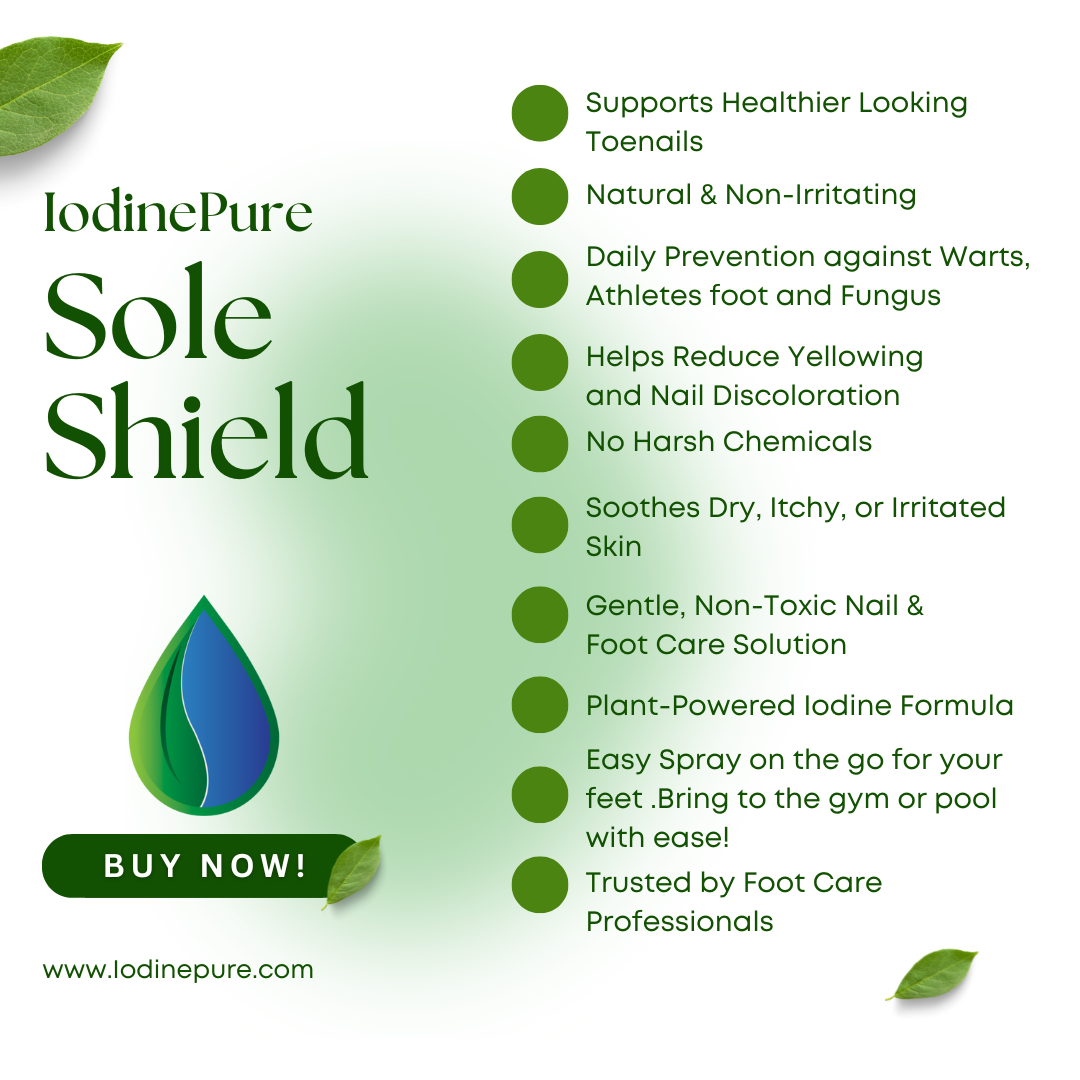
Sole Shield is two ingredients: aqueous iodine and water. It goes on clean, dry feet and into the shoe at the end of the day, so it reaches the two surfaces a wash cycle cannot, which is skin about to go back into a shoe and a shoe you are still wearing.
Two things it is not, and we would rather say them now than after you have paid. There is no fragrance in the bottle. Nothing in it is there to smell of anything, by design, so it will not leave your feet smelling of mint. And it is not a deodorant or an antiperspirant, so it has no effect on how much you sweat. If what you want is a fresh scent in thirty seconds, buy a powder. That is a different job and a powder does it better.
5. Fragranced powders and sprays
Credit where it is due: for the smell itself, right now, these are the fastest thing on this page. They work on your nose in seconds. What they do not do is change the damp or the skin, so tomorrow starts where today did. Used on already-damp feet they can make the next day slightly worse by adding to what is sitting in the shoe.
6. Activated charcoal insoles
Porous, and they absorb odour molecules from inside the shoe between wears. No effect on the skin, but a real reduction in what builds up in the footwear. Replace every few months, sooner once they hold a smell through a dry day.
7. Tea tree oil, diluted
Well documented antimicrobial properties in the literature, and it needs a carrier oil because neat tea tree oil irritates skin. Reasonable as a skin step, does nothing for the shoe.
8. Vinegar and baking soda soaks
Both shift the pH on the skin surface for a while, and evidence for either is thin. Dilute one part vinegar to two parts water, ten to fifteen minutes, and skip it entirely if the skin is split or sore.
How do you stop foot odor at the source, in the shoe?
If you only change one thing, change what happens to your shoes.

- Rotate two pairs. One pair worn daily never dries out fully between wears.
- Take the insoles out after every wear and dry them separately.
- Insoles and laces can go through a 60 °C wash. The shoe body usually cannot, so it gets brushed out, wiped, and rested with air rather than heat.
- Add a spray step to the inside of the shoe as part of the same habit, after the shoe is open, not instead of opening it.
- Replace insoles every three to four months, or sooner if the smell survives a full dry day.
We put the six popular shoe methods against the research in how to disinfect shoes. The freezer trick, which is the internet's favourite, is one of the ones that fails.
What if you are on your feet all day?
Long shifts compound every part of this: more hours in the shoe, more sweat, less recovery time between wears.
Athletes often pull the same trainers back on while they are still damp from yesterday. Nurses and healthcare workers spend twelve hours in closed footwear with nowhere to air anything out. Tradespeople in steel-toe boots get the most enclosed version of it.
For all three the answer is the same shape: two pairs in rotation, insoles out at the end of every shift, and the skin step done when the shoe comes off rather than at bedtime. If odour is not shifting on a routine that good, it is worth looking at the skin itself. Our complete guide to athlete's foot covers what to look for.
Why iodine and water instead of a fragranced spray?
Because they are aimed at different things, and it is worth being plain about which is which.
A fragranced spray is aimed at your nose. It is fast and it is honest about what it does. An iodine spray is aimed at the surface, and published research describes why iodine has been used on skin since the 1800s: it "rapidly penetrates into microorganisms and oxidizes key proteins, nucleotides, and fatty acids", with no observed link to resistance developing. That is a description of the element in the literature, not a promise about what happens inside your trainers.
The formulation matters more than the word on the label. If you have bought iodine at a pharmacy, "decolorized iodine" sounds like the gentle option and is not: the FDA-registered label lists 45% alcohol and warns that it will stain skin and clothing. Sole Shield is water-based, which is why it does not sting split skin between the toes and does not mark a white sock.
Two ingredients. No fragrance. Listed with Health Canada as a cosmetic, and on the shelf in 200+ foot care clinics across North America.
Frequently asked questions
What actually causes foot odor?
Bacteria breaking down sweat and dead skin inside a warm, closed shoe. Sweat on its own is close to odourless. The by-product of the breakdown is isovaleric acid, and in mapping across the foot it was found on the sole and not detected on the top, with Staphylococcus making up 98.6% of the bacteria down there.
Does foot odor mean I have athlete's foot?
Not on its own, no. But the two conditions that make feet smell, heavy sweating and hours in closed shoes, are the same two StatPearls lists as risk factors for tinea pedis. If the smell comes with itching, peeling between the toes, or a nail that has thickened or discoloured, that is worth looking at properly rather than washing harder.
How long does it take to get rid of foot odor?
Give a full routine two weeks before you judge it, and expect the shoes to lag behind the skin. A shoe that has been building up for a year does not reset in a night, and an insole that still smells after a dry day is usually past saving. If nothing has shifted in a month, the missing piece is almost always the footwear rather than the foot.
Why does foot odor come back even when I wash my feet?
Because washing reaches one of the three places it lives. The socks need a 60 °C wash rather than a 40, and the shoe needs opening up and drying between wears. Clean feet going into yesterday's shoe pick the problem straight back up.
Will Sole Shield make my feet smell nice?
No, and that is deliberate. There is no fragrance in it. It is two ingredients, iodine and water, so there is nothing in the bottle whose job is to smell of anything. If you want a fresh scent in the next minute, a powder does that better and we would rather tell you now.
What is the fastest way to reduce foot odor today?
Wash, dry hard between every toe including the fourth space, put on a clean pair of wool or bamboo socks, and wear a different pair of shoes to the ones you had on yesterday. Then open yesterday's pair, pull the insoles, and leave them somewhere with air. Today's smell is mostly today's shoe.
How do you get rid of smelly feet permanently?
Treat it as maintenance rather than a one-off fix. The bacteria behind the smell live on skin, in socks and in shoes, and all three restock every day you walk around. People who keep it away long term do the same four things without thinking: two pairs of shoes on rotation, socks washed at 60 degrees, feet dried properly between every toe, and something on the skin after a shower. Drop those for a fortnight in July and it comes back.
How do you get rid of calluses on feet?
Soften first, then go slowly. A warm soak, a pumice or foot file used gently on damp skin twice a week, then a urea cream to keep the skin soft. Do not take a blade to one at home, and if it is thick, sore, or you have diabetes or poor circulation, that job belongs to a foot care nurse or chiropodist. Callused skin matters for smell too, since thick dead skin holds moisture and gives bacteria more to feed on. Not sure what you are looking at? Here is how a plantar wart, a corn and a callus differ.
Read next
- Does smelly feet mean fungus? What the smell is telling you
- Why do my feet smell? The sweat, the bacteria and the shoe
- Why are my feet sweaty in winter? What causes sweaty feet
- Bromodosis: the medical name for smelly feet, in plain English
The bottom line
Three places, not one. The skin between your toes, the socks at 60 °C, and the shoe opened up and dried. Do those and you have covered more ground than any bottle will on its own.
See Sole Shield: two ingredients, no fragrance, for feet and the shoes they go back into.
Evan Lewis, PhD, specializes in natural and nutritional therapies for the prevention and management of chronic diseases and their complications, including the development of topical iodine therapy for foot care and wound health. IodinePure products are listed with Health Canada as cosmetics. This article is general information, not a diagnosis. If the skin is broken or weeping, if there is spreading redness or swelling, or if you have diabetes or poor circulation, see a professional rather than following a routine. Sources: Stevens D, et al. Spatial variations in the microbial community structure and diversity of the human foot is associated with the production of odorous volatiles. FEMS Microbiol Ecol. 2015;91(1). Nigam PK, Syed HA, Saleh D. Tinea Pedis. StatPearls. Hyperhidrosis. StatPearls. Akhoundi M, et al. Effect of Household Laundering, Heat Drying, and Freezing on the Survival of Dermatophyte Conidia. J Fungi (Basel). 2022;8(5):546. Lepelletier D, Maillard JY, Pozzetto B, Simon A. Povidone Iodine: Properties, Mechanisms of Action, and Role in Infection Control and Staphylococcus aureus Decolonization. Antimicrob Agents Chemother. 2020;64(9). DailyMed, Decolorized Iodine label.