Reviewed by Evan Lewis, PhD. Last updated August 2026.
Your shoes smell because bacteria are living in the lining and the insole, feeding on the sweat and dead skin left behind after every wear. Washing your feet does nothing to that colony. Until the shoe itself dries out properly and gets treated, the smell resets every morning.

Why do shoes smell even when your feet are clean?
Shoe odour is a microbiology problem, not a cleanliness one.
Two groups dominate inside footwear: Brevibacterium and Staphylococcus. They feed on sweat and dead skin in the warm, dark, enclosed space of a shoe, and the by-products are sulphur-containing compounds, chiefly isovaleric acid and methanethiol. In a 2015 study mapping the foot's microbial community, isovaleric acid was found on the plantar surface and was not detected on the top of the foot, with Staphylococcus making up 98.6% of the bacteria on the sole. The sole is the surface pressed into the shoe all day.
There is a reason the sole produces so much of the raw material. Eccrine sweat glands are concentrated at the axillae, palms, soles and face. Enclose the densest sweating surface on the body for twelve hours with no airflow and the interior never fully dries between wears. That is why shoe odour compounds over time rather than staying level.
Why doesn't washing your feet fix smelly shoes?
Because you are cleaning the source of the sweat and leaving the reservoir untouched.
You wash thoroughly at night. In the morning you put on yesterday's shoes, and within minutes the transfer runs the other way. By midday the cycle has reset. Your feet smell, your shoes smell, and nothing about your hygiene was wrong.
Socks are the second half of the same problem, and the fix is temperature rather than frequency. When researchers contaminated 180 cotton pads with three Trichophyton species and ran them through a domestic machine, 40 °C left the fungus alive while 60 °C and 90 °C removed it. Tumble drying did not do it, and a week in a freezer at minus 20 did not either. Most people wash socks at 30 or 40, and most people put removable insoles through no wash at all.
Do shoe deodorant sprays work?
For what they are aimed at, yes, and it is worth being straight about that.
Fragrance-based shoe sprays are aimed at your nose, and they reach it in seconds. Nothing else on this page is that fast. What they do not change is the damp or the population producing the sulphur compounds, so the fragrance fades in a few hours and the afternoon smells like the morning did. Some people find the combination of artificial scent over shoe odour worse than the original. That is also the catch with the Lume on feet hack.
Masking and addressing are two different jobs. Neither one is a fraud. They just do not substitute for each other, and if you buy one expecting the other you will be disappointed.
Which shoes smell worst, and why?
Not all footwear creates the same conditions.

- Boots: fully enclosed, minimal airflow, eight to twelve hours at a stretch. The interior stays warm and damp all day and takes the longest to dry overnight. StatPearls names occlusive shoes worn for extended periods as a predisposing factor for dermatophyte infection, and a work boot is the purest version of that.
- Athletic shoes: high sweat output during use, thick foam midsoles that hold moisture, mesh uppers that trap material in the fibres.
- Work shoes: enclosed like boots, worn in conditions that increase perspiration. Nurses, tradespeople and food service workers report persistent shoe odour despite good hygiene, because the hours are the variable, not the washing.
- Skates: dense padding, no ventilation, near-constant moisture. Usually the worst category of the lot.
Why do ski boots smell so much worse than shoes?
Because a ski boot is the worst version of every factor on this page at once. A rigid plastic shell with no airflow at all, a thick foam liner that soaks up everything, one pair of socks worn for eight hours of hard work, and then the whole thing gets buckled shut and thrown in a bag for the drive home.
The liner is the part that smells, and it is also the part most people never take out. Pull it. A liner stood on its own dries in a night, where the same liner left inside the shell is still damp on Saturday morning after drying since Thursday. Boot bags with a fan or a heated dryer do the same job faster, and heat should stay gentle, because liner foam and glue do not enjoy a radiator.
End of the ski day, before the drive: unbuckle everything, pull both liners, pull the footbeds out of the liners, and let all four pieces sit in moving air. Treat the inside of the liner at that point rather than in the morning, because you want the surface treated while it is drying rather than after it has spent the night wet. Then swap socks. One thin technical pair, not two, and never a cotton pair, which holds water against the skin and makes the liner wetter than it needs to be.
What does shoe odor tell you about fungal risk?
More than most people realise, and this is the part worth taking away.
The two things that make a shoe smell are sweat volume and hours enclosed. Those are the same two things StatPearls lists as risk factors for tinea pedis: "the risk of tinea infections is elevated with excessive sweating" and occlusive footwear worn for long stretches. Tinea pedis affects roughly 10% of the population.
A shoe you can smell from across the room is telling you the conditions inside it are the conditions dermatophytes want. That does not mean you have anything. It means the smell is an early, free readout on an environment that matters for more than your dignity, which is why odour is worth treating as a signal rather than a nuisance.
The environment also outlasts the wear. A 2022 scoping review found evidence of transmission in 44% to 47% of households with an affected member, and environmental persistence of up to 18 months, with recovery from slippers, sandals and socks. If it is in the house, the footwear is part of how it stays there. Our complete guide to athlete's foot covers what to look for on the skin.
Where Sole Shield fits, and what it is not
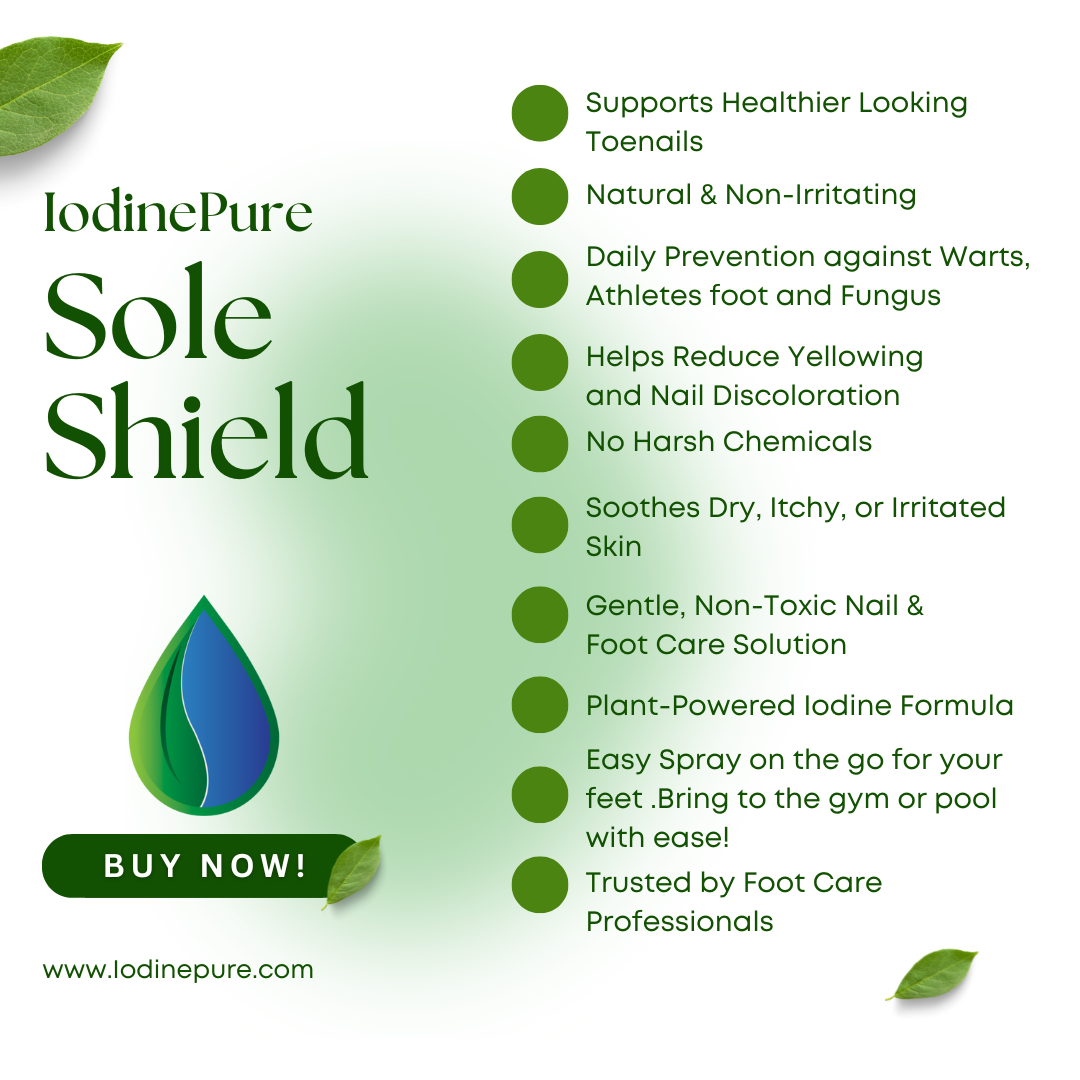
Sole Shield by IodinePure is two ingredients: aqueous iodine and water. It is made to go on clean, dry feet and into the inside of shoes, boots and skates, which are the two surfaces a wash cycle cannot reach.
Iodine has been used on skin since the 1800s, and published research describes why. It "rapidly penetrates into microorganisms and oxidizes key proteins, nucleotides, and fatty acids", with no observed link to resistance developing. That is a description of the element in the literature, not a promise about what happens inside your boots.
There is no fragrance in the bottle. Nothing in it is there to smell of anything, by design. So it will not do what a scented spray does, and it is not a deodoriser, not an antiperspirant, and not a surface disinfectant for floors or instruments. If what you want is a fresh scent the moment you spray, buy a fragranced product. That job belongs to a different bottle and we would rather say so before you order.
The formulation matters more than the ingredient name. If you have bought iodine at a pharmacy before, "decolorized iodine" sounds like the gentle option and is not: the FDA-registered label lists 45% alcohol and warns that it will stain skin and clothing. Sole Shield is water-based, which is why it does not sting split skin between the toes and does not mark a white sock.
Application takes about five seconds a shoe. Listed with Health Canada as a cosmetic, and on the shelf in 200+ foot care clinics across North America.
How do you fix shoes that already smell?
A single spray into a wet shoe is not the job. A reset week is.
- Unlace the shoe, pull the insole out, and brush or wipe the interior first. Anything you apply lands better on a surface that is not already loaded.
- Wash the insoles and laces at 60 °C if the material allows it. This is the step with the most evidence behind it and the one nobody does.
- Stand the shoe open somewhere with moving air for a full 24 hours. Air, not heat. Radiators and dryers warp adhesive.
- Spray the interior at the end of each day, after the shoe is open, not instead of opening it.
- Rotate to a second pair for the whole week so nothing goes back on damp.
- If the insole still smells after a full dry day, replace it. Some foam is past saving and no routine will argue it back.
We tested the six popular shoe methods against what the research actually shows in how to disinfect shoes. The freezer trick, the internet's favourite, is one of the ones that fails.
What should athletes, nurses and tradespeople do differently?
- Athletes: deal with the shoes when you take them off, not when you get home. Do not zip damp trainers into a bag. Tongue pulled open, insole out.
- Nurses and healthcare workers: foam clogs hold moisture through a twelve-hour shift. Two pairs alternating is worth more than anything you spray into one pair.
- Tradespeople: steel-toe and composite boots trap heat and damp together. Insoles out at the end of every shift, boots stood open overnight.
- Skaters: unbuckle everything, pull the footbed, never store wet kit in a closed bag. Why hockey skates smell goes through the chain.
Frequently asked questions
What absorbs shoe smell best?
Baking soda absorbs odour molecules inside a shoe and gives temporary relief, and cedar inserts absorb moisture. Both are worth having, and neither changes the damp that the shoe rebuilds tomorrow. Absorption stops working once the material is saturated, which is why drying the shoe out between wears beats anything you drop inside it.
Does iodine help shoe odor?
Iodine has a long documented history on skin, and published research describes it as rapidly penetrating microorganisms and oxidising key proteins, nucleotides and fatty acids. Sole Shield puts iodine and water into the shoe interior in a water-based spray that is safe for most footwear materials and listed with Health Canada as a cosmetic. There is no fragrance in it, so it is not doing the same job a scented spray does.
How do I make my boots stop smelling?
Insoles out and washed at 60 °C, boots stood open with moving air for a full 24 hours, a second pair worn for that week, and the interior sprayed at the end of each day once the boot is already open. After the reset week it becomes a five-second habit. If the insole still smells after a dry day, replace it.
Why do my ski boots smell, and how do I stop it?
Because the liner holds a full day of sweat inside a sealed plastic shell and then travels home buckled shut. Pull both liners and their footbeds out at the end of every ski day, stand all four pieces in moving air or a gentle boot dryer, and treat the inside of the liner while it is drying rather than the next morning. Thin technical socks, one pair, never cotton, and never store the boots buckled with the liners in.
Can smelly shoes cause athlete's foot?
Not on their own. The smell is a readout on moisture and hours enclosed, and those are the two things StatPearls names as risk factors for tinea pedis, so a shoe that smells is a shoe with the conditions in it. A 2022 review also found household transmission evidence in 44% to 47% of homes with an affected member and environmental persistence up to 18 months, so footwear is part of how it stays in a house.
Will Sole Shield make my shoes smell nice?
No, and that is on purpose. There is no fragrance in it, because it is two ingredients: iodine and water. If you want your boots to smell of something in the next thirty seconds, a scented spray does that and does it better. This is a different step aimed at the surface rather than the smell.
How often should I spray the inside of my shoes?
Daily is reasonable if the shoes are on all day, and it matters more that the shoe is opened up and allowed to dry first. A spray does not replace airing. Pull the insole, stand the shoe open, then treat the interior as part of the same end-of-day habit.
Read next
- Does smelly feet mean fungus? What the smell is telling you
- How to stop your feet smelling in shoes
- Can smelly shoes cause athlete's foot?
- Why are my feet sweaty in winter? What causes sweaty feet
The bottom line
Open the shoe. Pull the insole. Wash what can be washed at 60. Rotate a second pair. Then add the spray step, on top of that habit rather than instead of it.

Two ingredients. No fragrance. Listed with Health Canada as a cosmetic. See Sole Shield.
Evan Lewis, PhD, specializes in natural and nutritional therapies for the prevention and management of chronic diseases and their complications, including the development of topical iodine therapy for foot care and wound health. IodinePure products are listed with Health Canada as cosmetics. This article is general information, not a diagnosis. If the skin is broken or weeping, if there is spreading redness or swelling, or if you have diabetes or poor circulation, see a professional rather than following a routine.
Sources: Stevens D, et al. Spatial variations in the microbial community structure and diversity of the human foot is associated with the production of odorous volatiles. FEMS Microbiol Ecol. 2015;91(1). Nigam PK, Syed HA, Saleh D. Tinea Pedis. StatPearls. Hyperhidrosis. StatPearls. Akhoundi M, et al. Effect of Household Laundering, Heat Drying, and Freezing on the Survival of Dermatophyte Conidia. J Fungi (Basel). 2022;8(5):546. Jazdarehee A, et al. Transmission of Onychomycosis and Dermatophytosis between Household Members: A Scoping Review. J Fungi (Basel). 2022;8(1):60. Lepelletier D, Maillard JY, Pozzetto B, Simon A. Povidone Iodine: Properties, Mechanisms of Action, and Role in Infection Control and Staphylococcus aureus Decolonization. Antimicrob Agents Chemother. 2020;64(9). DailyMed, Decolorized Iodine label.