Reviewed by Evan Lewis, PhD. Last updated 9 August 2026.
Mando is a whole-body deodorant, and "whole body" is an invitation people took literally. Feet became one of the most popular places to use it. The hack works for what it is built to do. It also leaves two gaps that matter if your feet spend all day in closed shoes. We make a foot and shoe spray, and it is worth saying up front that it is not a deodorant, so read this knowing exactly where we stand.
Key takeaways
- Mando is a whole-body deodorant designed to stop odour forming rather than perfume over it, and feet are skin, so the hack is legitimate.
- A deodorant is aimed at odour-causing bacteria. It is not built for fungus, and a closed shoe grows both.
- It also stops at your skin. Your footwear, the thing re-seeding your feet every morning, goes untreated.
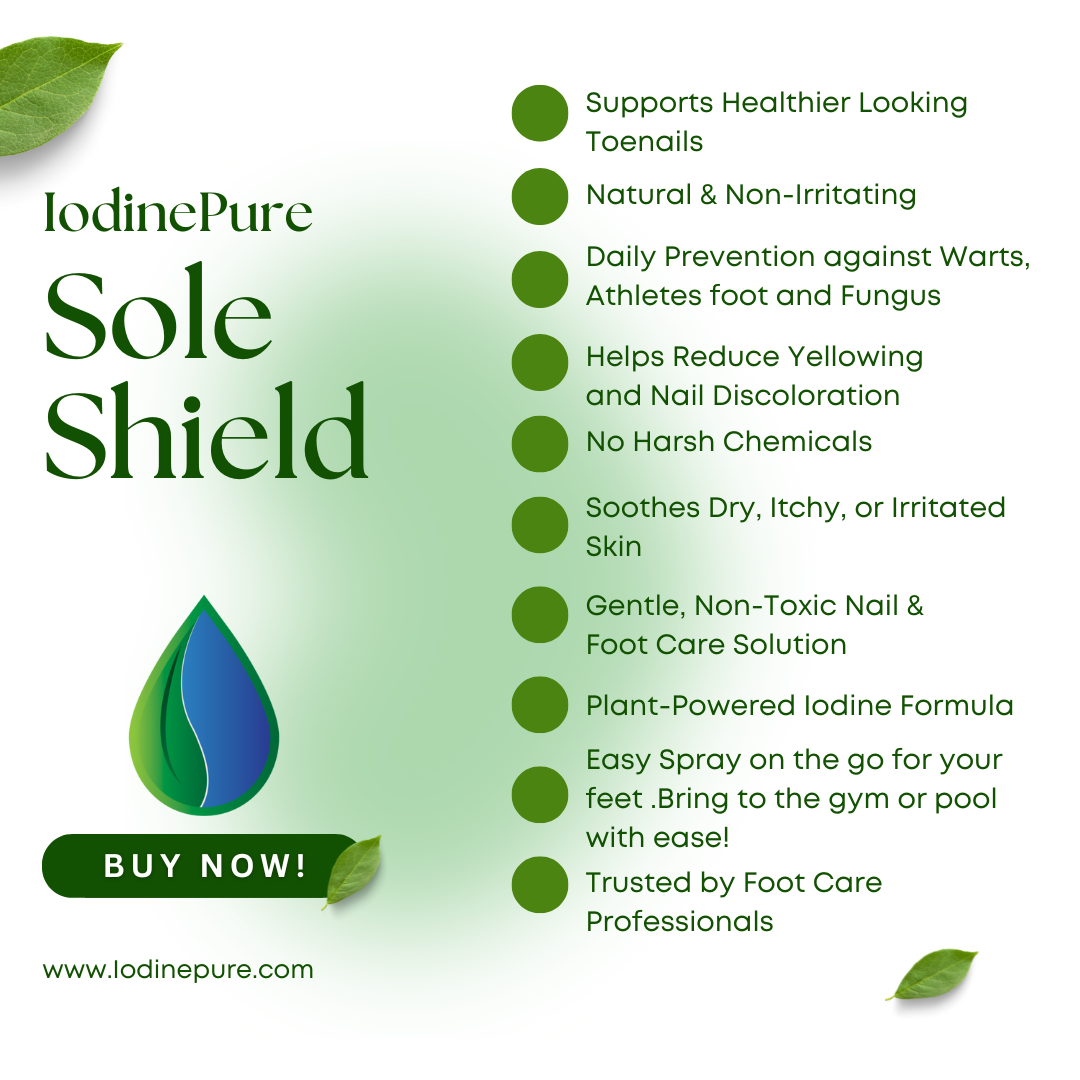
- Sole Shield is 2 ingredients, iodine and water. It is not a deodorant, has no fragrance, and masks nothing. It works on the microbes themselves, on your feet and inside your shoes.
What Is Mando?
A whole-body deodorant, sitting in the same category as Lume, and it earned its following honestly. The approach is stopping odour forming rather than perfuming over it: the formulation is built to act before odour develops, and it comes in several formats for use anywhere on the body.
Feet were an obvious extension. Foot odour is largely a bacterial process, sweat itself is close to odourless until skin bacteria get to work on it, so a product aimed at those bacteria does something real when applied to a foot. People are not imagining the improvement.
There is a reason feet in particular are the problem area. StatPearls notes that eccrine sweat glands are "concentrated in areas such as the axillae, palms, soles, and face", so the sole is one of the sweatiest surfaces on the body before you put a shoe over it.
Credit where it is due. It is a well-made product being used sensibly.
What Are the Two Gaps When You Use Mando on Feet?
Fungus, and footwear. A deodorant is not built for either, and a closed shoe supplies both.
1. A deodorant is not aimed at fungus
This is the important one. Deodorants target the bacteria involved in odour. That is their design brief and they are good at it.
A closed shoe, though, is warm, dark and damp for twelve hours a day, and those conditions suit more than odour bacteria. StatPearls, reviewing tinea pedis, states that "wearing occlusive shoes for extended periods predisposes patients to dermatophyte infections" and that "the risk of tinea infections is elevated with excessive sweating", and puts the condition at roughly 10% of the total population. So the same shift that makes your feet smell is also the one that suits athlete's-foot fungus. If your concern includes flaking between the toes, itching, or nails that have started to look off, a deodorant is simply not the category of product aimed at any of that. It was never claiming to be.
2. It stops at your skin
You can apply a deodorant to perfectly clean feet every morning and then put them straight into the same shoes you wore yesterday. Footwear is almost never washed, it holds moisture, and it has been collecting shed skin for months. It re-seeds your feet the moment you lace up.
Socks are the same story, and warm water does not settle it. Akhoundi and colleagues found dermatophyte conidia survived a 40 °C household wash and were removed at 60 °C, while freezing and heat drying both failed. Treating the foot and ignoring the shoe and the laundry means starting the same job again every single day. The shoe is the half of the problem that regenerates.
What Is Sole Shield, and What Is It Not?
It is a two-ingredient iodine spray for feet and footwear. It is not a deodorant. Sole Shield contains no fragrance and nothing that masks a smell. If you want your feet to smell of something, this is not that product.
It is 2 ingredients, elemental iodine and pure water. Iodine is a broad-spectrum antimicrobial mineral, meaning its range covers bacteria and fungi, and it has been used on skin since the 1800s. Reviewing the evidence in Antimicrobial Agents and Chemotherapy, Lepelletier and colleagues describe iodine as rapidly penetrating microorganisms and oxidising key proteins, nucleotides and fatty acids, with no observed link to resistance developing. Those are findings about iodine as an ingredient, in the preparations the researchers used. It works on the microbes involved rather than covering anything up, which is a different job from deodorising.
The routine covers both halves. Mist feet after showering once they are dry, and spray the inside of shoes, boots and skates after each wear. The 60ml bottle is fast drying, does not stain skin or socks, and fits a gym bag so the shoe step actually happens. It is listed with Health Canada as a cosmetic and used in 200+ foot care clinics across North America.
How Do Mando and Sole Shield Compare?
They are not really competitors. One is aimed at odour on skin, the other at the microbes on skin and inside the shoe.
| Mando on feet | Sole Shield | |
|---|---|---|
| Category | Whole-body deodorant | Two-ingredient aqueous iodine foot and shoe spray, not a deodorant |
| Aimed at | Odour-causing bacteria | Bacteria and fungi |
| Fragrance | Available in scented options | None. Nothing that masks anything |
| Covers your shoes? | No, applied to skin | Yes, spray inside footwear after each wear |
| Relevant to athlete's foot? | Not what a deodorant is built for | Iodine's range covers fungi as well as bacteria |
| Ingredients | Multi-ingredient deodorant formulation | Two: iodine and pure water |
Should You Stop Using Mando?
No. If it is working on your feet, keep using it, and swapping products is not the upgrade here.
The upgrade is covering what it does not reach. If your only concern is that your feet smell at the end of a long day, a deodorant is a perfectly sensible answer and you may not need anything else. If the concern is the environment inside the shoe, the flaking between your toes, or a nail that has started looking discoloured, that is a different category of problem, and it needs a product aimed at the microbes rather than at the odour.
So either add a shoe step to your routine, or use a bottle that was built for the foot and the shoe from the start.

Sole Shield
Not a deodorant. No fragrance. It works on the microbes, on your feet and in your shoes.
✓ Two ingredients: iodine and pure water
✓ Broad-spectrum range covering bacteria and fungi
✓ Mist feet after showering, spray shoes after each wear
✓ 60ml, fast drying, no staining on skin or socks
✓ Used in 200+ foot care clinics across North America
Shop Sole ShieldCommon questions
Can you use Mando on your feet?
Yes. Mando is a whole-body deodorant and feet are skin, so the hack is a legitimate use of it. Foot odour is largely a bacterial process, and a product aimed at odour-causing bacteria does real work on a foot. What it is not built for is fungus, and it works on skin only, so the inside of the shoe is a separate job.
Is Sole Shield a foot deodorant?
No. Sole Shield contains no fragrance and nothing that masks odour. It is two ingredients, iodine and pure water, and iodine is a broad-spectrum antimicrobial mineral whose range covers bacteria and fungi. It works on the microbes rather than covering up a smell, which is a different job from deodorising.
Does deodorant help with athlete's foot?
Deodorants are formulated to address odour-causing bacteria, and athlete's foot is fungal, so it is not the category of product built for that. StatPearls notes that occlusive shoes worn for long periods predispose people to dermatophyte infections and that excessive sweating raises the risk, which is why a broad-spectrum approach covering bacteria and fungi, applied to feet and to footwear, addresses more of the picture.
Why do my feet still smell even with deodorant?
Usually because the shoes were never treated. Footwear holds moisture, is rarely washed, and re-seeds clean feet every time you put it on. Socks matter too: dermatophyte conidia survive a 40 °C wash and need 60 °C to be removed. Treating the foot without treating the shoe and the laundry means repeating the same job every morning.
What Is the Bottom Line?
Mando does what a deodorant does, and does it well. The gap is not quality, it is scope: a deodorant is aimed at odour bacteria on skin, while a closed shoe grows fungus too and never gets treated at all.
We made the same argument about the Lume on feet hack, and covered why shoes are the half everyone skips.
References
- StatPearls. Hyperhidrosis. NCBI Bookshelf NBK459227
- StatPearls. Tinea Pedis. NCBI Bookshelf NBK470421
- Akhoundi M, Nasrallah J, Marteau A, Chebbah D, Izri A, Brun S. Effect of household laundering, heat drying, and freezing on the survival of dermatophyte conidia. J Fungi. 2022;8(5):546. PubMed 35628801
- Lepelletier D, Maillard JY, Pozzetto B, Simon A. Povidone iodine: properties, mechanisms of action, and role in infection control. Antimicrob Agents Chemother. 2020. PMC7449185
Evan Lewis, PhD, specializes in natural and nutritional therapies for the prevention and management of chronic diseases and their complications. His research spans chronic disease, diabetes complications, clinical nutrition, and nerve health, including the development of topical iodine therapy for foot care and wound health. IodinePure products are listed with Health Canada as cosmetics. Mando and Lume are trademarks of their respective owners; product information is from publicly available labeling and materials.